
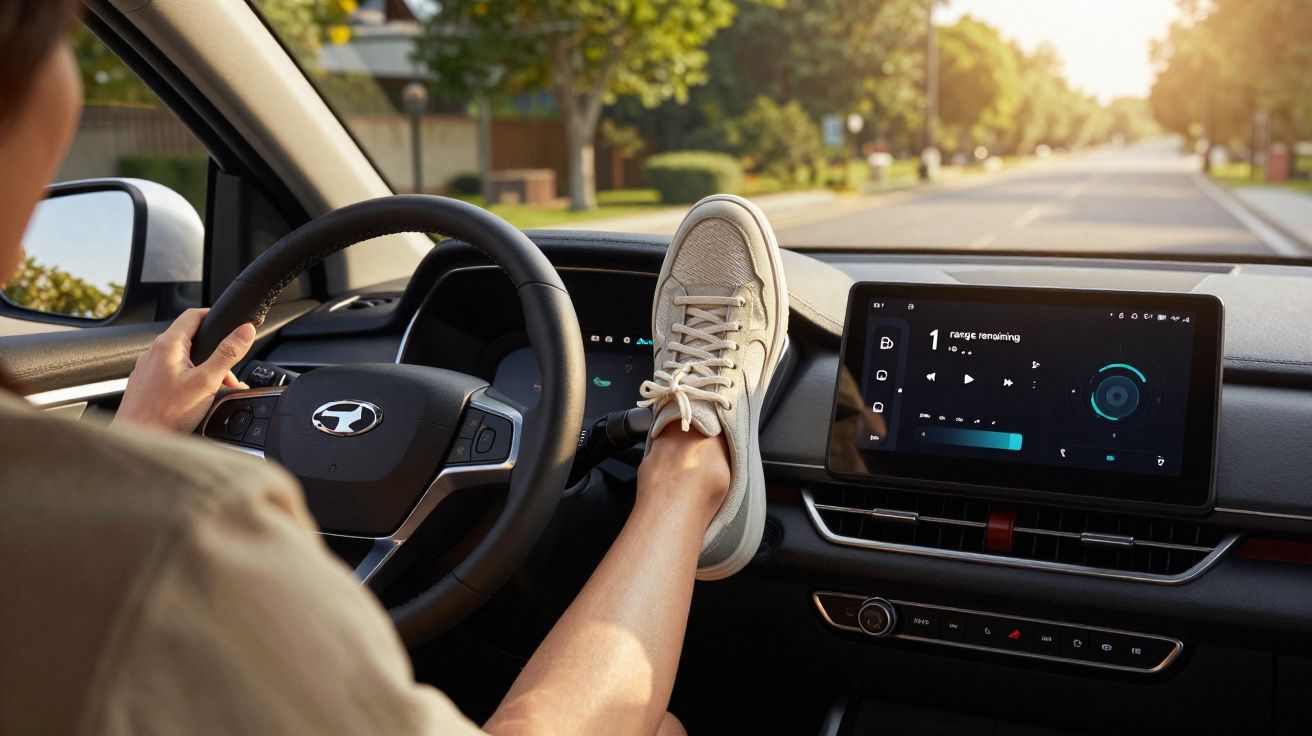
The lights flip to green. The car ahead launches as if it’s making a getaway: engine flaring, a brief sprint, then a sharp stop at the next red. You drift along more calmly behind, yet the fuel gauge still edges down. Later at the pump comes that familiar sting: you’ve paid more than you meant to - again. Then a colleague tells you they get an easy extra 150 kilometres out of a tank, with the very same engine as yours. Eventually you start wondering: exaggeration, luck, or do they simply drive differently? The answer sits inside a simple habit that very few people practise deliberately - and it starts at the exact moment your foot touches the accelerator.
The quiet craft of taming your right foot: a gentler accelerator habit
It almost sounds too obvious to matter: the most powerful habit for saving fuel is using a smooth, anticipatory accelerator foot. No jittery dabbing at the pedal, no impulsive “just this once” full-throttle bursts - instead, steady pressure and calm progression. Drive like that and the whole journey becomes more “flowing”. The engine works in a more consistent rhythm, the car feels less strained, and you do too. Most of us recognise that moment when we realise we’re driving in stress mode despite not actually being late. What helps is a deliberate reset: ease off slightly, look further ahead, and iron out the pace.
Picture two commuters: same route, same time of day, same car. One person accelerates hard into every gap, brakes late, and sits right on the bumper ahead. The other leaves space, uses rolling time towards junctions and traffic lights, builds speed smoothly to the chosen cruising pace, and keeps it as steady as possible. In real-world consumption checks, differences of around 1.5 to 2 litres per 100 kilometres are entirely plausible. Over 15,000 kilometres a year, that adds up to several hundred pounds. The absurd part is that both often arrive at nearly the same time - except one steps out with a higher pulse and a lower bank balance.
There’s no magic involved - it’s straightforward physics. Every hard acceleration demands extra energy; every unnecessary braking event throws that energy away. Engines favour steadiness: at a stable speed they tend to operate more efficiently, requiring less fuel injection, with calmer revs. Modern trip computers make this brutally visible. If you commit to “soft” driving for two or three days, you’ll often see double‑digit percentage improvements in average fuel use. Realistically, nobody manages it perfectly every day - but if you live this habit on even 70% of your drives, your fuel bill will noticeably drop.
Before you start: check tyre pressures and remove obvious excess weight. These aren’t the main story here, but they make the benefits of a gentler accelerator foot easier to achieve - and they reinforce the idea that efficiency is built from small, repeatable choices.
How to train the fuel-saving habit that gives you extra kilometres
The simplest way in is to spend a week pretending you have a raw egg under your accelerator foot. When setting off, apply only enough throttle to keep traffic moving smoothly - without the sprinting theatrics. Train your eyes to look at least two or three vehicles ahead, not just at the rear bumper in front. As soon as you can tell a set of lights is likely to turn red, or traffic is thickening, ease off early and let the car roll. If your car has a live consumption display, turn it into a small game: the goal is to avoid spiking the numbers during acceleration and keep the curve as “flat” as you reasonably can.
Everyday life is where the traps are. You’re a little late in the morning, so you press on. On an A‑road there’s that urge to have to overtake “that one driver”. Or you carry the vague belief that gentler driving automatically means losing time. In reality it’s often a minute, sometimes nothing at all. A useful mental reframing is to stop treating driving like a race and start treating it as a routine that protects your money. And if you catch yourself slipping into frantic inputs, don’t beat yourself up - breathe, smooth the speed, and carry on.
“Since I’ve started accelerating more gently and rolling with foresight, I fill up noticeably less often - and I arrive more relaxed,” says a commuter who covers 80 kilometres a day.
A practical mini-checklist for building this habit could look like this:
- When pulling away, accelerate only up to the mid-range revs, not to the edge of the red line
- Increase your following distance slightly so you can use rolling time instead of braking
- Above 70 km/h, aim for a steady cruising speed rather than constant variations
- Check the consumption readout deliberately once a week, not every minute
- Spot stressful moments early and mentally “shift down a gear” before you do it with the car
One more training tip that helps it stick: pick a single trigger phrase you repeat as you leave your street - for example, “smooth is quick”. It sounds simplistic, but it nudges you into the right behaviour before the first junction, when habits are easiest to set for the whole trip.
Why this single habit changes more than you think
Taming your accelerator foot doesn’t only reduce what you spend at the pump. It subtly reshapes the whole experience of driving. There’s less aggressive tugging at the flow of traffic, less stop‑start adrenaline. Journeys often feel calmer - almost like watching a different film. Many people report that after switching to anticipatory, gentle driving they feel less tired, particularly on long commuter runs. And as a quiet bonus, brakes, tyres and the clutch often last longer because they’re simply not being punished as much.
There’s also a side effect you won’t find on most leaflets: this habit spreads. Children in the back seat absorb what “relaxed driving” looks like. Newer drivers in your circle see that you don’t need to be the fastest to arrive well. Your driving style sends a small but clear signal to everyone around you: fewer pointless sprints, less impatience, more ease on the road. At a time when traffic feels like constant pressure for many people, that’s almost a discreet form of self-care.
Ultimately it comes down to a straightforward question: do you want to keep being surprised each month by how quickly the tank empties, or are you willing to train a tiny new habit that makes every kilometre a bit cheaper? The good news is you don’t need to be a tech obsessive, trawl through apps, or take up extreme hypermiling. It’s enough to remember, on every trip, how much control your right foot really has. Not flashy, not “Instagrammable” - but effective, kilometre after kilometre.
| Key point | Detail | Value for the reader |
|---|---|---|
| Gentle accelerator | Smooth pull-away, steady cruising speed, fewer sprints | Measurable fuel savings without any technical modifications |
| Anticipatory driving | Look far ahead, roll early instead of braking hard | Lower consumption, less wear on brakes - and less stress |
| Everyday routine, not a one-off | Build the habit into most drives, not only “when you remember” | Noticeably lower long-term costs and a calmer drive |
FAQ
- Do I really save much just by accelerating more gently? Yes. On typical commuting routes, 10–20% lower fuel use is realistic if you drive steadily and with anticipation.
- Won’t slower acceleration cost me too much time? Usually hardly any - on a 30‑kilometre trip it’s often only one to two minutes, if that.
- How can I tell whether I’m driving too aggressively? If you often need to brake hard, your trip computer regularly shows high instantaneous consumption, or you feel rushed internally, that’s a clear sign.
- Does cruise control help save fuel? On motorways and A‑roads it can help maintain a consistent speed; in town it tends to make little difference.
- Does this habit work with electric cars too? Yes. A gentle accelerator reduces energy use and increases range, even though regenerative braking recovers some energy.

Comments
No comments yet. Be the first to comment!
Leave a Comment