
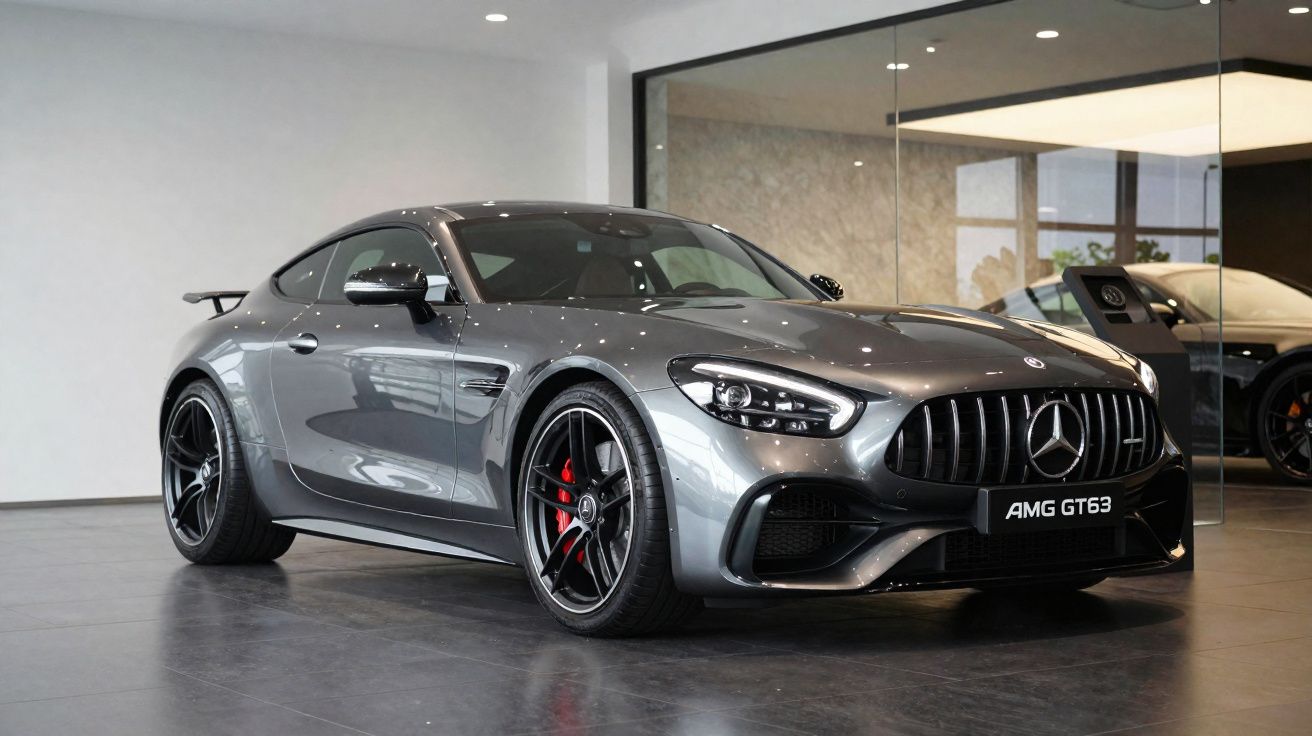
The Mercedes-AMG GT 63 Pro arrives in that narrow band where outright performance, serious money and status all intersect. From the pavement, it looks like the sort of machine that would naturally be weighed up against Porsche’s evergreen 911. Inside Mercedes-AMG, however, the message is clear: they do not believe their customers are heading to Porsche dealerships in the first place.
Two-door coupés, but two very different mindsets
On a basic spec-sheet reading, the GT 63 Pro and the Porsche 911 appear to overlap. Each is a low-slung two-door coupé, each can be had with a 2+2 seating arrangement, and both exist to deliver attention-grabbing performance numbers. AMG argues that the similarity largely ends with that checklist.
At the model launch in Australia, Mercedes-AMG executives described a buyer group that is already firmly within the brand’s orbit. The typical customer is moving out of cars such as the G63 SUV or the E63 saloon and wants something more focused and more emotional as an additional car for the driveway.
The GT 63 Pro is pitched less as a Porsche alternative and more as the next step for hardcore AMG loyalists.
That framing is important. A driver swapping a G63 for a GT 63 is rarely agonising over 911 configurations. They are chasing the familiar badge, the specific character of AMG’s V8, and the louder, more mischievous personality that goes with it.
Front engine versus rear engine: the character divide
Beneath the styling, the two cars are built around very different ideas. The Porsche 911 remains faithful to its signature rear-engine layout, with its flat-six mounted over the rear axle. That approach brings strong traction, a distinctive balance on the move, and a silhouette that is instantly recognisable worldwide.
The Mercedes-AMG GT 63 Pro takes the opposite route. Its twin-turbo V8 sits at the front, pushed back behind the front axle line in a traditional grand tourer, front-mid configuration. Drive is sent to all four wheels via AMG 4Matic+ all-wheel drive.
Same segment on paper, different philosophies on the road: the AMG is a front-engined bruiser, the 911 remains a rear-engined precision tool.
In practice, that produces two contrasting styles of speed. The 911 tends to feel compact, agile and rear-led. The GT 63 Pro comes across as longer and broader-shouldered-more of a high-speed continent-crosser that can still put on a serious show at a circuit.
610 hp: Mercedes-AMG GT 63 Pro targets Stuttgart head-on
Whatever the philosophical differences, the figures make it plain that AMG has Porsche’s performance yardsticks in mind. Under the long bonnet is AMG’s familiar 4.0-litre twin-turbo V8, producing 610 hp (around 618 PS) and 850 Nm of torque in GT 63 Pro specification.
- Engine: 4.0-litre twin-turbo V8
- Power: 610 hp
- Torque: 850 Nm
- Drivetrain: 9-speed automatic, AMG 4Matic+ all-wheel drive
- 0–100 km/h: 3.1 seconds
- Top speed: 317 km/h
Compared with the standard GT 63, the Pro brings a meaningful uplift: 26 extra horsepower and 50 Nm more torque. In Porsche terms, those numbers land neatly in the 911 hierarchy-comfortably above the hybrid-assisted 911 GTS (535 hp, 609 Nm) and just shy of the 911 Turbo S (711 hp, 800 Nm).
Judged purely on acceleration and top-end pace, AMG is not shying away from the comparison. A 0–100 km/h time of 3.1 seconds and a 317 km/h maximum speed place the GT 63 Pro in territory historically associated with supercars, not merely rapid GT cars.
Sound and sensation: flat-six versus V8 thunder
One of the least scientific, yet most persuasive, differences is noise. The 911’s flat-six carries decades of motorsport history and delivers a distinctive, hard-edged howl when worked high in the rev range-part of the model’s identity for many fans.
AMG offers an equally recognisable but very different appeal: a deep V8 rumble, accompanied by turbo hiss and the occasional crackle from the exhaust. For long-time AMG followers, that soundtrack is a major part of the draw, and a key reason the Porsche option never truly enters the conversation.
For many GT 63 Pro buyers, the V8 soundtrack is not a detail; it is the emotional hook that keeps them in the AMG camp.
Why AMG customers are staying put
Within Mercedes-AMG, the GT 63 Pro is positioned as a natural progression for existing owners. Drivers of high-performance AMG SUVs and saloons often want something more intense, yet they still prefer the comfort of a familiar badge, cabin layout and user experience.
That loyalty is practical as well as emotional. The dealer relationship, the ordering and configuration process, and the general cabin look-and-feel are all instantly familiar to established AMG customers. Switching to a 911 can mean adapting to a different ownership rhythm, a different ergonomics approach, and even a different kind of reputation in the office car park.
From AMG’s standpoint, the GT 63 Pro plugs a specific gap: supercar-grade numbers combined with the day-to-day usability, technology environment and brand story their customers already know.
Porsche still stands alone as a benchmark
None of this is to suggest the 911 is being written off. Across the industry it remains a reference point for steering feel, handling precision and track capability. Its rear-engine layout delivers a balance that competitors still find difficult to emulate.
AMG’s argument is narrower: many of its clients admire the 911 without actually wanting one. They respect the icon, but still choose to spend their money with the three-pointed star.
Reading the spec sheet: enthusiasts versus real buyers
Online discussions often hinge on lap times, engine placement and acceleration charts. Real purchasing decisions are frequently messier. A buyer coming out of a £150,000 G63 may be juggling school runs, winter conditions and image, as well as the occasional weekend blast.
Looked at through that lens, the GT 63 Pro has a straightforward logic. It offers four-wheel drive, a familiar infotainment set-up, and the comfort and assistance features expected of a modern Mercedes. It delivers supercar pace without the day-to-day trade-offs that typically come with mid-engined exotica.
| Aspect | AMG GT 63 Pro | Typical 911 (GTS/Turbo) |
|---|---|---|
| Engine position | Front-mid | Rear |
| Main customer path | Existing AMG owners | Sports car enthusiasts, mixed brands |
| Character | High-speed GT, big V8 feel | Compact, track-focused |
| Image | Muscular, luxury performance | Iconic sports car |
What “2+2” and “AMG 4Matic+” really mean for owners
Two phrases crop up constantly around cars like the GT 63 Pro and 911: “2+2” and all-wheel drive. They read like jargon, but they have real implications in everyday use.
A 2+2 layout means two full-size seats up front and two smaller rear seats. In reality, those back seats work best for children, short trips, or extra bags. For an AMG owner used to an E63, it can feel like a step down in practicality. For someone moving from a strict two-seater, those extra seats can feel like genuine flexibility.
AMG 4Matic+ is an all-wheel-drive system capable of varying torque distribution between the axles. In dry weather it helps deliver hard, repeatable launches; in poor conditions it makes the power far easier to use. In a powerful front-engined coupé, it can be especially reassuring for drivers who use the car year-round rather than only on warm, dry weekends.
How a typical AMG garage could evolve
Imagine a familiar AMG household line-up: a G63 handling daily life, perhaps an E-Class or S-Class for work, and room for one “fun” car. Rather than swapping one of those cars for a Porsche, the GT 63 Pro can slot in as the sharper weekend toy-while keeping the same badge on the bonnet.
That approach can simplify ownership: one servicing relationship, one digital ecosystem, and a consistent Mercedes-AMG feel across the fleet. For high-net-worth owners, that sort of continuity has value even if it rarely features in the sales pitch.
It is also where personalisation can matter more than outsiders assume. Many AMG buyers enjoy specifying their cars to mirror the rest of their collection-interior trims, colours and performance-focused options chosen to fit a house style. That tendency can make staying with AMG feel like the path of least resistance, because the buying process and the end result are predictably “theirs”.
Running realities play a part too. High-output cars of this type will consume tyres and brakes quickly if used hard, and owners who plan occasional track days often think about dealer support, warranty expectations and how painless it is to book work at a trusted centre. For an established AMG customer, keeping everything under one umbrella can be a strong reason to choose the GT 63 Pro over starting afresh with a different brand.
Seen that way, AMG’s claim that GT 63 customers are not truly cross-shopping a 911 becomes more believable. The cars may chase similar headlines and similar numbers, but for many buyers the decision was effectively made before any spec sheet was opened-brand allegiance, driving taste and day-to-day practicality pulling them firmly towards the Mercedes-AMG GT 63 Pro keys.



Comments
No comments yet. Be the first to comment!
Leave a Comment