
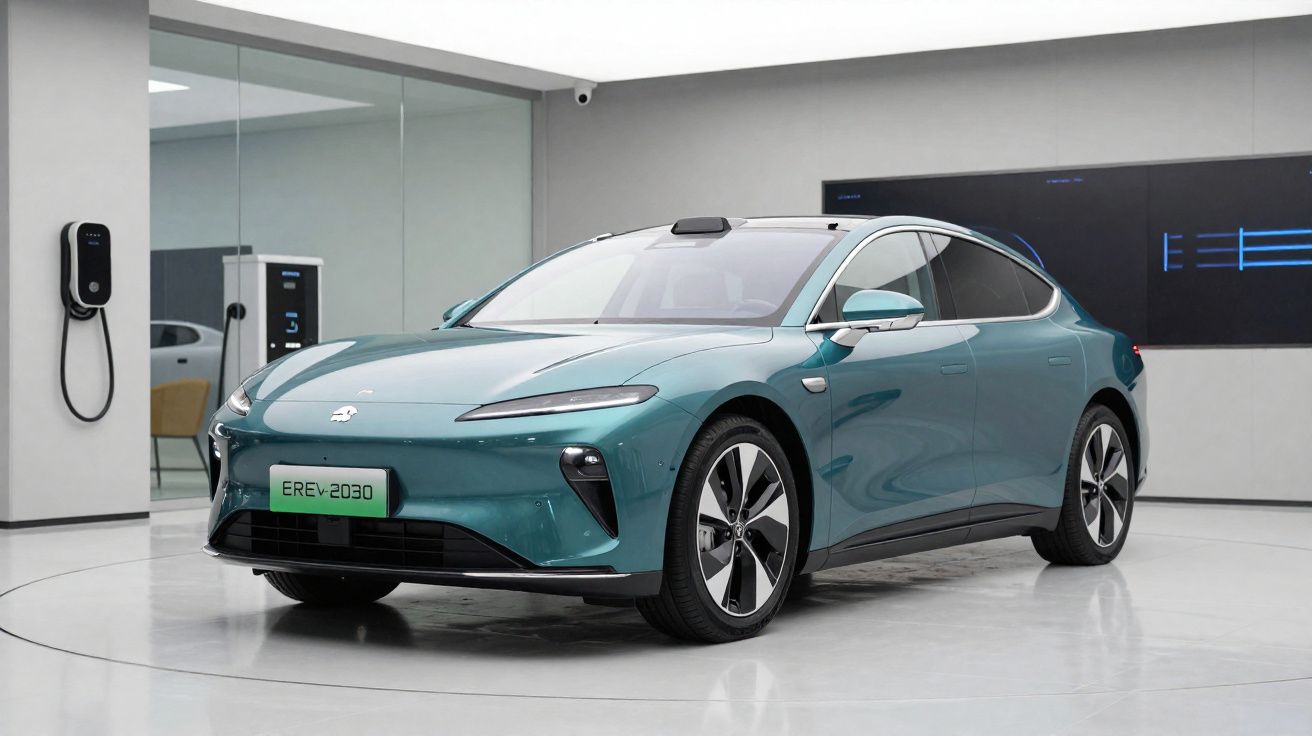
Into this already uneasy landscape arrives a technology many people had written off as finished: the range‑extended electric vehicle - a stepping stone between full battery power and traditional combustion that is now quietly returning.
What a range‑extended electric vehicle (EREV) actually is
From behind the wheel, a range‑extended electric vehicle, often shortened to EREV, behaves much like a normal electric car.
The car is propelled by an electric motor drawing energy from a battery pack, just as it would in a typical EV.
An EREV drives on electricity first; a small petrol engine only starts up to generate extra electricity when the battery charge gets low.
In most cases, the electric-only range is roughly 150–300 km, depending on the battery capacity and how the vehicle is driven. When that charge is used up, a small combustion engine starts automatically.
The key point is that this engine usually does not drive the wheels. Instead, it works as a generator, sending electricity back into the battery or directly to the motor. That can extend the overall driving distance to as much as 1,000–1,500 km on a full tank.
For motorists accustomed to long motorway days and limited charging options, that kind of total range is particularly compelling.
A concept that stumbled early - then boomed in China
The underlying idea has been around for years.
More than a decade ago, Fisker attempted it with the Karma and BMW offered it with the i3 REx. Both drew plenty of interest, but neither became a major seller.
At the time, public charging was scarce, battery packs were relatively small, and the whole approach felt both ahead of the infrastructure and oddly specialised.
The real shift happened in China. A combination of long travel distances, fast-paced urban growth and assertive industrial policy created conditions where EREVs could scale beyond novelty status.
Chinese customers bought roughly 2.4 million range‑extended models in 2025, turning what had been a fringe layout into a mainstream category.
Manufacturers such as Li Auto built their brand around the range‑extended format, particularly in profitable SUV segments. The appeal was straightforward: spacious family vehicles could run electrically for everyday urban driving, while keeping petrol as a safety net for long trips - without the cost and weight penalty of fitting an ultra‑large battery.
Why American drivers are showing strong interest in range‑extended electric vehicles
China’s momentum has attracted attention in the United States, where pick-ups and large SUVs dominate and charging coverage remains thin once you leave major cities.
Scout Motors, a newer marque backed by Volkswagen, has become an early barometer of demand. Of around 160,000 reservations for its forthcoming off‑road‑styled vehicles, approximately 87% of customers reportedly opted specifically for the range‑extender arrangement.
That is a difficult signal for US manufacturers to overlook. Ford, Ram, Jeep and Audi are all developing programmes that keep electric drive as the primary means of propulsion, while adding a small petrol engine as reassurance for long-distance travel and towing.
For a heavy 4×4 that may regularly traverse rural areas with limited charging, the promise is simple: charge at home, do most day-to-day driving electrically, and use petrol only when the route demands it.
Key reasons buyers are tempted
- Reduced “range anxiety” on longer journeys
- The ability to refill in minutes at a petrol station
- Lower upfront cost than an EV with a very large battery
- Less dependence on dense, high‑power charging networks
- EV-style driving in town: quiet operation and instant torque
Environmental groups warn of a greenwash risk
Although many buyers are enthusiastic, climate and clean‑transport campaigners are more cautious.
Advertising often presents EREVs as “electric cars with occasional petrol back-up”. In practice, the climate impact depends heavily on how owners use them day to day.
If drivers seldom plug in, an EREV can operate much like a conventional petrol SUV - only heavier and more complicated.
The NGO Transport & Environment reviewed real‑world usage information for several popular models. After the battery is depleted and the petrol generator takes over, fuel consumption averages about 6.4 litres per 100 km, comparable to many conventional combustion vehicles.
If the vehicle is charged regularly, petrol use may be limited mostly to infrequent long journeys. But if it is rarely charged, it effectively becomes a petrol‑powered heavyweight carrying an underused battery.
Engineers are split on the “two‑in‑one” solution
Among engineers and powertrain specialists, opinion is divided.
Some firms, including Mahle Powertrain, argue that combining a full electric drivetrain with an internal‑combustion unit in one car is not a sensible long‑term destination. From this perspective, EREVs are a transitional fix that will dwindle once fast chargers are widespread and battery range improves further.
Running two systems together also brings penalties: extra weight, higher cost, and more components that could potentially fail.
Others take a more practical stance. They point out that many drivers - particularly beyond dense city centres - still value the certainty of being able to stop quickly and refuel when necessary. In that light, a small generator engine is framed as a convenience feature, smoothing out today’s infrastructure gaps in much the same way as four‑wheel drive or a roof box supports specific use cases.
Europe is watching - and beginning to join the race
Europe sits between China’s enthusiasm and America’s cautious adoption.
Charging provision is expanding, but it is inconsistent. Some routes are well covered, while many rural areas still lag behind. A small number of Chinese‑built range‑extended models are already arriving, giving regulators and consumers a real‑world trial.
Meanwhile, established groups such as BMW and Volvo, along with Xpeng, are exploring their own versions of the formula, often with company‑car fleets in mind - especially where high annual mileage makes charging strategy and downtime more consequential.
| Aspect | Pure EV | Range‑extended EV | Conventional petrol |
|---|---|---|---|
| Main energy source | Battery only | Battery first, petrol as backup | Petrol only |
| Typical refuelling | Charging point | Charging point + fuel pump | Fuel pump |
| Long‑trip anxiety | High for some drivers | Low, if fuel is available | Low |
| Technical complexity | Medium | High | Low to medium |
How policy and behaviour will shape the future
Timing is a major reason EREVs are appearing more often now.
Governments are tightening emissions requirements, yet charging roll‑out and electricity‑grid upgrades are not always keeping pace. Car makers are under pressure to cut fleet emissions quickly without alienating customers who are uneasy about moving straight to full battery vehicles.
Range‑extended models can help achieve strong “electric mileage” figures in official testing, while avoiding some of the practical pain points associated with long‑distance charging today.
Even so, their real‑world environmental value depends on everyday habits.
An EREV charged every night and used electrically for most commuting can sharply reduce petrol demand; the same vehicle, rarely charged, may burn as much fuel as a standard SUV.
Regulation and incentives can influence outcomes. Measures such as tax benefits tied to proven electric usage, workplace charging at offices, and smart home‑charging tariffs can all encourage drivers to use the battery as intended.
A few terms drivers often confuse
The terminology around electrified cars can be needlessly confusing. Three acronyms are especially relevant:
- BEV (battery electric vehicle): no engine at all - only a battery and an electric motor.
- PHEV (plug‑in hybrid): both the electric motor and the engine can drive the wheels directly.
- EREV (extended‑range electric vehicle): only the electric motor drives the wheels; the engine’s job is to generate electricity.
In everyday driving, a PHEV may switch back and forth between engine and motor frequently. An EREV tends to feel closer to a pure EV, with the petrol generator running more steadily in the background when required.
What this could mean for a typical driver
Imagine a family in a small town with a 40 km commute each way, plus a few visits each year to relatives several hundred kilometres away.
With an EREV providing 200 km of electric range, most working days could be covered on battery power alone, replenished overnight at home. Over a full year, the majority of kilometres might therefore be electric.
On holiday journeys, once the battery is low, the petrol generator would start and keep the car moving without the stress of hunting for available rapid chargers near busy motorway services. Petrol use would not disappear, but it could be far lower than running a conventional petrol SUV for every trip.
For that household, the main compromise becomes complexity and price compared with a simpler, larger‑battery EV. The decision will hinge on home‑charging costs, the dependability of local public charging, and longer‑term policy direction around fossil fuels.
Extra considerations: running costs, servicing and resale
Beyond range and emissions, prospective owners tend to weigh day‑to‑day costs. An EREV can be economical if it is charged frequently, because electricity is typically cheaper per mile than petrol. However, if it is used largely as a petrol vehicle, running costs may look much closer to a conventional SUV - and potentially worse, because the car is carrying additional weight.
Servicing can also be more nuanced than with a BEV. While the petrol engine may run less often, it still needs maintenance, and the vehicle contains both high‑voltage electrical systems and a combustion power unit. Resale values will depend on how quickly charging infrastructure improves, how taxation evolves, and whether future restrictions favour full BEVs over any vehicle carrying an engine.
Extra considerations: infrastructure, home charging and grid readiness
Where you live can determine whether an EREV’s advantages are genuinely realised. Owners with off‑street parking and a home charger are far more likely to use the battery consistently. By contrast, drivers without reliable access to charging - for example, those relying on street parking - may find themselves using the petrol generator more than intended.
Local grid capacity and the pace of charger installation matter too. If rapid chargers become common, reliable and well‑priced along major routes and in rural communities, the practical case for carrying an engine may weaken. Until then, EREVs can look like a pragmatic hedge against uneven infrastructure.
Risks, benefits and what may change next
The format offers clear strengths: less range anxiety, an easier transition for drivers accustomed to petrol stations, and potentially lower demand for battery materials than very long‑range EVs.
But the downsides are real. Manufacturers could use EREVs as a comfort blanket, slowing investment in charging networks and fully electric cars. Some owners may treat charging as optional, undermining emissions goals.
As rapid charging expands and electricity grids are modernised, the balance may tilt towards simpler, fully battery‑electric vehicles. Until those improvements are widespread, range‑extended electric vehicles are likely to remain on order lists and forecourts - occupying the grey space between yesterday’s combustion model and a fully electric future.

Comments
No comments yet. Be the first to comment!
Leave a Comment