
The briefing ought to have been a non-event: tidy ranks of chairs, identical water bottles lined up on tables, and the same corporate logo backdrops you’ve seen so often they fade into the background. The sort of midweek livestream you half-watch on a Tuesday morning while your thumb keeps scrolling, audio muted.
Then a single line landed that made people finally lift their eyes from their screens.
One of engineering’s most trusted names-a marque synonymous with durability, accuracy and a kind of stubborn dependability-said out loud what plenty of the sector will only admit privately. Electric cars? They matter, but they are not the final stop.
You could sense the atmosphere tighten.
Because when a brand built on “forever” suddenly questions the supposed future, it cuts through the noise.
Toyota and the moment a rock-solid brand quietly changes direction
The company in question is Toyota: the manufacturer that effectively turned reliability into a belief system.
For years, while competitors sprinted out headline-grabbing EV ranges and glossy announcements, Toyota chose patience on full electric vehicles. The Japanese giant kept its focus on hybrids, fuel efficiency and a deliberately cautious stance on major pivots.
That’s why it lands so differently when senior figures at Toyota keep reiterating-publicly, repeatedly-that EVs by themselves will not own the entire future, and that carbon neutrality requires “multiple solutions”.
This isn’t a startup fishing for attention.
It’s the world’s biggest carmaker calmly suggesting that the finish line everyone is fixated on might not be where the real race ends.
Toyota’s “multiple solutions” strategy: EVs, hybrids, plug-in hybrids and more
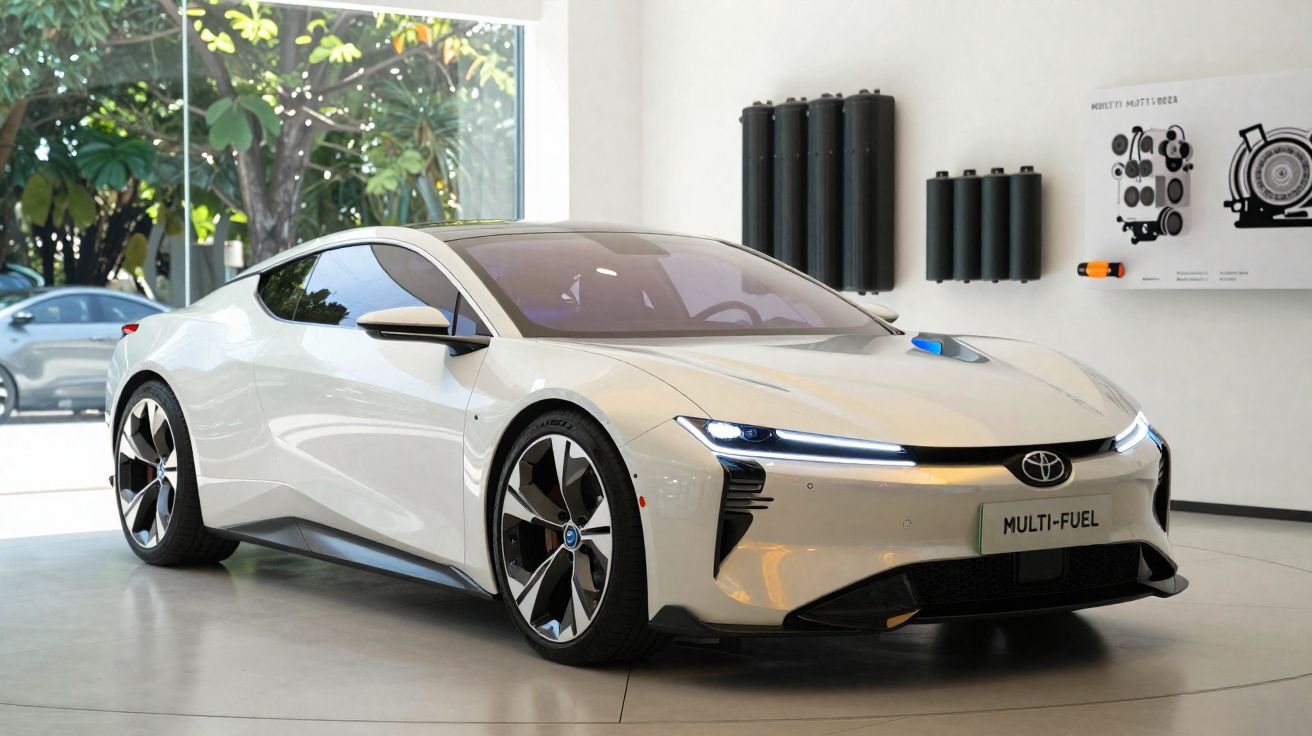
Listen to Toyota’s latest strategy briefings and the message is consistent: they want a full toolkit-hybrids, plug-in hybrids, hydrogen fuel cells, synthetic fuels and, yes, battery-electric vehicles. The crucial point is that they do not present battery-electric vehicles as the single correct answer.
They are committing billions to solid-state batteries, while also arguing-sometimes in the same breath-that places such as India, Africa and parts of Europe are not structurally prepared to switch to all-electric motoring at the pace policymakers often imagine.
Toyota also leans on unromantic data rather than hype. In several regions, EV sales growth is cooling. Charging networks remain inconsistent once you leave major cities. Second-hand electric cars are losing value faster than many buyers anticipated.
And, largely away from the spotlight, Toyota’s hybrid sales continue to rise.
That small detail irritates critics and reassures finance teams.
On paper, this can sound almost old-fashioned. Why not go fully all-in on EVs like Tesla or BYD?
Toyota’s answer is essentially that it is playing a different sport: risk management at global scale. They build for drivers who may never be within reach of a Tesla Supercharger. For taxi drivers who cannot afford to sit waiting at a charger. For countries where the power grid can buckle when everyone switches on air conditioning at once.
Their engineers keep returning to the same principle: cut emissions across as many miles as possible, as quickly as possible, using technology people can genuinely use today.
That approach is less social-media-ready than unveiling a futuristic electric SUV.
From Toyota’s perspective, though, it’s how you shift the habits of billions, not merely impress millions.
What this means for drivers: Toyota’s message in a world of electric cars noise
So what if you’re at a dealership, genuinely unsure whether your next car must be electric?
Toyota’s stance offers a form of permission: you can think in stages rather than in absolutes. Instead of forcing yourself into a full EV that doesn’t match your reality, you can start with how you actually live.
- How far do you typically drive each day?
- Where, precisely, would you charge?
- Who else relies on the car?
Toyota’s mix-and-match philosophy points to a practical conclusion: the “right” car is the one that reduces your emissions the most without derailing your budget or your week.
Not the one that wins the loudest arguments online.
Many people privately feel a pang of guilt if they don’t switch to an EV immediately-especially if they live in a small town, rent a flat, or simply don’t have off-street parking.
Most of us recognise that moment when a glossy advert or a viral TikTok makes your ageing diesel feel like a moral failing.
Coming from a conservative brand like Toyota, the quieter message can be unexpectedly reassuring: transition can be incremental. You might choose a hybrid now, move to a plug-in later, and go fully electric when your area, your grid and your finances genuinely align.
And let’s be candid: almost nobody maintains a perfect daily spreadsheet tracking carbon footprint, charging routines and future resale value.
Most drivers just want something that starts every morning-and doesn’t feel like a leap into the unknown.
Two extra realities Toyota’s approach forces into the conversation
One piece that rarely gets front-page treatment is that “clean” depends on more than the badge on the boot. The emissions footprint of any vehicle is shaped by the electricity mix powering it, how and where the battery materials are sourced, and the longevity of the car itself. In a region where the grid is still carbon-heavy, a highly efficient hybrid can sometimes deliver meaningful short-term reductions while infrastructure catches up.
Another overlooked factor is skills and servicing capacity. Mass EV adoption isn’t only about installing chargers; it also depends on workshops trained for high-voltage systems, parts supply chains that can handle new components, and a used-car market that buyers trust. If second-hand electric cars keep depreciating sharply, that affects affordability and confidence-especially for households buying used rather than new.
A practical translation of Toyota’s carbon neutrality argument
At recent briefings, a Toyota executive summed up the company’s view with a trace of defiance:
“Battery electric vehicles are a key tool,” he said, “but they are not the only tool. Our goal is not to sell electric cars. Our goal is to reach carbon neutrality for every customer, in every market, with what actually works on the ground.”
That can sound dry until it’s converted into everyday decisions. “What actually works” may look like:
- A straightforward hybrid for long rural commutes where charging is unrealistic
- A plug-in hybrid for families who can charge at home but still do long holiday road trips
- A full EV as a second city car, rather than the only vehicle in the household
- Hydrogen or alternative fuels for fleets and heavy-duty use
The heresy here is subtle: the future of cars could be messy, mixed, and stubbornly non-binary.
A future that resembles a patchwork, not a single clean revolution
When Toyota says electric cars are not the goal but one route among several, it opens the door to a less glamorous, more plausible future.
Picture cities operating fleets of quiet EV buses, while remote communities lean on ultra-efficient hybrids. Imagine rapid chargers existing alongside hydrogen pumps and synthetic fuel depots. In that world, your “green choice” is shaped as much by your postcode as by the latest keynote.
It isn’t the tidy sci‑fi narrative politicians like to sell.
Yet it may be closer to how big transitions usually happen: unevenly, through compromise, with overlapping technologies that stubbornly persist long after press releases declare them obsolete.
And perhaps that’s the uncomfortable bit. If Toyota is broadly right, there won’t be one cinematic moment when the final petrol car disappears into the sunset. Instead, we may face a long, complicated, slightly chaotic period in which drivers, brands and governments continually renegotiate what the “future of mobility” actually means.
| Key point | Detail | Value for the reader |
|---|---|---|
| EVs are a tool, not the end goal | Even industry giants like Toyota treat electric cars as one option among several routes to carbon neutrality | Reduces the pressure to see full EV adoption as the only “right” choice |
| Mixed technologies will coexist | Hybrids, plug-ins, EVs, hydrogen and synthetic fuels are likely to share the road for years | Helps you plan purchases with a realistic view of how the market may evolve |
| Context matters more than trends | Infrastructure, driving habits and budget shape the best solution for each driver | Encourages decisions based on your life, not just marketing or social pressure |
FAQ
Does Toyota really think electric cars are a dead end?
No. Toyota is investing heavily in EVs and new batteries, but it argues that electric cars are one of several solutions rather than the single ultimate answer for every market and every driver.Why is Toyota pushing hybrids instead of going fully electric?
Toyota’s case is that hybrids can reduce emissions quickly in countries where charging networks and power grids are not ready for mass EV adoption-reaching more drivers sooner using existing infrastructure.Should I delay buying an electric car after this?
Not necessarily. If you have dependable access to charging, your daily driving is fairly predictable and the costs stack up for you, a full EV can still be a sensible choice. The key point is that it doesn’t have to be the only acceptable choice.Will there still be petrol or hybrid cars in ten years?
Very likely, particularly in regions with weaker infrastructure or different regulations. Rules are tightening in many places, but the complete disappearance of combustion engines is likely to take longer than the slogans imply.How can I future-proof my next car purchase?
Start with your typical mileage, local petrol and electricity prices, your charging options, and how long you expect to keep the car. Then compare a hybrid, a plug-in and a full EV using total cost of ownership-not only list price and optimistic promises.
Comments
No comments yet. Be the first to comment!
Leave a Comment