
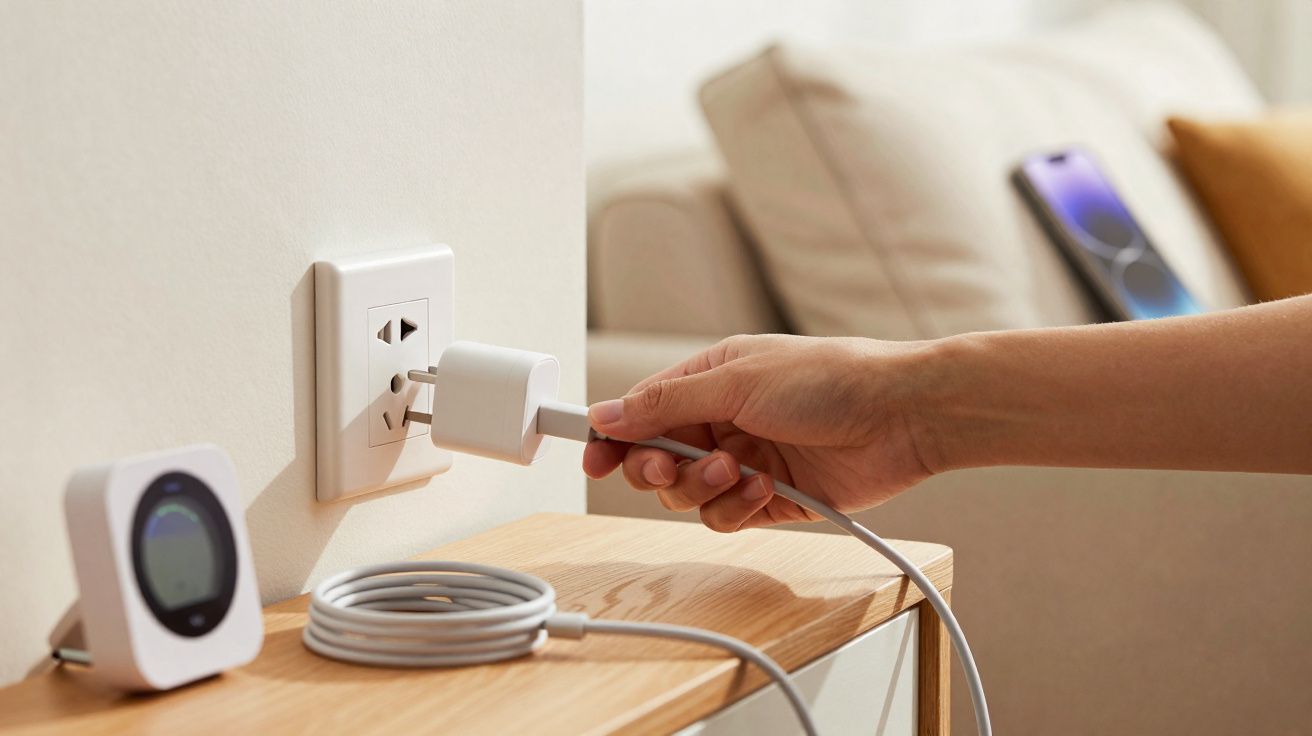
The kitchen has fallen silent and the rest of the house has finally settled. All you can hear is the fridge’s steady murmur, the router’s faint glow and that stubborn red standby light on the telly. On the worktop, three chargers are tangled together, their white plugs still in the socket, waiting for phones that aren’t even there.
You switch off the main light and wander off, barely registering the tiny LEDs that never quite disappear. Then, a few months later, your electricity bill drops through the letterbox with a weight that feels physical. You scan the figures, looking for a reason that’s more specific than “everything costs more”.
And then it hits you: how much of your home is using power even when it looks switched off?
The “off” charger that never truly switches off (vampire power / phantom load)
A charger left plugged in without a device attached isn’t doing nothing. It draws a small, continuous amount of electricity-minute by minute, all day long. It’s the kind of usage you’d never notice over 24 hours because it’s only a trickle.
But once you scale that up across your home, it starts to look different. A phone charger by the hallway table, a tablet lead in a child’s bedroom, the laptop power brick behind the sofa you forgot about-each one taking a little power, all the time. This is exactly what energy specialists mean by “vampire power” or “phantom load”: electricity being used in the background when nothing is actively charging.
In a fairly typical UK household you may have two mobiles, a tablet, a couple of laptops, a smartwatch charger, a Bluetooth speaker and perhaps an electric toothbrush base in the bathroom. Realistically, a good number of those chargers remain plugged in 24/7.
On their own, many modern chargers only pull a fraction of a watt when idle. Over a full year, though, that low-level draw can add up to a few pounds-and it can be more than £50 once you include other devices sitting on standby. One energy supplier has estimated that standby appliances and chargers can make up roughly 5–10% of a household’s electricity use. That’s money leaving your account even though nothing is actually charging.
The reason is straightforward once you look inside the casing. Every charger contains a small transformer and control electronics that convert mains electricity into a safe voltage for your device. As long as the plug is in and the wall socket is switched on, that circuitry is partly “awake”.
Some newer chargers are built to be efficient at idle and waste very little. Older models-and especially cheap, no-name units-tend to be less refined. If you’ve ever noticed a charger feeling slightly warm even with no phone attached, that warmth is paid-for energy dissipating into the room. One evening won’t move the needle much; thousands of evenings can.
Practical charger habits that reduce standby use and lower your bill
The most effective step is also the simplest: unplug chargers when you’ve finished, or switch them off at the wall. No clever trick beats cutting the power entirely.
To make that doable day-to-day, it helps to stop scattering chargers around the house. Set up a couple of dedicated charging zones instead-perhaps one near the front door, one by the bed, and one in the kitchen. Use a switched extension lead (or a multi-socket extension with its own on/off switch) so you can shut down every charger with a single click. You’ll tame the cable mess and reduce the background draw at the same time.
Energy saving is far easier when it’s built into how your home is arranged, not just something you hope to remember.
Of course, weekdays are chaotic. You come in, dump your bag, plug in your phone (and maybe your partner’s), and sink into the sofa. When you finally head upstairs you’re thinking about sleep, not wall switches. Let’s be honest: almost nobody does it perfectly every night.
We’ve all had that moment in the morning when we realise everything reached 100% hours ago-and the little power bricks have been quietly warming themselves ever since. That’s where small, realistic “workarounds” earn their keep: a smart plug with a timer that cuts power at, say, 01:00, or a household rule such as “the last person to bed turns off the charging strip”. You won’t manage it every time. But even doing it half the week changes what you see on the bill.
An energy adviser summed it up to me with a memorable comparison:
“Treat every always-on charger like a dripping tap. One drip doesn’t matter. Ten taps dripping all year long is a leak you’ll keep paying for.”
If you prefer a clear plan, write down the main phantom load culprits in your home and tackle just two or three first.
- Phone, tablet and laptop chargers left plugged in 24/7
- Games consoles that are “off” but still on standby
- TVs and streaming boxes with LEDs lit all night
- Smart speakers and Wi‑Fi extenders in rooms you barely use
- Old chargers in drawers that stay plugged in “just in case”
Choose a couple you’re willing to deal with this week. Small steps can still deliver real savings.
Extra tip: use your smart meter (or an energy monitor) to spot phantom load
If you have a smart meter with an in-home display, try this: note your electricity use late at night when nobody is cooking, washing or charging. Then switch off a few standby-heavy items (a charging strip, the TV area, consoles) and watch the number change. It’s one of the quickest ways to make vampire power feel real rather than theoretical-and it can help you decide where your effort pays off most.
Extra tip: swap out risky or inefficient chargers
If you’ve got very old chargers, or cheap units that run hot, consider replacing them with reputable, efficient models-especially for everyday use. A well-designed charger is less likely to waste energy at idle and is typically more reliable long-term. As a bonus, you can reduce clutter by choosing a single high-quality charger (for example, a multi-port USB charger) for one charging zone, rather than keeping several separate plugs permanently in the wall.
Rethinking what “off” really means
Once you start paying attention, your home looks different. The standby light under the TV stops blending into the background. The warm laptop brick behind the curtain suddenly feels like a clue. You begin to see that “off” often means “waiting”-and waiting still costs.
This isn’t about guilt-tripping yourself. It’s about noticing what’s quietly happening in the background and deciding what genuinely needs to stay powered. You don’t have to unplug the entire house and live like you’re camping. You simply choose-on purpose-where electricity is worth spending.
There’s also a bigger picture beyond your own meter. If millions of homes cut standby use-switching off chargers, trimming phantom load, reducing needless idle draw-that reduces demand on the grid. Less wasted electricity means fewer emissions, and less pressure to build generation capacity just to feed devices that aren’t being used.
Some people will dismiss it as “only pennies”. At the level of one plug, they’re not entirely wrong. The point is accumulation: a single small leak is easy to ignore, but dozens of small leaks add up.
So the next time you open your energy app or unfold a bill and feel that familiar lurch, take a quick look at your sockets before blaming everything on the cost of living. Idle chargers won’t be the headline culprit, but they can definitely be part of the supporting cast.
You can start tonight: one charging station, one switch, one habit. Fewer little lights glowing in the dark-seen or unseen. It’s a small pushback against silent waste, beginning with a forgotten phone charger and ending with a more deliberate way of running your home.
| Key point | Detail | Why it matters to you |
|---|---|---|
| Chargers use electricity even without a device | A plugged-in charger remains partially active and draws a small, continuous amount of power | Helps explain why bills rise even when everything appears “off” |
| Small devices add up | Across multiple chargers and other standby gadgets, modest usage becomes costly over the year | Shows the real impact of everyday habits |
| Simple routines reduce consumption | Centralise charging zones, use switched extension leads, and set timers on smart plugs | Delivers meaningful savings without a drastic lifestyle change |
FAQ
How much does a plugged-in charger really cost me per year?
A single modern charger left idle may cost under £1–£3 a year, but several chargers plus other standby devices can push the total into tens of pounds annually.Is it dangerous to leave chargers plugged in all the time?
Most branded chargers are designed to be safe, but cheap, counterfeit or damaged chargers can overheat. Unplugging reduces both fire risk and unnecessary wear.Does switching off at the wall make a difference?
Yes. Switching off cuts power completely, stopping phantom load and preventing the transformer from staying warm.Are older chargers worse than new ones?
Often, yes. Older or low-quality chargers are usually less efficient and tend to waste more energy when idle than newer, well-designed chargers.What’s the easiest first step if I don’t want to unplug everything?
Create one main charging station using a switched extension lead and get into the habit of turning that single switch off once devices are fully charged.





Comments
No comments yet. Be the first to comment!
Leave a Comment