
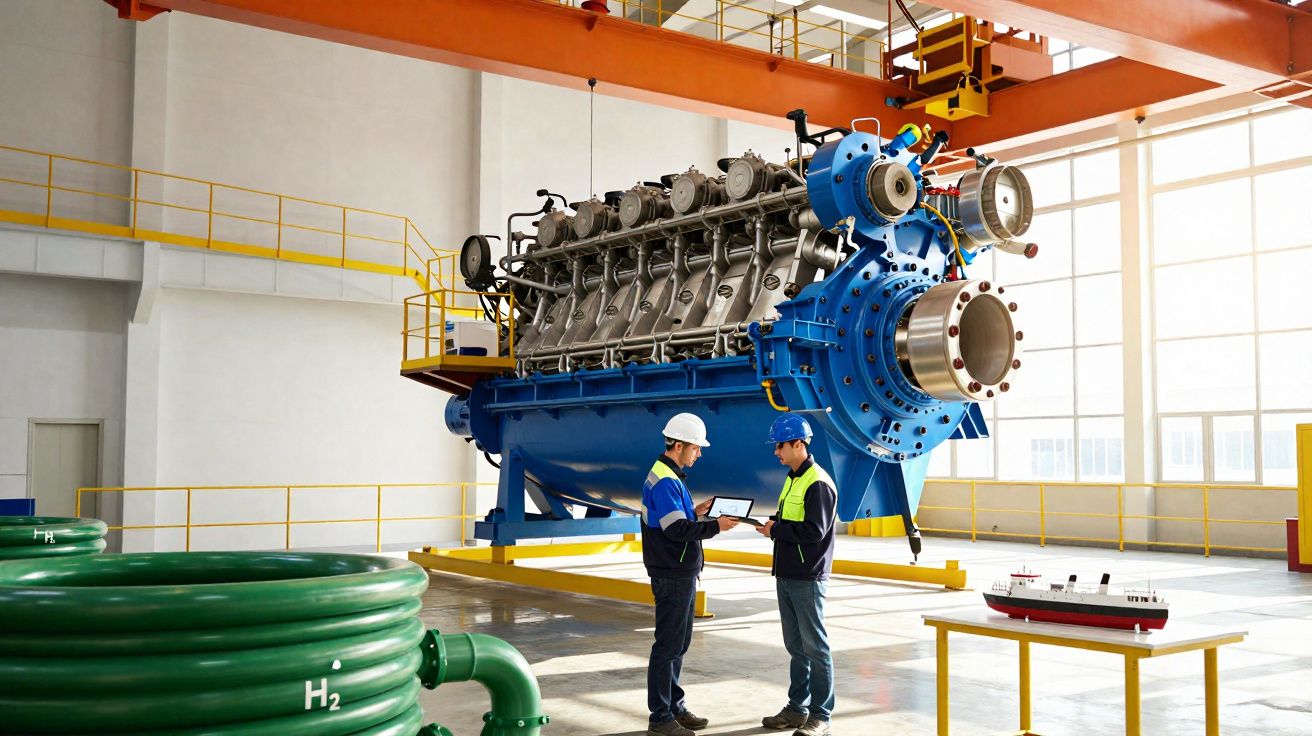
On France’s Atlantic seaboard, a long-established factory in Saint-Nazaire is gearing up-largely out of the spotlight-for what could be its busiest period since the post-war industrial surge.
The Saint-Nazaire works, famous for diesel engines that can outweigh a fully loaded passenger aircraft, is entering a new phase under its German owner Everllence. A sharp upswing in demand from nuclear power and low‑carbon shipping is pushing the site towards a decade of sustained growth.
From S.E.M.T. roots to an Everllence Saint-Nazaire powerhouse
In Saint-Nazaire, heavy engineering is woven into the local identity. The engine plant traces its origins to 1946, when the Society for the Study of Thermal Machines (S.E.M.T.) began developing and manufacturing very large diesel engines for ships and power stations.
For decades, S.E.M.T. became a recognised benchmark in marine propulsion and industrial engines. While the original business ceased to exist in 2006, both the site and the brand lineage carried on through a series of ownership changes and are now part of the German energy group Everllence, previously known as MAN Energy Solutions.
Roughly 600 people are employed at the Saint-Nazaire facility today. Approaching its 80th anniversary, the site is not being marked by ceremony so much as by tangible change: a substantial industrial expansion, new office space and a pronounced increase in output.
Everllence intends to turn Saint-Nazaire into an industrial “war machine”, raising production by around 40% by 2028.
At the heart of the plan is a straightforward market shift. Orders for extremely robust, fuel‑flexible engines are rising quickly in two fields that do not always expand together: nuclear energy and maritime transport.
Nuclear engines designed for worst‑case events
Within a nuclear power plant, Everllence engines-alongside a small group of competitors-fulfil a quiet yet essential function. They are not intended to drive the main turbines or supply the grid in routine operations.
Instead, they sit ready as the reactor’s last-resort protection, engineered to start when multiple layers of infrastructure fail.
These large engines are deployed as:
- emergency diesel generator sets,
- backup power systems for critical safety equipment,
- autonomous electricity units when the external grid goes down.
If a plant loses its outside power supply, the engines must start within seconds. Once online, they deliver electricity to:
- reactor and spent fuel pool cooling systems,
- safety and containment pumps,
- instrumentation and control systems that allow operators to maintain oversight.
They are specified for “design‑basis accidents” and beyond-earthquakes, flooding, or wide-area grid failures where time margins are tight. In this context, reliability is not a sales claim; it is embedded in nuclear standards and proven through demanding test regimes.
According to the IAEA, global nuclear capacity could expand from roughly 377 GW today to nearly 1,000 GW by 2050, drawing emergency equipment suppliers such as Everllence into a multi-decade investment cycle.
Every new build, as well as each life‑extension programme, requires established backup power solutions. That reality is feeding Saint-Nazaire’s order pipeline and is why the site is preparing for long-run expansion rather than a short-lived peak.
A related factor-often overlooked outside the sector-is qualification and documentation workload. Nuclear customers typically require strict traceability of materials, audited manufacturing processes, and detailed maintenance planning. As volumes grow, this pushes manufacturers not only to add capacity, but also to strengthen quality assurance, testing discipline and configuration control.
Maritime transition: regulation as the main tailwind
Shipping is being reshaped by a different set of pressures, but with similarly strong force. International rules are tightening around CO₂ and pollutant emissions from vessels operating across global routes.
The International Maritime Organization (IMO) is targeting a 40% reduction in carbon intensity by 2030 and 70% by 2040, with climate neutrality around mid‑century as the end point. In parallel, the European Union is bringing shipping into carbon pricing: cargo ships above 5,000 tonnes will increasingly pay for emissions through the carbon market.
For shipowners and charterers, the cost implications are substantial:
- new low‑carbon‑ready ships can cost 30–50% more than conventional vessels,
- alternative fuels such as advanced biofuels or e‑methanol can be two to five times the price of heavy fuel oil,
- fleet renewal may demand up to US$28 billion per year,
- fuel supply and infrastructure investment could reach US$90 billion per year.
Given these numbers, large-scale scrappage of existing tonnage is difficult to justify. Retrofitting engines and propulsion systems can be a far more economical route.
Converting 320‑tonne engines for low‑carbon fuels
Everllence’s approach is explicit: modify its huge four‑stroke engines so they can operate on liquid biofuels and other low‑carbon fuels now, rather than waiting for a fully hydrogen‑ or ammonia‑based fleet that could take decades to roll out.
A headline product is the 51/60DF series, a multi‑fuel engine that can weigh up to about 320 tonnes per unit in marine installations, and exceed 400 tonnes in the largest power variants.
Core characteristics of the MAN 51/60DF‑type engine include:
- four‑stroke architecture with very high power density,
- inline 6‑cylinder, V‑12 and V‑18 configurations,
- output up to approximately 20,700 kW at 500–514 rpm,
- operation on diesel, heavy fuel oil, natural gas or advanced biofuels,
- direct start in gas mode using around 1% pilot fuel.
With a 510 mm bore and a 600 mm stroke, it squarely belongs in the “mega‑engine” class-suited to large cargo ships, floating power barges and emergency power systems for critical infrastructure.
By prioritising conversions and fuel flexibility, Everllence gives shipowners a practical pathway to reduce emissions without redesigning vessels from scratch or replacing entire propulsion layouts. This is translating into heavy demand for Saint-Nazaire: the plant is scaling annual production from 48 to 72 large engines, with around 24 additional units scheduled for 2025 alone.
The French site is increasingly positioned as a global centre for XXL engines that comply with tighter climate rules while enabling the continued use of existing ships and infrastructure.
An additional driver is operational risk management. Fuel availability, port infrastructure and charter requirements can vary dramatically by region; multi‑fuel capability allows operators to adapt to supply constraints and policy shifts without immobilising vessels for prolonged redesign work.
6,000 m² of refurbished offices and a factory refit
Meeting rising demand requires more than simply increasing build rates. Everllence is using the current cycle to modernise the Saint-Nazaire site more broadly.
On the production side, capital expenditure is focused on:
- upgraded assembly and machining lines,
- improved internal logistics and material flows through workshops,
- test facilities adapted for new fuels and hybrid configurations.
Away from the shop floor, the white‑collar areas are also being overhauled. Around 6,000 m² of office space is due to be fully renovated over a two‑year period.
This property upgrade, framed as a concrete “birthday present” for the plant’s 80th year, is designed to:
- improve working conditions and provide more collaborative spaces,
- attract scarce engineering and digital talent,
- support a move towards more design work, systems integration and innovation.
The ambition is for Saint-Nazaire to do more than assemble engines: it is expected to host teams working on control systems, fuel conversion kits and lifecycle services for both nuclear operators and shipowners.
Saint-Nazaire as an Atlantic energy hub
Geography strengthens the business case. The Everllence factory looks onto the Greater Nantes–Saint-Nazaire Seaport, a major gateway for energy flows on France’s Atlantic coastline.
In 2025 the port handled 26.4 million tonnes of cargo, including 18 million tonnes of energy products such as oil and LNG. More than 3,000 ships call each year, supporting close to 28,700 direct jobs across 1,460 hectares.
Nearby, the plant sits among major industrial players including Atlantic Shipyards, EDF, TotalEnergies and ArcelorMittal. It also has access to a dedicated quay, enabling 48/60 and 51/60 engines-sometimes weighing as much as a small locomotive-to be loaded directly onto specialist ships or barges.
| Key figures for the Saint-Nazaire energy hub | Value |
|---|---|
| Annual port traffic (2025) | 26.4 million tonnes |
| Energy-related traffic | 18 million tonnes |
| Ships handled per year | 3,068 |
| Direct jobs on site | ~28,700 |
| Port area | 1,460 hectares |
The wider region is also aligned with France’s “France 2030” industrial strategy through the Loire Estuary East ZIBaC programme, funded with €8.2 million to back projects in hydrogen, CO₂ capture and biofuels. Everllence’s product direction fits well with this agenda, supplying heavy-duty equipment that can operate within emerging low‑carbon energy chains.
Engines, energy security and climate targets
Behind the talk of “war machines” and 320‑tonne blocks of steel is an unavoidable balancing act: societies are pursuing climate neutrality while also demanding secure, continuous access to energy.
In nuclear power, emergency engines are a final layer of protection. In shipping, multi‑fuel engines offer a route to lower emissions while the world still depends on long-distance maritime logistics. Companies such as Everllence operate at the intersection of these constraints.
This also brings fuel strategy trade-offs into sharper focus. Switching a large vessel from heavy fuel oil to sustainable biofuel can reduce CO₂, but it shifts attention to feedstock supply, land-use concerns and price volatility. For nuclear backup power, moving from conventional diesel to synthetic or bio‑derived fuels can lower lifecycle emissions, yet it requires rigorous validation to preserve reliability under extreme conditions.
For readers unfamiliar with the terminology, “dual‑fuel” describes an engine that can run on either a gaseous fuel (such as natural gas or biomethane) or a liquid fuel (such as diesel). A very small amount of the liquid fuel-known as pilot fuel-ignites first, helping the gaseous fuel combust more cleanly and efficiently. This setup lets operators respond to fuel-price swings and regulatory updates without replacing the engine’s core architecture.
In operational terms, a ship using a 51/60DF‑type engine might initially run largely on LNG, later transition to bio‑LNG or e‑methane blends, and then meet tighter rules through further retrofits. A nuclear plant can rely on comparable standby technologies, recognising that fuel flexibility may become increasingly valuable if carbon pricing expands to backup generators or if particular fuels become politically contentious.
For Saint-Nazaire, that uncertainty is close to favourable. So long as policy and investment continue to push towards lower‑carbon energy and more stringent safety expectations, demand for large, adaptable engines should remain strong-and the factory reaching 80 years is preparing to work harder than at any point in its ninth decade.




Comments
No comments yet. Be the first to comment!
Leave a Comment