
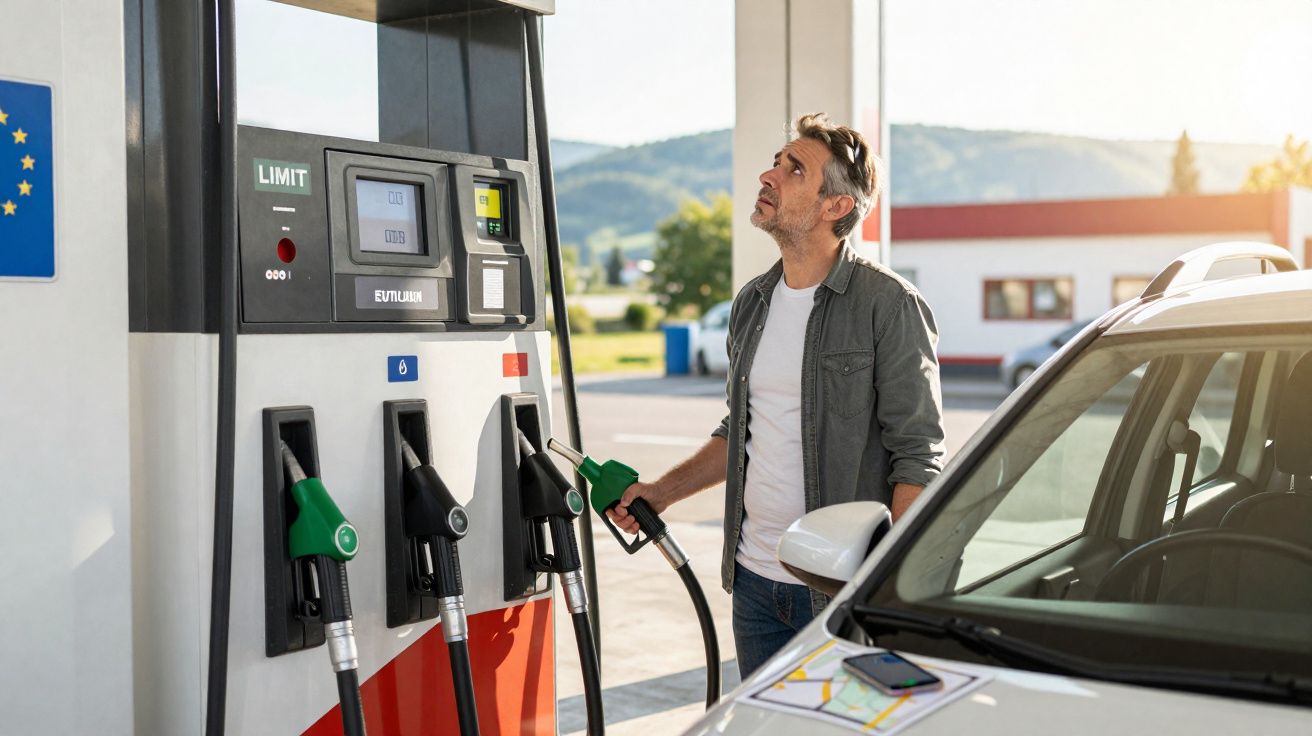
Slovenia has moved quickly in response to the fallout from the conflict involving Iran and the blockage of the strategically vital Strait of Hormuz. With oil prices soaring and panic-buying starting to appear at filling stations in various countries, Ljubljana has introduced a cap on daily fuel purchases-applying to residents and foreign motorists alike.
Slovenia’s fuel rationing rules in force from 22 March
From Sunday 22 March, Slovenia became the first European Union member state to roll out an official petrol and diesel rationing system. The decision followed the latest tensions linked to Iran and the disruption at the Strait of Hormuz, a maritime choke point through which around a quarter of global oil trade normally passes.
In Slovenia, private individuals may now buy only 50 litres of fuel per day, while companies and farmers are limited to 200 litres.
These daily limits apply nationwide at all filling stations. Retailers are required to monitor sales and, once a customer reaches the cap, stop dispensing-effectively “turning off the pump”. The restrictions cover both petrol and diesel.
The Slovenian government has framed the measure as precautionary. Officials say national reserves are well stocked and that Slovenia currently has sufficient fuel. The point of rationing, they argue, is to prevent panic-buying from draining storage and creating shortages that would not otherwise exist.
Why the Strait of Hormuz crisis hits Europe’s petrol and diesel prices
Market anxiety has been driven by the closure of the sea route at Hormuz. Media reports describe the strait as roughly 212 km long and about 50 km wide, with 12–13 million barrels of oil per day moving through it-around a quarter of global trading volume.
When that corridor is blocked or considered unsafe, oil prices tend to jump on international exchanges. Traders price in tighter supply, shipping firms avoid the passage or reroute vessels, and the extra risk and distance push up costs. The end result is more expensive crude oil-and, ultimately, higher petrol and diesel prices in Europe.
- Around 25% of global oil trade flows through the Strait of Hormuz
- 12–13 million barrels per day are affected
- Result: rising crude prices and higher pump prices
In several countries, these increases have reportedly triggered long queues at filling stations as drivers try to fill up before prices climb further. Slovenia’s daily caps are designed to dampen exactly that kind of surge in demand.
Regulated fuel prices turn Slovenia into a tank tourism hotspot
A second driver behind Slovenia’s decision is its domestic pricing policy. Fuel prices in Slovenia are regulated, and despite the Middle East crisis, petrol and diesel have remained cheaper than in neighbouring countries such as Austria and Italy.
Most recently, the government set a ceiling of €1.47 per litre for Euro Super 95 petrol. Diesel is capped at €1.53 per litre. In Austria, media reports suggest prices are approaching €1.80 per litre for petrol, while diesel is nearing €2.00 per litre.
A price gap of more than €0.30 per litre in some cases has fuelled a wave of “tank tourism” to Slovenian filling stations.
Many drivers from Austria and northern Italy have been willing to take significant detours to refuel in Slovenia. The larger the difference, the more worthwhile a border crossing becomes-particularly for commuters, professional drivers and people living in border areas.
How Slovenia is tackling tank tourism and protecting fuel reserves
Ljubljana has effectively faced two pressures at once: rising strain on national stocks caused by domestic stockpiling, plus an added influx of vehicles from abroad chasing lower prices.
Rationing is intended to defuse that combination. In addition, the government has encouraged fuel retailers to apply even tighter limits for foreign customers, although the exact approach is left to individual filling-station operators.
In practice, this may look like:
- 50 litres per day for Slovenian private customers
- 200 litres per day for company vehicles and agricultural businesses
- Potentially lower caps for foreign number plates, depending on the filling station’s decision
Slovenia is therefore attempting to keep its supply situation stable without fully shutting out foreign motorists.
Border-region reactions: economic boost or daily nuisance?
In Slovenia’s border areas, the influx of foreign vehicles has produced mixed reactions. Local reporting suggests many residents see the longer queues and heavier traffic as a burden: someone who simply wants to refuel quickly may end up stuck behind a line of cars with foreign registration plates.
Others view tank tourism as an opportunity for extra local income. Drivers coming from Austria or Italy to refuel often turn it into a short “day out”-a meal in a restaurant, a coffee in town, and perhaps some shopping with local businesses.
In some towns close to the border, cheaper fuel becomes an economic factor in its own right-bringing both benefits and drawbacks.
Similar cross-border tensions are well known elsewhere in Europe-for example between Germany and Poland or the Czech Republic-where cheaper fuel, tobacco or alcohol attracts customers from across the border while also causing frustration locally.
What the rationing means in day-to-day terms for motorists
A practical question for people in Slovenia is whether 50 litres per day is restrictive. For most private motorists it will likely feel generous; commuters and occasional drivers rarely need that much in a single day.
The picture changes for frequent drivers, small haulage firms and farmers. For them, 200 litres per day can become tight-especially during harvest periods or on long transport routes. Many businesses will now need to plan more carefully and consolidate trips.
The rule also underlines how dependent everyday mobility remains on oil. Even when petrol and diesel are still available, placing a limit on access can be enough to unsettle households and companies.
Additional practical points: planning, enforcement and cross-border travel
For drivers transiting Slovenia, it is sensible to assume that compliance checks will be handled at the point of sale and may vary slightly by retailer. If you are travelling in a convoy or operating multiple vehicles, allow extra time for refuelling and avoid leaving tank stops until the last moment-particularly near border crossings where demand is typically highest.
Businesses with time-sensitive logistics may also find it useful to review route planning and scheduling to reduce exposure to queues. Where feasible, refuelling outside peak periods and coordinating depot operations can help stay within daily limits without disrupting deliveries.
Background: why the route through Hormuz is so sensitive
The Strait of Hormuz connects the Persian Gulf with the Gulf of Oman and the Indian Ocean. Countries including Iran and Oman sit on its shores, yet the wider global economy relies on this shipping lane remaining open.
Because so many oil tankers pass through such a narrow corridor, markets react sharply to any military tension in the region. Even rumours of possible blockages can be enough to raise insurance premiums and push shipping firms to adjust routes.
European consumers experience the impact through higher pump prices. Every litre of petrol carries a complex global supply chain behind it-from oil fields to tankers, then refining and onward distribution.
How the situation could develop across the EU
Slovenia’s Prime Minister has sought to calm the public, stressing that storage is full and there is no need for panic. The daily limit is intended to prevent panic-driven shortages rather than signal an immediate lack of fuel.
Even so, the policy is likely to be watched closely across Europe. If the Middle East situation worsens or shipping disruptions persist, other EU countries may consider similar tools.
| Country | Measure | Aim |
|---|---|---|
| Slovenia | Daily limit of 50/200 litres | Protect reserves, curb tank tourism |
| Other EU countries | No formal rationing so far | Monitor the situation, possible price measures |
In past crises, governments have more often relied on tax adjustments, temporary subsidies or releasing strategic reserves to dampen prices. A formal rationing scheme like Slovenia’s remains unusual.
What drivers can do now
Anyone driving in or through Slovenia should adapt to the new limits. Stockpiling large quantities in spare containers is likely to be difficult under the caps. A better approach is to plan refuelling stops and cut unnecessary journeys.
Useful steps include:
- Sharing journeys (car-sharing) to reduce fuel use
- Choosing less congested routes to avoid queues and lower consumption
- Checking tyre pressure and servicing to improve fuel efficiency
- Adjusting speed-especially on motorways, where speed strongly affects consumption
This development is a stress test for Europe’s energy policy. Slovenia is demonstrating how a country can respond to a looming supply risk not only through prices, but via clear quantity rules. How long the rationing lasts-and whether other EU states follow-will ultimately depend on whether the situation in the Gulf stabilises or escalates further.


Comments
No comments yet. Be the first to comment!
Leave a Comment