
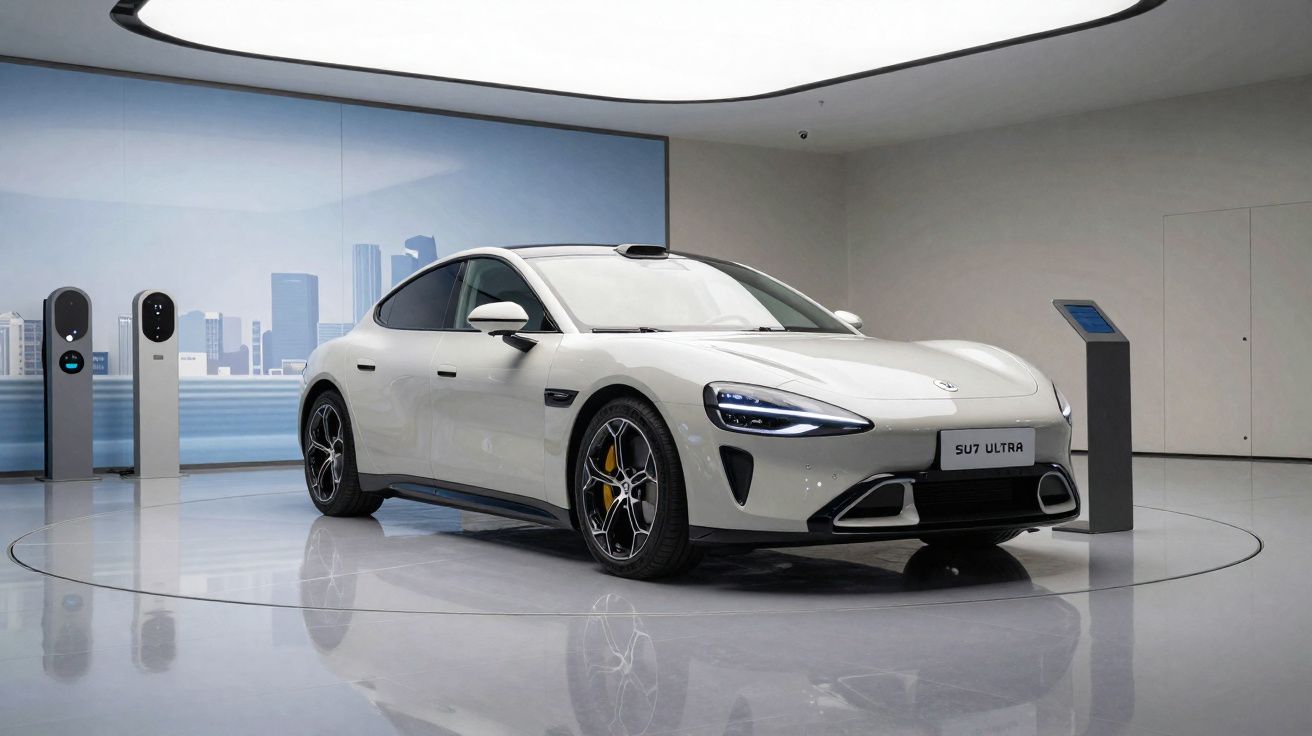
Xiaomi SU7 Ultra: from Nürburgring headline to fully road-legal in Germany
What looked, only recently, like little more than a Nürburgring publicity stunt has abruptly become a tangible milestone: the Xiaomi SU7 Ultra is now officially registered for regular road use in Germany. That single step matters far beyond one car, because it signals the arrival of a manufacturer best known for smartphones-and now intent on closing in on Europe’s premium electric brands.
From Nordschleife lap record to a Munich number plate
Xiaomi has been working in the automotive sector for roughly three years, and the SU7 immediately targeted territory typically dominated by Porsche, Tesla and similar players: a large, fully electric saloon with a clear performance brief. Sitting at the very top of the line-up is the Xiaomi SU7 Ultra, a highly powerful flagship designed to showcase the firm’s technology.
In summer, a prototype of the Ultra completed the Nürburgring Nordschleife in 6:22.091-an eye-catching benchmark in the EV world. The later production-spec version then posted 7:04.957, putting it at the front of the pack among series-production electric saloons on this circuit. Suddenly, cars such as the Porsche Taycan Turbo GT-and even the hypercar icon Rimac Nevera-became points of comparison rather than untouchable references.
The Xiaomi SU7 Ultra has positioned itself as one of the world’s quickest electric saloons-now not only on a race track, but officially on European roads.
The key administrative moment arrived in early July 2025: the first SU7 Ultra was registered in Munich with a German number plate and full road approval under European rules. The car carries the registration M SU7088E and is being used by the manufacturer as a real-world development and validation vehicle.
Xiaomi has already put this car through an approximately 800 km test tour linking Berlin, Hamburg and Frankfurt. On an unrestricted Autobahn section, it reportedly reached 260 km/h-legally, and in everyday conditions rather than a controlled test. While the approval itself is an individual registration, the underlying implication is broader: the essential groundwork for European homologation is, in practice, in place-an important prerequisite for future customer sales.
Xiaomi SU7 Ultra specifications: 1,548 PS, 350 km/h top speed, 600+ km range
On paper, the Xiaomi SU7 Ultra reads like a supercar. According to the manufacturer, the flagship offers:
- Power: 1,548 PS from a fully electric drivetrain
- 0–100 km/h: 1.98 seconds (claimed)
- Top speed: up to 350 km/h
- Battery: 93.7 kWh CATL Qilin II
- Range: 630 km on China’s CLTC cycle
That range figure needs context for European readers. CLTC is typically more optimistic than the WLTP standard used across Europe. Industry observers expect the Ultra to land at a little over 500 km in more realistic WLTP-equivalent terms-still a striking number for a saloon with this level of performance.
Alongside the Ultra, Xiaomi is also planning several more “everyday” SU7 variants. These are expected to span roughly 320 to 690 PS and-depending on battery size-could reach up to 902 km on the CLTC cycle. Converted to a WLTP-style expectation, that’s around 722 km, a figure that could put pressure on many established premium EVs.
Why the Nürburgring matters for Xiaomi’s image strategy
Chinese brands are taking different routes into Europe. Some buy visibility through major football sponsorships, while others focus primarily on price. Xiaomi’s approach is far more image-led: Nürburgring credibility, bold design, headline performance-and later, a relatively accessible entry price.
The Nürburgring plays an outsized role in this plan. Few circuits carry a similar global reputation, particularly among German car enthusiasts. A strong showing there tends to translate into instant legitimacy. Xiaomi is clearly using the SU7 Ultra to prove it can deliver far more than competitively priced consumer electronics.
Europe from 2027: Xiaomi SU7 and YU7 with a premium feel at a disruptive price
Xiaomi is now openly stating that its European market launch is targeted for 2027. The SU7 saloon is intended as the core model, supported by an SUV called the YU7. To avoid stumbling over local expectations and requirements, Xiaomi has established a development and design centre in Munich, where engineers and designers are tuning chassis set-up, driver-assistance systems and interior execution specifically for European customers.
For SU7 versions below the Ultra, Xiaomi is said to be aiming for a premium positioning with a comparatively low entry point. A starting price in the region of €35,000 has been suggested for simpler variants. If that figure holds, the SU7 would head straight into the territory of the Tesla Model 3, Hyundai Ioniq 6 and BMW i4-while promising more equipment and more range for similar (or less) money.
A premium electric saloon offering more than 700 km of WLTP-style range at a mid-market price could significantly shake up the segment.
An added factor: charging expectations and long-distance use in Europe
If Xiaomi wants to convert Nürburgring interest into real sales, performance figures alone will not be enough. European buyers will scrutinise charging speed, route planning, battery pre-conditioning and how reliably the car holds high charge rates on motorway journeys. Compatibility and user experience across major networks-such as Ionity and large national providers-will be as important as the peak power headline.
Just as critical is trust-building around ownership: clear warranty terms, parts availability, transparent repair times and a service footprint that works outside major cities. For a newcomer, these practicalities often matter more than acceleration times once the initial excitement fades.
What this could mean for European manufacturers
Xiaomi’s Nürburgring push is not happening in isolation. Other Chinese manufacturers-such as BYD with the Yangwang U9-are also drawing attention and challenging established performance narratives. The evolving Nürburgring timeline shows how quickly the competitive bar is rising, and how strongly European brands may need to respond.
That puts companies such as Porsche, BMW, Mercedes, Audi and also Tesla under pressure on two fronts. They must defend (or extend) their technical advantages, while also managing a pricing structure that becomes harder to sustain. If a new entrant combines sports-car performance and long range with an entry price around €35,000, the traditional margin logic in the premium EV space is likely to be tested.
Homologation, CLTC and WLTP: what these terms actually mean
Several technical terms appear repeatedly in discussions around the SU7 Ultra. Here is what they mean in plain language.
| Term | Meaning |
|---|---|
| Homologation | Technical approval enabling a vehicle to be sold and driven on public roads under the regulations of a specific market, such as the EU. |
| WLTP | Worldwide Harmonised Light Vehicle Test Procedure; the European standard used for consumption and range figures. |
| CLTC | China Light-Duty Vehicle Test Cycle; a Chinese test cycle that usually produces higher (more optimistic) range values than WLTP. |
The fact that the vehicle has achieved approval in Germany indicates Xiaomi is already navigating demanding EU requirements: crash performance, driver assistance, lighting, software security, charging compatibility and more. For potential buyers, it is a signal that the project is moving beyond track-day headlines.
Risks, opportunities and real-world usability
Even with impressive numbers, a practical question remains: how usable is a car like the Xiaomi SU7 Ultra day to day? With more than 1,500 PS available, most driving on A-roads and motorways will never come close to exploiting the full output. More revealing will be aspects such as charging behaviour, software update quality, aftersales support and residual values-areas where new entrants often need time to mature.
At the same time, Xiaomi brings substantial experience from consumer technology. Connected services, infotainment design and seamless smartphone integration are core strengths. If Xiaomi transfers that competence cleanly into the car-without compromising reliability or safety-its appeal to tech-focused drivers (particularly those already invested in the Xiaomi ecosystem) could be significant.
Ultimately, success in Europe will depend on a combination of competitive pricing, a credible service structure, dependable real-world range and a safety record that builds confidence. The first road-legal Xiaomi SU7 Ultra on European streets marks the point at which it becomes clear whether the Nürburgring “Green Hell” narrative is merely marketing-or the beginning of a genuine premium EV challenge.

Comments
No comments yet. Be the first to comment!
Leave a Comment