
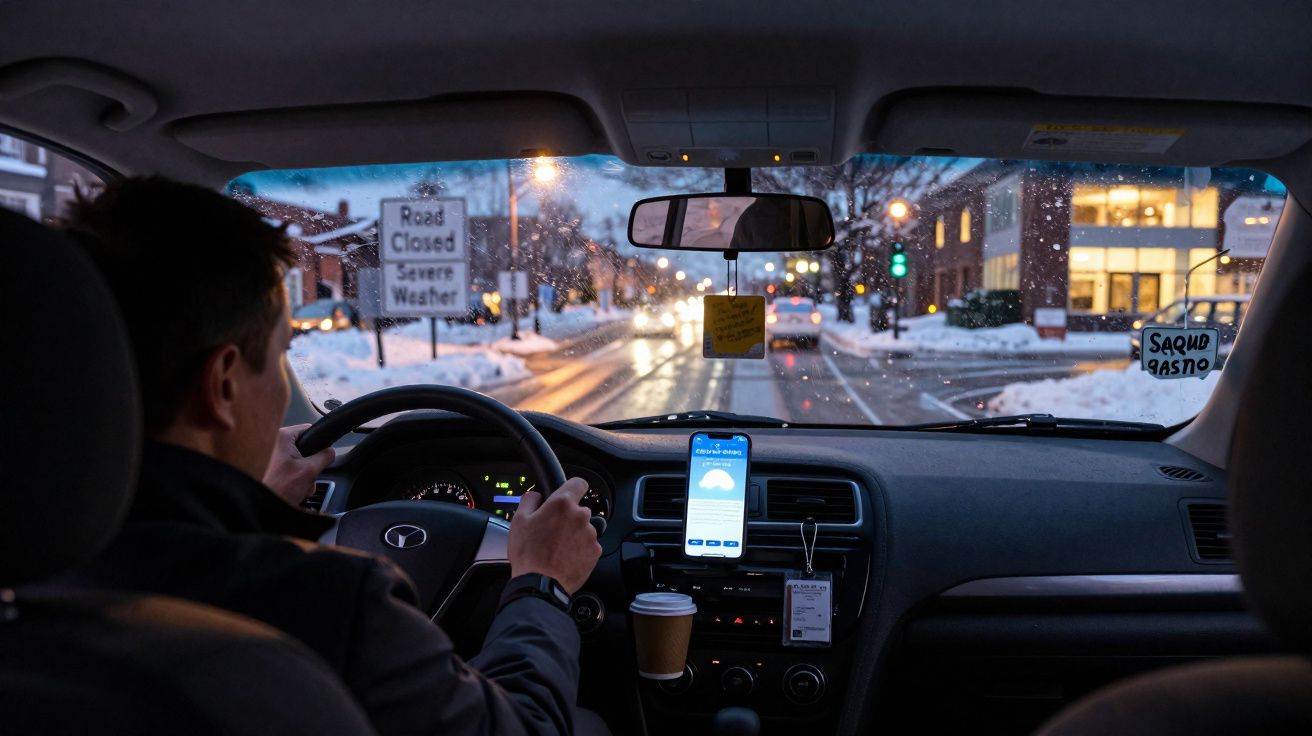
The first flakes began drifting down just after 4 p.m. - light, harmless snow, the sort that has children glued to the window and adults checking weather apps twice. By early evening the sky above the town had taken on that odd, streetlamp-orange glow, and the snowploughs and gritters were already queuing at the council depot like lorries on a starting line. On one screen: the council leader’s briefing, firm and measured - “Stay home unless your journey is absolutely essential.” On the other: your manager’s group email - “We expect normal operations tomorrow. Please attend as usual.”
Outside, the snow gets heavier.
Inside, the pressure rises with it.
And the worst of the storm still hasn’t properly arrived.
Drivers told to stay home as businesses insist on “business as usual”
All afternoon, notifications have stacked up one after another, like cars shunting on an icy slip road. The Met Office has moved from “keep an eye on it” to a straight winter storm warning: heavy snow, whiteout conditions, and travel becoming dangerous after 9 p.m. Local police have repeated the message online, urging drivers to stay off the roads so gritters, snowploughs, and ambulances can get through.
At almost the exact same time, big employers have pushed out messages insisting on normal operations.
For many workers, that translates into something painfully simple: you’re still expected to be on those very roads you’re being told to avoid.
In a retail park car park near the dual carriageway, a supermarket cashier called Elena stands beside her car with her phone in hand. She has just read the council’s plea to stay home on Facebook - and then, immediately after, her manager’s text: “We’re open regular hours. Please be on time.” Her saloon still carries last week’s grit dust, the tyres are well past their best, and her commute includes a bridge that always ices over first.
She scrolls through the comments under the council post. Dozens of people tag their workplaces, asking whether they’re shutting.
The official response is courteous but blunt: the council can advise and warn - it cannot order private businesses to close.
This tension is nothing new, but every winter storm drags it back into the open. Public bodies are judged on safety - on how few people end up in ditches or in A&E. Businesses are judged on staying open - on targets, staffing, stock levels, and keeping services running. Both sides talk about “responsibility”, but they mean different things when they say it.
In the middle sit the drivers and workers, each forced into a personal risk calculation.
Who do you listen to: the mayor on the news, or the manager who signs off your next payslip?
How to navigate a winter storm when you feel pulled in two directions
The first choice is usually made before your alarm goes off. Tonight - while the snow is still only a soft hiss against the glass - is when you work out what your real safety margin looks like. Check the forecast hour by hour, not just the headline totals. When is the heaviest snow expected on your route? Are there hills, exposed stretches, or bridges that routinely turn into skating rinks?
Then take a practical look at your car, not a hopeful one: screenwash topped up, fuel at least half a tank, ice scraper within reach, phone fully charged, and a blanket plus snacks in the back.
None of that turns you into a superhero on ice - but it does reduce how exposed you are if things go wrong.
After the practical bit comes the human bit: the tight feeling in your stomach when your boss says, “We’ll play it by ear.” For a lot of people, the fear of being branded unreliable is as real as the fear of hitting a barrier on black ice. Most of us know that exact mental tug-of-war: risk versus rent, safety versus shifts.
One quiet truth helps: you’re allowed to describe what conditions are like where you live - from your driveway, not from someone else’s office window.
And, realistically, you won’t do that every day. But in weather like this, a quick photo or 10-second video of your road at 6 a.m. can move the conversation from “You’re overreacting” to “Right - I can see the problem.”
At times it comes down to one sentence you can say clearly without sounding hostile. Rehearse it now, before you’re stressed and rushing. Something plain and honest, such as: “I want to work, but the roads where I am aren’t safe right now. Can we look at another option?”
“That morning, I sat on the edge of the bed staring at my boots,” says Marcus, a delivery driver who skidded off the road in a storm two years ago. “The dispatcher said what they always say: ‘We’re short-staffed - we need you.’ The police had just posted: ‘Stay off the roads.’ In the end, the ditch won. I wish I’d listened to the people who weren’t making money from my risk.”
Alongside your personal judgement, it can help to anchor yourself in a plan:
- Create a backup plan tonight: someone you could swap with, a supervisor you can message early, or a remote task you can offer to do.
- Set a personal “no-drive line”: a specific visibility level or snowfall rate where you simply will not get behind the wheel.
- Prepare one clear sentence for your employer so you’re not improvising under pressure at 5:30 a.m.
- Tell one person outside work where you’re going, which route you’ll take, and when you expect to arrive.
- Keep one non-negotiable: do not silence that small internal voice that says, This is too much for me and this car today.
It’s also worth checking what your workplace policy actually says - not what people assume it says. Some employers have severe weather guidance that includes remote working, alternative duties, or a “don’t travel if advised not to” clause, but staff only remember it when it’s too late. If you’re in a union, this is exactly the sort of situation they can advise on, and if you’re not, ACAS guidance can help you understand how absence, pay, and safety obligations are usually handled in the UK.
Finally, consider the wider travel picture, not just your driveway. In heavy snow, roads can look passable at 7 a.m. and be impassable by 9 a.m. if the snowfall intensifies or visibility collapses. If you do have to travel, plan for the return journey as well: check whether bus routes are suspended, whether rail services are running, and whether your route home relies on untreated side streets that may not be gritted.
When safety, work, and real life collide on a snowy night
Storms have a way of revealing cracks that were already there: between salaried staff who can log on from home and hourly workers who lose money unless they can clock in. Between workplaces that genuinely say, “Stay safe - we’ll sort it,” and those that quietly reward whoever forces their way through the blizzard. Between public messaging that sounds protective and private pressure that feels anything but.
On nights like this, that gap grows with every fresh centimetre of snow on the tarmac.
What happens next is rarely tidy. Some people will call in and spend the morning refreshing their banking app, doing the maths with a sinking feeling. Some will grip the wheel all the way to work, then spend an eight-hour shift replaying every slide, skid, and near miss. A few will post dashcam clips and argue in the comments about personal responsibility and corporate greed. Meanwhile the gritters will go back and forth, trying to scrape away not just the snow, but the tension with every cleared lane.
And underneath it all, the same question remains: who gets to decide what “essential” really means when your name is on the insurance documents?
As the night draws on, the snow will keep falling, indifferent to push alerts and memos. The authorities will repeat: stay home. Businesses will count the cost of shutting - and perhaps the reputational cost of staying open. Out on the roads, each driver will carry a private calculation: job, safety, family, pride, fear.
Some will stay in and feel guilty. Some will go out and feel reckless. And some will start asking for better policies - and better conversations - the next time “winter storm warning” appears on the radar.
That’s where tomorrow really begins: well after the roads are cleared and the headlines have moved on.
| Key point | Detail | Value for the reader |
|---|---|---|
| Storm warnings vs. work expectations | Authorities urge people to stay home while many employers demand normal attendance and “business as usual” | Helps you make sense of the mixed messages landing on your phone tonight |
| Personal safety assessment | Check your route, your car, and your own limits before the alarm goes off | Gives you a clear way to decide whether driving is reasonable |
| Communicating with employers | Use simple, honest language and share local conditions from your doorstep | Offers a way to protect your safety while keeping the work relationship workable |
FAQ
- Question 1: Can my employer force me to drive to work during a severe snow warning?
- Question 2: What should I tell my boss if I believe the roads are unsafe where I live?
- Question 3: Are there legal protections if I refuse to drive in dangerous conditions?
- Question 4: How can I prepare my car quickly if I have to go in anyway?
- Question 5: What’s the safest way to drive if the storm hits while I’m already on the road?




Comments
No comments yet. Be the first to comment!
Leave a Comment