
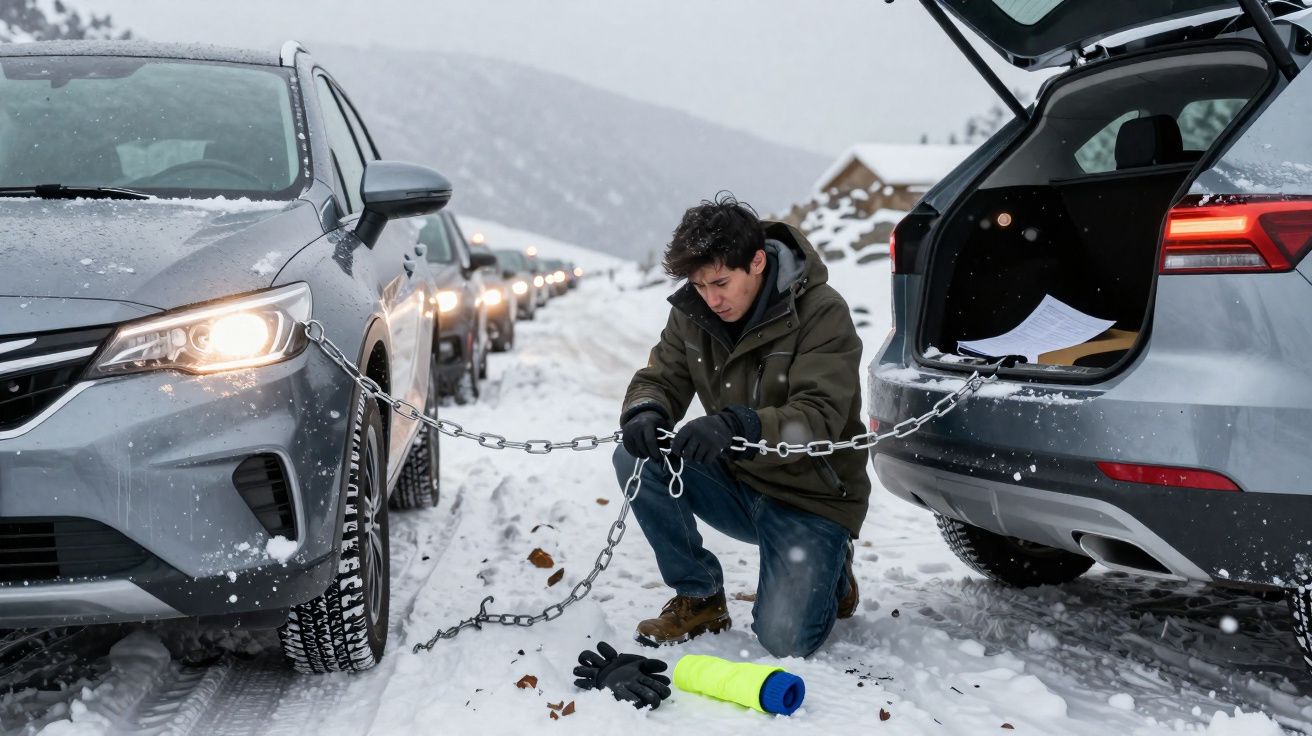
Snow chains are widely treated as essential kit the moment the snow settles and mountain passes turn properly wintry. In brochures they look straightforward, safe and almost foolproof. Anyone who has actually had to fit them in a blizzard on the edge of an unlit country road discovers the less glamorous reality: stress, freezing hands, fiddly mechanisms - plus hidden risks for your car, your nerves and your wallet.
Fitting snow chains in a snowstorm: practice quickly turns into a nightmare
On paper it’s only a few simple steps; in real life, the first fit is often a serious test of patience. Plenty of drivers have never tried their chains on their own car before. They end up flicking through the instructions in sub-zero temperatures while snow blows straight into their face.
The scene is usually the same: numb fingers, bulky gloves, a head torch or phone light, and a slippery verge. The steel web tangles itself, the fastener refuses to lock, and traffic hammers past at close range.
If you fit snow chains for the first time in an emergency, you almost always pay for it in stress, lost time and mistakes.
Many systems also require you to move the car briefly so the chain seats itself correctly around the tyre. That means rolling a short distance forwards or backwards, getting out again into slush, re-tensioning, and checking everything is properly aligned. On narrow mountain roads with poor lighting, this can quickly become a risky manoeuvre.
A practical point that’s easy to overlook: keep fitting essentials where you can reach them without emptying the boot in the snow. Warm waterproof gloves, a kneeling mat, a hi-vis vest and a small torch can make the difference between a controlled stop and a dangerous scramble at the roadside.
Snow chains and compatibility: not every set suits every car
Modern cars with large alloy wheels and tight wheel arches often make snow chains awkward. Quite simply, there may not be enough clearance between the tyre, suspension strut and wheel arch. Traditional steel chains can then rub against suspension components.
It gets more serious when electronic driver aids are involved. If a chain sits or flails in the wrong place, it can damage sensor wiring or parts associated with ABS and ESP. The result can range from warning lights on the dashboard to expensive repairs.
- Check the vehicle handbook: is there an approved snow chain option?
- Only use snow chains with tyre sizes that are explicitly approved
- Pay attention to “chain-suitable” wheels and the exact chain design specified
- If in doubt, ask the manufacturer or a garage before you buy
Retailers often push “universal” models. It sounds convenient, but “universal” does not automatically mean “it will fit your wheel arch and suspension”. Discovering on an Alpine holiday that the chain fouls the wheel arch leaves you, quite literally, stuck in the snow.
Driving with snow chains: loud, bumpy and slow
Once the chains are on, the car feels noticeably different. Each wheel rotation can send distinct thumps through the steering wheel, seat and bodywork - especially when the road isn’t consistently covered by a deep layer of snow.
The car will rumble, cabin noise rises sharply, and fine vibrations can become genuinely tiring over time. Anyone who has to cross multiple passes or tackle long stretches on chains will feel it physically and mentally within an hour.
There’s also a hard speed limit in practice: depending on the model, the recommended maximum speed is usually around 30–50 km/h. If you’re under time pressure or setting off late, you should assume your journey will take much longer.
With snow chains, every fast road becomes the slow lane. If you rush, you increase the risk - to the chains, the car and your passengers.
Limited lifespan: steel and asphalt do not mix
Many people assume a set of snow chains will last almost forever because they’re used so rarely. That’s only partly true. Chains wear extremely quickly as soon as they’re run on bare road without an unbroken snow layer.
The hard metal links grind against the tarmac with every metre. They can flatten, bend open or snap. If you drive long distances on mixed surfaces - snow, slush and dry patches - you can push the chains to their limits within just a few winters.
Loose or damaged links aren’t merely ineffective; they can become a safety hazard if they snag inside the wheel arch or catch brake lines.
Hidden danger: damage to your own vehicle
Most drivers’ biggest fear is losing control on ice. The next concern ought to be vehicle damage caused by wrongly fitted or damaged snow chains.
If the chains aren’t tight enough, they can slap against tyre sidewalls, alloy rims or suspension parts while driving. That can leave gouges in wheels, harm rubber, or strike dampers and axle components.
A loose chain turns into a rotating hammer inside the wheel arch - with predictably unpleasant consequences.
There’s also a legal and practical downside: in some areas you can be penalised for driving on fully cleared roads with chains still fitted. Metal links can scar the road surface and leave ruts - which is why road maintenance teams are rarely impressed when drivers keep chains on “just in case”.
Using snow chains correctly: avoid the common mistakes
Check before winter, not when the weather warning hits
A simple step that’s often ignored is doing a first test fit on a dry driveway or car park. That way you’ll find out whether the instructions make sense, whether all parts are present, and how much force the fasteners actually need.
If you also label which chain goes on which side and how the fastener should sit, you can save valuable minutes when conditions are nasty.
Choose the right driving style
With snow chains fitted, the rule is: be gentle. Hard acceleration, abrupt braking and sharp steering shorten chain life and increase the chance of a chain working loose.
A useful rule of thumb:
| Situation | Recommended action |
|---|---|
| Deep, continuous snow cover | Fit chains; drive slowly and smoothly |
| Mixed surface (partly clear, partly snow) | Use chains only where absolutely necessary; remove them in between |
| Fully cleared road | Remove chains immediately to prevent damage |
After you’ve used them, it’s worth adding one more routine: rinse off salt and grit, let the chains dry, and store them properly. It helps prevent corrosion, makes the next fitting less frustrating, and reduces the chance of discovering seized fasteners when you need them most.
Snow socks as an alternative: comfort over clatter
Textile traction aids - often called snow socks - are seen by many as a modern alternative. They pull over the tyre like a sleeve, are lighter, and are usually more intuitive to fit.
Because there’s no metal involved, the risk of scratching alloys or damaging the wheel arch is lower. Many newer cars with tight clearances cope far better with these systems.
The drawback is durability: the fabric wears very quickly if it touches dry tarmac. Snow socks are best for snow-covered roads and shorter stretches - for example, a steep driveway or a rural track.
Snow socks win on comfort; classic snow chains win under extreme, sustained loads on Alpine routes.
How to choose the right snow chain system for everyday use
If you live in lowland areas and rarely see serious snowfall, a good winter tyre and a set of snow socks in the boot can be more practical than heavy metal chains. In mountainous regions with frequent snow, a high-quality chain system that matches your car exactly is usually the better investment.
It helps to be honest about your typical driving:
- Occasional trips to ski resorts: simpler, easy-to-fit solutions are often best
- Work journeys over passes and high roads: robust, certified snow chains, with fitting practised in advance
- City driving with only occasional slush: focus on quality winter tyres; keep chains as an emergency backup
Choosing winter equipment calmly using these criteria - and doing one hands-on practice run before the first snowfall - dramatically reduces the chances of a frustrating breakdown in a storm. Snow chains remain a powerful aid, provided drivers understand their limits, their quirks and their pitfalls.






Comments
No comments yet. Be the first to comment!
Leave a Comment