
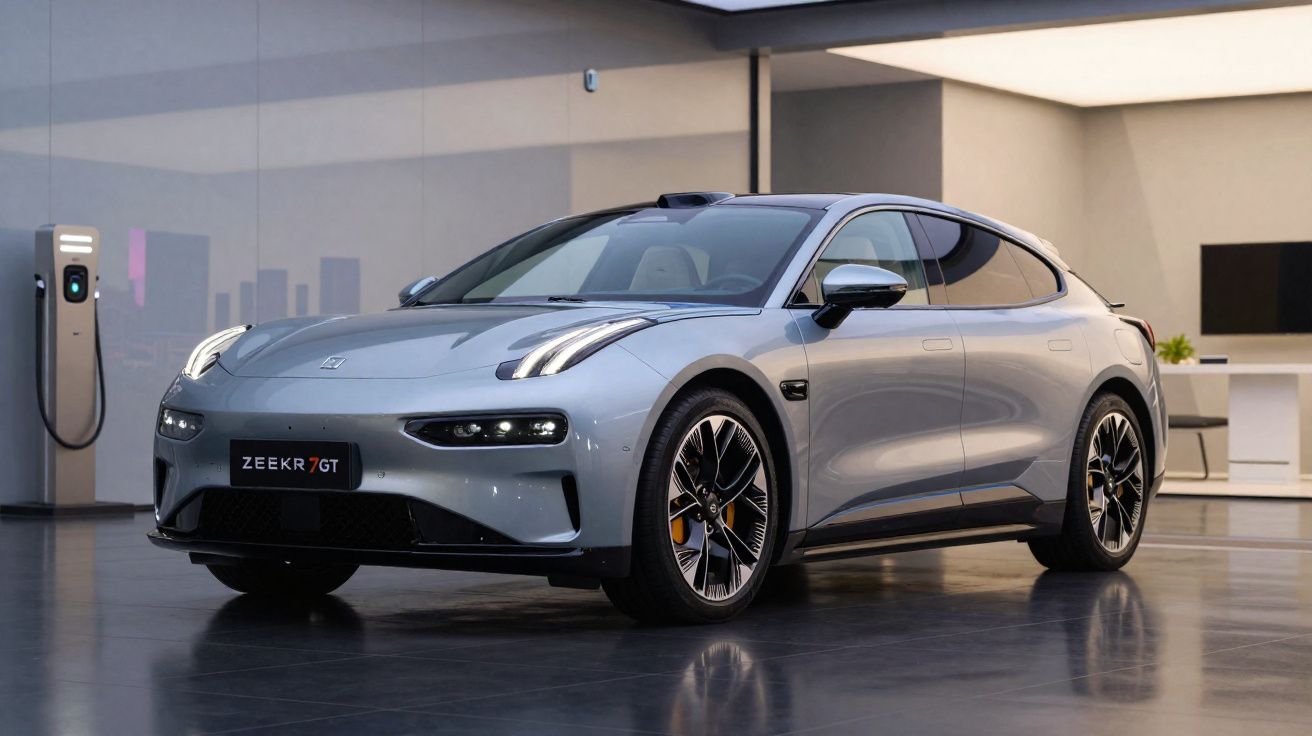
Zeekr, Geely’s premium electric offshoot, is lining up an ambitious European expansion centred on a dramatic new estate car designed to mix sharp looks, substantial driving range and pricing intended to put BMW, Mercedes and Audi under pressure.
Zeekr’s major European expansion begins in 2026
Launched in 2021, Zeekr has so far concentrated largely on China. Even so, it already trades in parts of northern and eastern Europe - including Scandinavia, the Netherlands and Switzerland - where it recorded roughly 5,000 registrations in 2025. The next step is a far broader push into western Europe, with Germany, Belgium and France first in line.
Four battery-electric models are set to lead that roll-out:
- Zeekr X – a compact C‑segment SUV
- Zeekr 7X – a larger, family‑focused D‑segment SUV
- Zeekr 001 – a large coupé‑inspired SUV, on sale since 2021
- Zeekr 7 GT – a sporty D‑segment shooting brake aimed at being the European flagship
The newest and most attention-grabbing of the bunch is the 7 GT, which also serves as Zeekr’s technology showcase for France in 2026.
The Zeekr 7 GT is positioned as a premium electric estate offering long range, strong performance and a starting price below €50,000.
A low, sleek shooting brake designed to lure BMW drivers
While many electric estates play it safe with restrained styling, the Zeekr 7 GT goes all-in on the shooting brake theme. It sits low with a stretched roofline, a short bonnet and a sharply tapered rear. Strong shoulder lines and sculpted bodywork give it more of a grand tourer attitude than a conventional family estate.
Its stance is helped by the dimensions. A 2.92 m wheelbase pushes the wheels outwards, trimming the overhangs and freeing up interior room. Zeekr’s pitch is straightforward: offer something as visually striking as a Tesla or Mercedes, but with extra day-to-day usefulness.
Big boot, proper rear-seat comfort
In the cabin, the 7 GT is intended to cover both “lifestyle” and family duties. Rear legroom is described as generous, thanks largely to the long wheelbase. A flat floor improves the practicality of the middle rear seat compared with many petrol or diesel estates.
Load space is one of its clearest selling points. Zeekr quotes:
- 647 litres of boot capacity with the rear seats up
- Up to 1,737 litres with the rear seats folded
That places it firmly among large estates, making it a plausible replacement for a traditional diesel wagon when it comes to long journeys, sports equipment or bulky work gear.
With up to 1,737 litres of luggage space, the 7 GT aims to pair EV pace with classic estate practicality.
Premium equipment in every trim - including the Zeekr 7 GT Core RWD
Zeekr is relying heavily on generous standard specification to counter any hesitation buyers may feel about a newer Chinese badge. Even the entry model, called Core RWD, is presented as coming with a notably comprehensive mix of technology and comfort features.
Onboard technology and comfort highlights
Standard specification includes:
- 15‑inch central OLED touchscreen with Apple CarPlay and Android Auto
- Adaptive cruise control plus a full set of driver assistance systems
- Panoramic glass roof
- Dual‑zone climate control
- Powered tailgate
- Heated front and rear seats, plus a heated steering wheel
- 10‑speaker sound system
Zeekr is also placing emphasis on perceived quality, recognising that shoppers comparing BMW, Audi and Mercedes are rarely forgiving about trim fit, material choice and overall finish. Expect soft-touch surfaces, contrasting trim elements and a minimalist dashboard layout dominated by the central display.
Performance and range: up to 646 hp with long-distance capability
The specifications show Zeekr intends to compete directly with established European players. Two output levels are planned, matched to two battery sizes.
| Version | Power output | Battery capacity | Claimed range |
|---|---|---|---|
| Zeekr 7 GT (base) | 422 hp (rear‑wheel drive) | 75 kWh | Lower than long‑range, figure TBC |
| Zeekr 7 GT (performance) | 646 hp | Up to 100 kWh | Up to 655 km (test cycle figure) |
The attention-grabber is the up to 655 km claim for the 100 kWh version. On paper, that puts it ahead of a BMW i5 Touring quoted at roughly 602 km, and comfortably beyond many alternatives that sit closer to the 500 km region.
With a quoted 655 km from a 100 kWh battery, the 7 GT is aimed at long-distance touring rather than being limited to city use.
Charging: 22 kW AC and very high-power DC
Charging capability is another headline area. A 22 kW AC onboard charger is included as standard, making it useful for quicker top-ups on three‑phase public posts and suitable home wallboxes in parts of Europe.
For rapid charging, Zeekr says the 7 GT can accept up to 480 kW DC in ideal conditions. With access to a charger capable of that output, the brand claims a 10–80% charge in around 13 minutes - placing it among the fastest-charging EVs announced to date.
The car also includes V2L (vehicle‑to‑load), enabling owners to power external equipment from the traction battery. In practice, that could mean anything from camping kit to tools at a remote work site, turning the estate into a mobile power source.
Pricing: the lever Zeekr hopes will unsettle BMW
The first clear pricing signal comes from Belgium, where the Zeekr 7 GT starts at €49,990. UK and French prices for 2026 are still unconfirmed, but this figure strongly indicates the approach: price it meaningfully below comparable German premium models while offering stronger standard kit and a longer claimed range.
A starting price under €50,000 for a 422 hp, well-specified electric estate leaves traditional German rivals with limited breathing room.
As a reference point, a similarly potent BMW i5 Touring or a Mercedes EQE SUV can rise well beyond that level once optioned to match the Zeekr’s specification. Zeekr is wagering that both company-car users and private buyers will decide the value equation justifies taking a chance on an unfamiliar badge.
How the Zeekr 7 GT compares with key rivals
In Europe, Zeekr’s most obvious estate benchmark is the BMW i5 Touring, while the Denza Z9 GT targets a similar “electric GT” niche. Based on currently available figures:
| Model | Power | Battery | Range (km) | Boot volume (L) | Fast charge 10–80% | Base price |
|---|---|---|---|---|---|---|
| Zeekr 7 GT | 422 / 646 hp | 75 or 100 kWh | Up to 655 | 647 – 1,737 | 13 min (up to 480 kW) | €49,990 (Belgium) |
| BMW i5 Touring | n/a | n/a | 602 | n/a | n/a | n/a |
| Denza Z9 GT | n/a | n/a | ~500 | n/a | n/a | n/a |
Even without the full rival data set, Zeekr’s intended advantage is clear: range, practicality and sticker price in one package.
What the Zeekr 7 GT could mean for buyers in France and the UK
For French motorists in 2026, the 7 GT lands at a time when many households are looking to move on from ageing diesel estates but remain cautious about EV trade-offs. A long claimed range is designed to reduce anxiety on lengthy autoroute journeys, while a large boot and flexible passenger space preserve the everyday usefulness people expect from a break.
In the UK, the same logic applies to motorway-heavy routines: buyers who want an estate for family duties, long trips and carrying bulky loads often still gravitate towards traditional premium brands. Zeekr is attempting to win them over with strong specification as standard, avoiding the familiar premium-brand experience of a lengthy (and expensive) options list.
Company-car drivers may also find the overall running-cost picture attractive, alongside any favourable tax treatment that applies to zero-emission vehicles under local rules.
Key terms: V2L, fast charging and battery capacity
Three technical points are likely to matter most to anyone weighing up the 7 GT:
- Battery capacity (kWh): A larger number - such as 100 kWh - typically supports longer range, but it can also add weight and cost. The 7 GT offers both 75 kWh and 100 kWh options, letting buyers balance price against endurance.
- Fast charging rate (kW): The 480 kW figure is a best-case headline. Actual charging speeds vary with charger output, battery temperature and state of charge, so real-world charge times may be longer.
- Vehicle‑to‑load (V2L): This allows the car to supply power to external devices - for example, charging laptops on-site, running an e‑bike charger on holiday, or keeping a small fridge operating during a power cut.
Real-world scenarios: who the Zeekr 7 GT suits best
Picture a household in Lyon or Manchester combining daily commuting with regular cross-country travel. With the larger battery, the 7 GT should be capable of completing long motorway runs with a single rapid-charging stop - assuming the route offers sufficiently high-power chargers. The 22 kW AC capability also becomes useful when staying overnight at hotels or visiting family with access to three‑phase supply, helping to reduce the time required to refill the battery.
For freelancers and small firms, the blend of a large boot and V2L could be particularly appealing: transport equipment and power it once you arrive. Photographers, tradespeople and outdoor event organisers could plug into the car directly rather than carrying a separate generator.
There are still unknowns that will shape buyer confidence, including long-term reliability, residual values, dealership reach and the quality of software support in France, the UK and the wider region. Even so, the overall proposition is clearly designed as a credible challenge to established premium estates such as the BMW i5 Touring: strong numbers, a hard-hitting price and a body style that keeps practicality at the forefront.

Comments
No comments yet. Be the first to comment!
Leave a Comment