
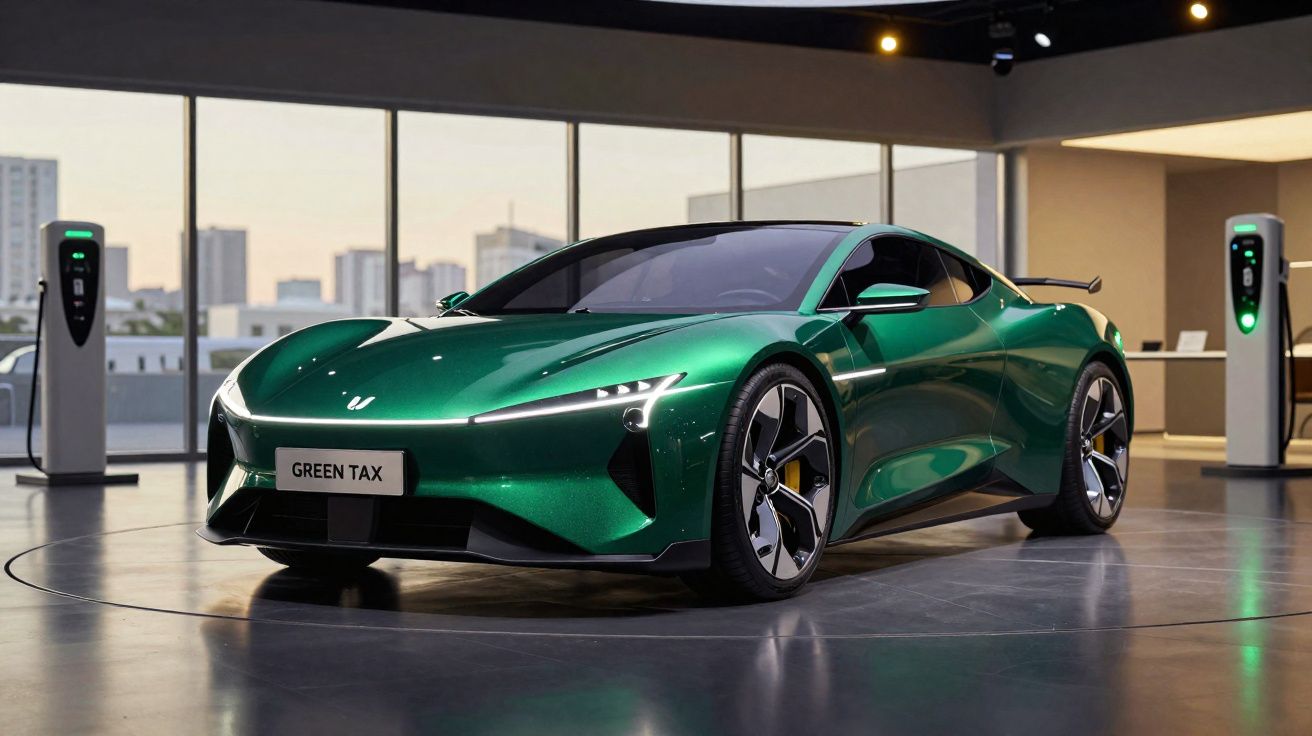
A man in his mid‑50s stood in front of me. Company car. Brand‑new electric vehicle. Beside us, an older diesel clattered away; its driver had only popped in to buy some bread rolls and looked perfectly content. We got talking. The EV driver ran through grant forms, the cost of fitting a home wallbox charger, and electricity prices that keep creeping up. Then he said, almost under his breath: “Sometimes I wonder whether I’ve brought an expensive trap home with me.”
Over the past few months I’ve heard variations of that line again and again-from neighbours, colleagues, and in readers’ emails. The mood is shifting: quietly, but unmistakably. And, of all years, 2025 could be when many motorists get a proper reality check.
Electric cars and the green tax trap: why 2025 becomes a reality check for drivers
Anyone thinking about a new car today can hardly avoid the language of a “green future”. For years it sounded straightforward: incentive schemes, bonuses, favourable company‑car tax treatment-almost a free pass into the electric age. In 2025, that confidence could be pulled sharply back to earth. More and more commentators are talking about a “green tax trap” that is tightening slowly, but steadily.
Most of us recognise the feeling: you make what seems like the safe, virtuous choice-for the climate, for the future, for cleaner towns and cities. Then the rules of the game change. Taxes rise, incentives disappear, electricity becomes more expensive. All of a sudden, the old internal‑combustion cars don’t look like dinosaurs; in some scenarios they start to resemble the quiet winners of a complicated, hard‑to‑read system.
In industry discussions, people talk about this in lowered voices. One recurring scenario is particularly unsettling: petrol and diesel models becoming relatively more attractive from a tax and fixed‑cost point of view, while EV owners carry higher standing charges. It sounds backwards. Yet the numbers being discussed for the period from 2025 onwards are enough to make plenty of advisers genuinely uneasy.
From incentives to everyday costs: how the sums have changed
Picture a typical family outside a city: two children, a house, one car. Two years ago, there was a €6,000 environmental bonus, plus regional help towards a wallbox and sometimes even a contribution from an employer. Electricity was noticeably cheaper; public charging often felt like a bargain. Now the arithmetic looks different. Most incentives have largely gone, electricity prices swing unpredictably, and rapid charging on long motorway runs can cost almost twice what it did in 2021.
On top of that, some cities are openly considering higher fees for public parking bays with charging. What began as support can morph quickly into something that feels like an extra levy. Meanwhile, the diesel driver next to you may pay plenty at the pump, but has no wallbox installation bill, no recurring fees for charging apps, and no charging subscriptions. And if Vehicle Excise Duty (car tax) for modern combustion cars in certain segments doesn’t rise as sharply as many assumed, the comparison becomes far more interesting.
A particularly pointed example that consultants often raise is company fleets. For years, EVs were a tax gift for company‑car drivers: a lower benefit‑in‑kind charge, attractive leasing deals, and a pleasingly green image. Yet several scenarios being modelled in ministries and think tanks involve a gradual winding back of those advantages from 2025. Turn two or three dials-and a modern plug‑in hybrid, or even a very efficient diesel, can suddenly look more cost‑effective than a fully electric company car.
Why governments may “rebalance” the system
From a government perspective, the logic is almost unavoidable. Revenue from fuel duty and car taxation is enormous. As more people switch to electric, a chunk of that income shrinks. So policymakers look for other levers: electricity taxation, network charges, road pricing, city charging zones, parking fees. This is where the green tax trap starts to bite. What begins as a reward can end up as a new cost line-neatly packaged, but a cost line all the same.
The colder, structural truth is that EVs are not only an environmental project; they are also a vast tax and infrastructure project. Every kilowatt‑hour that goes into a battery has to move through the grid, through businesses, and-eventually-through new charging and pricing models. If 70% or 80% of the vehicle fleet is electric one day, these cars are unlikely to remain permanently privileged. Otherwise there is less money for roads, bridges and power networks. So adjustments get made elsewhere-and by the time you reach the horizon of 2025, that possibility becomes harder to ignore.
Two overlooked pressure points: resale values and charging access
One aspect that is increasingly hard to sidestep in a proper cost calculation is resale value. A car’s depreciation can outweigh surprisingly large swings in energy costs. If incentives fade and buyers become more cautious-especially about older battery technology-second‑hand prices can become less predictable. That matters whether you buy outright or lease: the whole deal is built on assumptions about what the car will be worth later.
Charging access is the other quiet divider. A private driveway with a wallbox and a sensible home tariff is a completely different world from relying on public rapid charging, app memberships and pricing that can change overnight. Two households can own the same model and experience radically different running costs-simply because one charges mostly at home and the other does not.
What to do if you’re choosing a car in 2025
All of this sounds gloomy, but it does not mean you should bury the EV dream in a panic. If you’re making a decision now, you need less ideology and more calculator.
First: total up the real costs properly. Not just list price and any incentives, but also insurance, servicing, your electricity tariff, and possible future parking and road‑pricing charges. Many motoring organisations now offer online calculators that at least give a sensible ballpark. Often, the gap between an efficient combustion car and an incentivised EV is smaller than marketing brochures suggest.
Second: look at your daily routine with brutal honesty. If you mostly do short trips, have a fixed parking space with your own wallbox, and rarely need long motorway stretches, an electric car can still work well even if the green tax trap tightens. It is very different if you depend on public chargers, drive long distances for work, or live in an older building with no reliable off‑street parking. In those cases, a hybrid-or even a highly efficient combustion model-can be the calmer financial choice for years.
A common mistake in this debate is letting moral pressure do the thinking. One side says: “Everyone’s going electric; I can’t be left behind.” The other says: “I won’t be pushed into a green corner; I’ll drive my diesel until it falls apart.” Reality sits between those camps. The plain truth is: nobody else will do your cost calculation for you-not politicians, not dealers, not influencers.
Two misconceptions also keep coming up. The first: “If today’s incentives have ended, new programmes will definitely replace them.” Maybe. Maybe not. Many households are currently planning around money they do not actually have guaranteed, which is risky. The second: “Electricity will definitely get much cheaper again.” It could, but it could also go the other way. The energy transition, grid upgrades and CO₂ pricing can all push electricity costs upwards. Do not anchor your decision to optimistic promises about the future if your budget is already stretched today.
Realistically, almost nobody spends their Sunday evening building a 10‑year total cost of ownership forecast for a family car. Let’s drop the pretence that ordinary households plan like that. Still, one afternoon with paper, pen and a few realistic assumptions can be worth it-not to find the perfect answer, but to spot the obvious traps before they snap shut.
“We’re watching a quiet shift-from a subsidised ‘car of the future’ to a normally taxed everyday product,” warned a mobility expert I spoke to recently. “Anyone who assumes in 2025 that the state will simply keep rewarding them could be in for a nasty surprise.”
So what does this mean in practical terms if you’re weighing up options in 2025? A handful of points come up repeatedly:
- Expect higher electricity prices at rapid chargers-not only fuel gets more expensive.
- Assume fewer direct purchase subsidies and more hidden incentives or conditions.
- Plan to keep your car longer than you might have in the past, especially with battery life in mind.
- Factor in possible future city charges, access restrictions and parking fees.
- Compare company‑car tax treatment for combustion, hybrid and electric models very carefully.
We are approaching a threshold where the whole promise of “cheap green driving” gets rearranged. The combustion engine may not become the hero of the road again. But in certain situations it could turn into the financially smarter underdog-and yes, that rubs against the story many of us have been sold for years.
The more you talk about it, the clearer it becomes: plenty of people are thinking the same thing; they just hesitate to say it out loud. Perhaps 2025 is the year we stop asking only “What is ecologically right?” and also ask, just as seriously, “What is economically honest?” Those answers will not always match. And that is where the most interesting conversations begin-at the supermarket car park, among friends, and around the family table.
| Key point | Detail | Added value for the reader |
|---|---|---|
| Green tax trap | Loss of incentives, new charges on electricity and infrastructure | Spot early that EVs may become less tax‑privileged |
| Cost reality 2025 | Rising electricity prices, possible changes to company‑car tax and Vehicle Excise Duty | Build a realistic total‑cost picture instead of relying on old advantages |
| Individual usage profile | Differences between kerbside parkers, commuters, family cars and company cars | Choose the right powertrain rather than following a trend blindly |
FAQ
Question 1: What exactly do experts mean by “green tax trap”?
Answer 1: It refers to the risk that technologies currently supported or tax‑favoured-such as electric cars-can later become less attractive financially through new taxes, charges or withdrawn advantages, while combustion cars can appear cheaper in relative terms in some areas.Question 2: Is an electric car still worth it in 2025?
Answer 2: For many commuters with their own charging at home, yes-particularly with lots of city driving and shorter trips. If you do frequent long distances or rely on expensive rapid charging, you should seriously include combustion and hybrid options in your calculations.Question 3: Are incentive schemes for electric cars really “gone for good”?
Answer 3: Nobody can guarantee that new schemes will not appear. What is clear is that the broad, generous purchase bonuses of recent years are largely over; future support is likely to be more selective and tied to stricter conditions.Question 4: Can combustion cars still be newly registered after 2035?
Answer 4: At EU level, a phase‑out of new combustion‑engine cars from 2035 has been agreed, with exceptions for e‑fuels. This does not apply to used cars: they can continue to be driven and traded, which could increase their appeal as a “long‑term solution”.Question 5: How can I protect myself in practical terms from the “green tax trap”?
Answer 5: Don’t decide on instinct-run different scenarios, prefer flexible finance options, track political changes, and plan your next car so you are not completely dependent on a single technology if the rules shift.





Comments
No comments yet. Be the first to comment!
Leave a Comment