
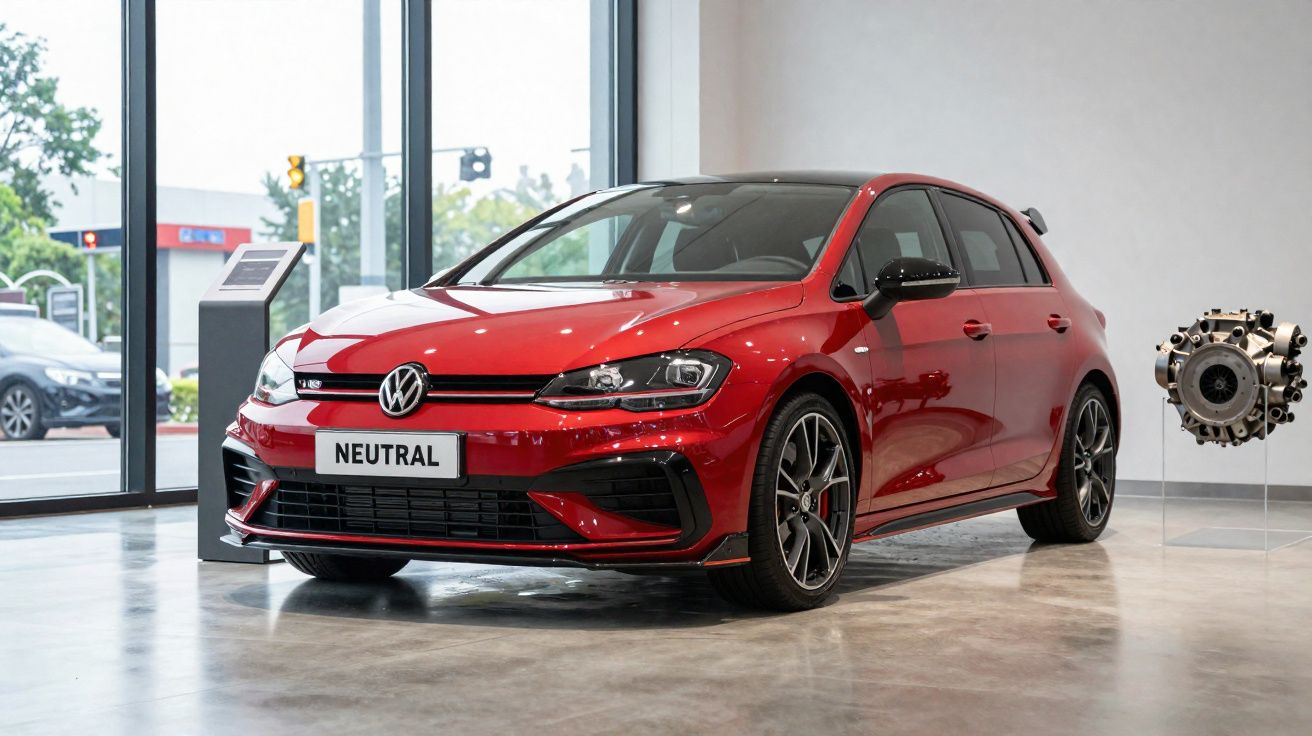
You’re sitting at the lights, almost without noticing it: fingers drumming on the steering wheel, one foot half irritated, half impatient on the clutch. In the lane beside you an older Golf waits too, but the scene inside looks different-driver leaning back, right arm relaxed, gear in neutral, both feet resting on the floor. His car seems calm. Yours gives a faint tremor, as if it’s itching to launch.
These are the seconds that stretch like chewing gum-seconds in which your car quietly takes a hit. And your wallet with it. Because those unremarkable moments at a red traffic light often decide how long the clutch, the gearbox and your own nerves last. The red phase becomes a small test of character.
What really happens to your car at a red traffic light (clutch and gearbox)
Many drivers feel “ready” and efficient when they wait with the clutch pressed and first gear selected. One hand stays on the gear lever, eyes fixed on the amber, engine humming away at idle. It’s so automatic that most people never stop to think about what’s happening in the mechanics underneath.
Yet this everyday pause is like a sneaky strength workout for components that didn’t sign up for it. The clutch is kept under constant load, the release bearing runs continuously, and parts keep working-just so you might pull away half a second sooner.
And that’s exactly where the invisible wear starts: you won’t notice it until it becomes expensive.
The pattern becomes obvious if you simply watch a busy junction for an hour. In one ADAC spot check in Munich, around two thirds of drivers waited at red with the clutch pressed and first gear engaged. Only a minority selected neutral and rested their hands comfortably on the steering wheel.
A workshop manager in Cologne once told me many city drivers see clutch problems before they even reach 100,000 km. He can often hear it in the way people describe their routine: “I drive mostly in town, I’m always stopping at lights.” And, almost without fail, they admit they “sometimes just stay in first while waiting”. That habitual traffic-light routine quietly writes the invoice for a future garage visit.
From a technical point of view, it’s surprisingly straightforward. If you keep a gear engaged and hold the clutch down, the release mechanism keeps pressing against the clutch spring. The release bearing has to spin the whole time, which accelerates wear. At the same time, the gearbox is effectively kept under load even though the car isn’t moving.
If, instead, you select neutral and release the clutch, the system relaxes. Less mass is being dragged around, bearings and springs get a chance to “breathe”. It may sound dry, but you’ll feel it in your bank account: a clutch replacement can easily run into four figures in euros. A small habit at red traffic lights helps stop those costs arriving years earlier than they should-one red phase at a time.
A simple red-traffic-light routine that noticeably reduces clutch wear
You can boil the gentler method down to three clear steps:
- Approach calmly: As you roll towards a red traffic light, lift off the accelerator early and brake smoothly.
- Just before stopping: Press clutch and brake together, then, as the car comes to a halt, select neutral.
- While waiting: Take your foot off the clutch and rest it beside the pedal. Hold the car with the footbrake or the handbrake. Only when you can see it’s about to move again-amber showing, or traffic clearly starting-press the clutch, select first gear and pull away with control.
Yes, it may add roughly half a second to your reaction time. Mechanically, though, it’s a small wellness treatment for the clutch and release bearing.
It’s also normal to feel slightly uneasy at first. The thought is hard to shake: “If I’m in neutral, I’ll be slow off the line and the driver behind will immediately beep.” We all know that moment-someone fills your mirror with impatience before the lights even change.
But in real-world driving, there’s virtually no practical time difference between “staying in gear” and “selecting gear at the right moment”. What actually wastes time is hesitation and distraction, not selecting neutral. And nobody gets it perfect every single day-sometimes you’re tired, sometimes you’re thinking about something else. Even so, building the habit of selecting neutral at red traffic lights shifts the load on your car decisively in a healthier direction, even if you manage it only 70% of the time.
A driving instructor in Berlin put it to me very bluntly:
“The clutch isn’t a holding pedal. If you wait on it, you’ll pay twice later-once in stress, and once in money.”
To make sure the intention survives everyday life, it helps to run a short mental checklist until it becomes automatic:
- Seen red? Watch the traffic flow, not just the bumper in front.
- Coast in smoothly-don’t rush to the line and brake hard.
- Just before you stop: clutch + brake, then straight into neutral.
- Foot off the clutch, relax your leg, leave the gear lever alone.
- As it changes: clutch first, then gear, then pull away progressively.
After a few days, many people notice something unexpected: their driving feels calmer, their body less tense, and the engine less frantic. That’s the point where driving becomes a little less stress and a little more deliberate routine.
Extra considerations for your clutch at red traffic lights: hills, heavy traffic, and modern systems
Two practical situations are worth adding. On inclines, using the handbrake while waiting can be especially helpful: it stops the car rolling without you balancing the clutch, and it reduces the temptation to “hold” the car on the biting point-one of the fastest ways to generate heat and wear. When it’s time to move, release the handbrake as you take up the bite and drive away smoothly.
And if your car has stop-start, the same principle still applies: selecting neutral and releasing the clutch (or following the manufacturer’s stop-start procedure) typically helps the system do its job properly. What you want to avoid is prolonged waiting with the clutch pressed, because the mechanical load remains even if everything else feels “at rest”.
What red traffic lights reveal about the way we drive
These tiny scenes at the lights say a lot about our day-to-day mindset. If you’re hanging on the clutch with a stiff ankle, you’re signalling-at least to yourself-“I need to sprint at any moment; I can’t afford to lose time.” If you select neutral, breathe once and simply wait, you’ve chosen a different pace for a fraction of a minute.
That attitude carries through the whole car: into wear, into fuel use, into the mood inside the cabin. Red phases are compulsory pauses in modern traffic, whether we like them or not. You can swallow them as irritation-or you can turn them into a routine that saves you hundreds of euros over time.
| Key point | Detail | Benefit to you |
|---|---|---|
| Select neutral at the lights | Engage neutral, release the clutch, hold the car with brake or handbrake | Reduces load on the clutch and release bearing, noticeably extending service life |
| A deliberate traffic-light routine | Early coasting, calm stop, relaxed pull-away | Less stress, smoother driving, less wear in city traffic |
| The “faster start” myth | Leaving it in gear gains almost no time, but increases load | Removes pressure, builds confidence, without being the “slow driver” |
FAQ
Does it harm the clutch if I wait at the lights in first gear with the clutch pressed?
Yes. It continuously loads the release bearing and the clutch mechanism. A brief pause isn’t an issue, but frequent and prolonged waiting in that position accelerates wear.How long does a red phase need to be for neutral to be worthwhile?
Many professionals suggest that from roughly 5–10 seconds of standing still, selecting neutral is worthwhile. In practice, most red phases are longer than that-so it’s almost always a win.Does this apply in stop-start queues and crawling traffic jams?
Yes. In slow-moving traffic, it helps not to creep forward metre by metre. Leave a little space, roll up smoothly, and when you do stop briefly, select neutral rather than holding the clutch down.Will this method save fuel as well?
Slightly, yes. The main effect is not fuel consumption but protecting the mechanics: less pressure on the clutch and less internal friction. Over time, that’s a double benefit.Is the handbrake better than the footbrake while waiting?
For longer red phases, the handbrake can be more comfortable. It rests your right leg and avoids holding the brake pedal down continuously-which is more pleasant and, at night, stops your brake lights dazzling drivers behind you.
Comments
No comments yet. Be the first to comment!
Leave a Comment