
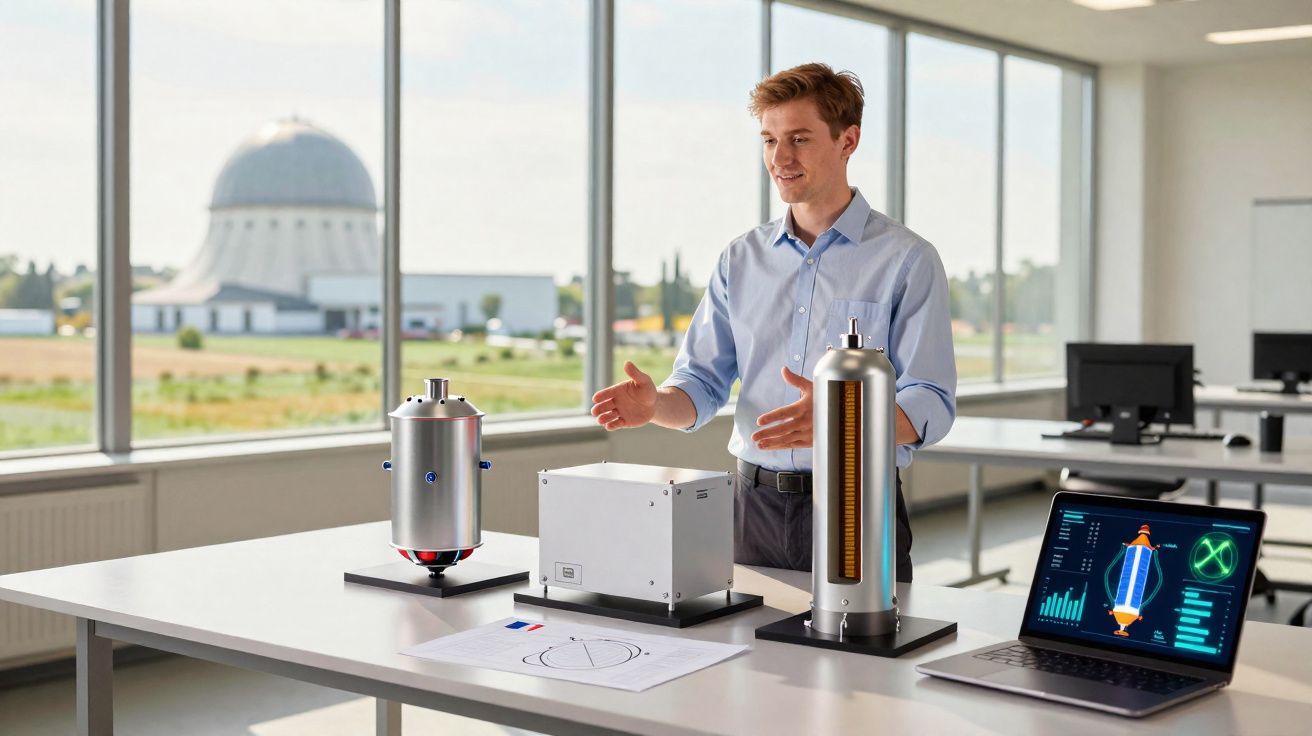
In the space of a few months, three young firms have carried their small and advanced reactor proposals from pitch decks into the formal gaze of France’s nuclear regulator, a notable burst of momentum in a field that has spent years answering sceptics.
Three challengers under ASNR scrutiny: a new chapter for French nuclear
From late 2025 onwards, France’s nuclear landscape has started to shift. Alongside the established industrial heavyweights, new entrants are now moving beyond ideas and submitting full technical files to the Nuclear Safety and Radiological Protection Authority (ASNR), the national body formed by consolidating earlier oversight organisations.
Three names are leading this new wave: newcleo, Stellaria and Jimmy Energy. Each is pursuing a different kind of SMR or AMR, with distinct end-users and development calendars. What they have in common is that they are now facing direct, detailed examination by one of Europe’s most exacting nuclear regulators.
The fact that three advanced reactor projects have landed on the ASNR’s desk is the strongest indication in years that French nuclear ambitions are moving from rhetoric to detailed engineering.
Two of the companies-Stellaria and Jimmy Energy-have already filed a DAC (Creation Authorisation Application). That step is consequential: if granted, it effectively turns the applicant into a nuclear operator, locking in a defined design and placing full, long-term legal responsibility for safety on the licence holder for the entire life of the installation.
newcleo has opted for a slightly different entry point. Before a full construction request, it has delivered an in-depth nuclear safety programme for its lead‑cooled fast reactor, initiating a structured technical exchange with the ASNR while parts of the design remain adjustable.
newcleo’s lead‑cooled fast reactor plan: Generation IV ambitions and recycled fuel
A start-up with unusually substantial funding
Founded in 2021 by Italian nuclear physicist and former CERN researcher Stefano Buono, newcleo has set itself a demanding goal: bring fast reactors back, but in a way that aligns with modern expectations on regulation, transparency and public acceptance.
Although the company has Franco‑Italian roots, it is headquartered in Paris. Since launch it has attracted more than €500 million from private European investors-an exceptionally large capital base for a young civil nuclear enterprise.
That funding is being deployed across several tracks at once: engineering work on the LFR‑AS‑30 and the larger LFR‑AS‑200 lead‑cooled fast reactors, preparation for a fuel manufacturing plant, and a sizeable experimental programme in Italy. The company’s stated aim is to submit a DAC in France by 2027, with a first modular reactor potentially operating around 2031 at the Chinon site-subject to a public debate and the necessary regulatory approvals.
Why liquid lead and fast neutrons matter
The newcleo concept sits within the Generation IV family. Instead of using water as the coolant, the reactor relies on liquid lead, and the core is driven by fast neutrons.
Key characteristics presented as safety advantages include:
- Atmospheric-pressure coolant operation, which lowers the likelihood of failures associated with high-pressure systems.
- A very high boiling point, providing generous temperature margins.
- High thermal inertia, which supports passive heat-removal strategies if active equipment is unavailable.
These properties underpin the safety justification now being assessed. The file provided to the ASNR describes behaviour during routine operation, during transients such as rapid shutdowns, and in degraded conditions. It also addresses post-shutdown heat removal and the means by which the core remains controllable and contained in severe situations.
At the centre of the newcleo proposition is a two-part promise: reliable low‑carbon electricity and a credible route to reducing the long-term burden of high‑activity waste.
A reactor concept built around advanced fuel
newcleo’s strategy tightly couples reactor design to the fuel cycle. In late 2024, it separately submitted a safety programme for a plant intended to manufacture advanced fuel, including MOX and recycled materials derived from existing spent fuel.
A key local milestone has already been secured: the Aube department has approved the sale of land for a MOX fuel facility valued at roughly €1.8 billion, expected to support around 1,700 direct jobs. The facility is intended to supply the lead‑cooled reactors and enable a multi‑recycling approach-treating certain high‑activity material streams as inputs for future fuel rather than consigning them to long-term storage.
Crucially, the regulator is not treating the reactor and the fuel plant as separate, unrelated dossiers. This combined assessment will influence the final safety view transmitted to the relevant ministry before any construction licence can be issued.
Data-led development: Italy’s test work and the PRECURSOR mock-up
Rather than relying mainly on modelling, newcleo is building its case around experimental results. At the ENEA Brasimone Research Center in Italy, 16 research installations are operating or under construction, examining fluid dynamics, materials performance and thermal behaviour under representative conditions.
In parallel, the company is developing PRECURSOR, a full-scale, non-nuclear mock-up rated at 10 MW thermal, producing roughly 3 MW of electricity. It contains no nuclear fuel and generates no fast-neutron flux. Its purpose is practical: to observe how pumps, heat exchangers, control systems and power conversion perform before any radioactive material is introduced in an operating plant.
Findings from Brasimone and PRECURSOR are intended to reduce uncertainty in the models used in the safety case-providing the ASNR with measured evidence rather than purely theoretical assurances.
A French proving ground for wider deployment
For Buono’s team, navigating the French process is not merely a domestic requirement. The ASNR is known for demanding detailed substantiation; securing acceptance in France could offer newcleo a robust reference framework to discuss with regulators elsewhere in Europe and beyond.
In addition, France’s National Commission for Public Debate (CNDP) is due to run a mandatory public consultation on the project in 2026. That stage will test not only the engineering narrative, but also the company’s ability to answer concerns about safety, waste, and local impacts.
Stellaria and Jimmy Energy: two contrasting routes to “small” nuclear
Three reactors, three strategies across the SMR and AMR market
While newcleo pursues fast reactors with an emphasis on recycling and long-term system change, Stellaria and Jimmy Energy are aiming for faster or more specialised industrial applications. All three sit in the SMR/AMR space, but their technical choices and target customers differ markedly.
| Company | Reactor name | Technology | Coolant | Approximate power | Main use | Timeline |
|---|---|---|---|---|---|---|
| Stellaria | Alvin | Fast reactor | Molten salts | Dozens of MW | Electricity and industrial heat | Prototype around 2030 |
| Jimmy Energy | JIMMY | Micro‑reactor | Helium gas | A few MW thermal | Low‑carbon process heat | Phased deployment in the late 2020s |
| newcleo | LFR‑AS‑30 / 200 | Fast reactor | Liquid lead | 30 MW then 200 MW | Grid power and fuel recycling | Early 2030s |
Stellaria’s Alvin uses molten salts as the coolant, enabling high-temperature operation without high-pressure water circuits. The salt chemistry is presented as part of the overall safety approach, with a role in heat transfer and in managing fission products.
Jimmy Energy takes a different angle: a compact, helium gas-cooled micro-reactor designed primarily for industrial heat. The concept is to site small units near factories so they can displace fossil-fuel boilers-cutting emissions without necessarily supplying the public electricity grid.
French SMR developers are not converging on a single universal design; instead, they are targeting distinct segments of the energy economy, from industrial boilers to steady baseload generation.
What this so-called “golden age” actually signals for France
From standardised grid reactors to diversified nuclear services
For much of the past half-century, French nuclear meant large, standardised reactors delivering electricity to the national network. The emerging pipeline is broader. Some designs still prioritise grid supply, but others position nuclear as a source of industrial heat, hydrogen production, or even maritime propulsion-an option the United Kingdom is also actively exploring.
This diversification speaks to a wider European challenge: decarbonising heavy industry, not just power generation. High-temperature nuclear heat could replace natural gas in sectors such as chemicals, steel and cement. Smaller units located on or near industrial sites could provide consistent heat with a smaller physical footprint than traditional large-scale stations.
A practical constraint that often decides outcomes: sites, supply chains and skills
Beyond reactor physics, the prospects of SMR and AMR deployment in France will depend heavily on deliverability. Suitable sites must balance industrial demand, environmental constraints, water availability where relevant, transport access for large components, and community acceptance. At the same time, serial manufacturing ambitions require a resilient supplier base for specialist steels, qualified welds, instrumentation and control systems, and high-integrity civil works.
Workforce capacity is another limiting factor. Even with modularity, nuclear projects need experienced safety engineers, construction managers, quality assurance specialists and operators. If multiple programmes progress at once, competition for talent could become as decisive as the technology choices themselves.
Risks, trade-offs and sustained regulatory pressure
None of these reactor pathways is risk-free. Advanced designs rely on coolants and materials with far less operational history than conventional water-cooled reactors. Lead can corrode structural metals; molten salts require rigorous chemical control; and gas‑cooled systems must be engineered to avoid hot spots and to maintain predictable thermal behaviour.
This is exactly where the ASNR applies pressure: demanding long-term corrosion evidence, credible emergency heat-removal provisions, and robust arrangements for waste and novel fuel forms. Developers must demonstrate not only safe normal operation, but also that low-probability accidents remain manageable.
Commercial and reputational exposure is also significant. Schedules can slip as experimental results arrive, supply chains evolve, or public opposition intensifies. One prominent failure could colour perceptions of the wider SMR category among investors, industrial customers and host communities.
Key concepts behind the headlines
What is a DAC, and why is it pivotal?
A DAC (Creation Authorisation Application) is, in effect, the legal starting point for a French nuclear installation. To submit it, a developer must lock down the design, provide a comprehensive safety demonstration, evaluate environmental impacts and set out plans for waste management.
Once filed, the dossier triggers intensive review by the ASNR, consultation with other public bodies and-when relevant-a structured public debate. Approval does not mean construction begins immediately, but it does indicate the project has crossed a major legal and technical threshold.
Fast reactors, SMRs and public perception
Labels such as “fast reactor” and “SMR” can sound unfamiliar-and for some people, unsettling. Put simply, a fast reactor uses higher-energy neutrons, which can fission not only conventional uranium fuel but also certain components of long-lived waste. An SMR is a smaller-than-traditional reactor, often designed for factory-style manufacture and delivery by road or ship.
Advocates argue that fast reactors and SMRs can reduce waste, strengthen safety margins and lower construction risk through repeatable modules. Critics raise concerns about proliferation, lingering questions around waste, and the possibility of optimistic promises on cost and delivery dates.
France’s emerging “golden age” sits precisely at that junction: big expectations, stringent regulation, substantial investment, and a public with a long memory of nuclear debate. Whatever the eventual outcomes, the fact that newcleo, Stellaria and Jimmy Energy are now pushing through the regulator’s front door marks a clear turning point in the country’s energy trajectory.


Comments
No comments yet. Be the first to comment!
Leave a Comment