
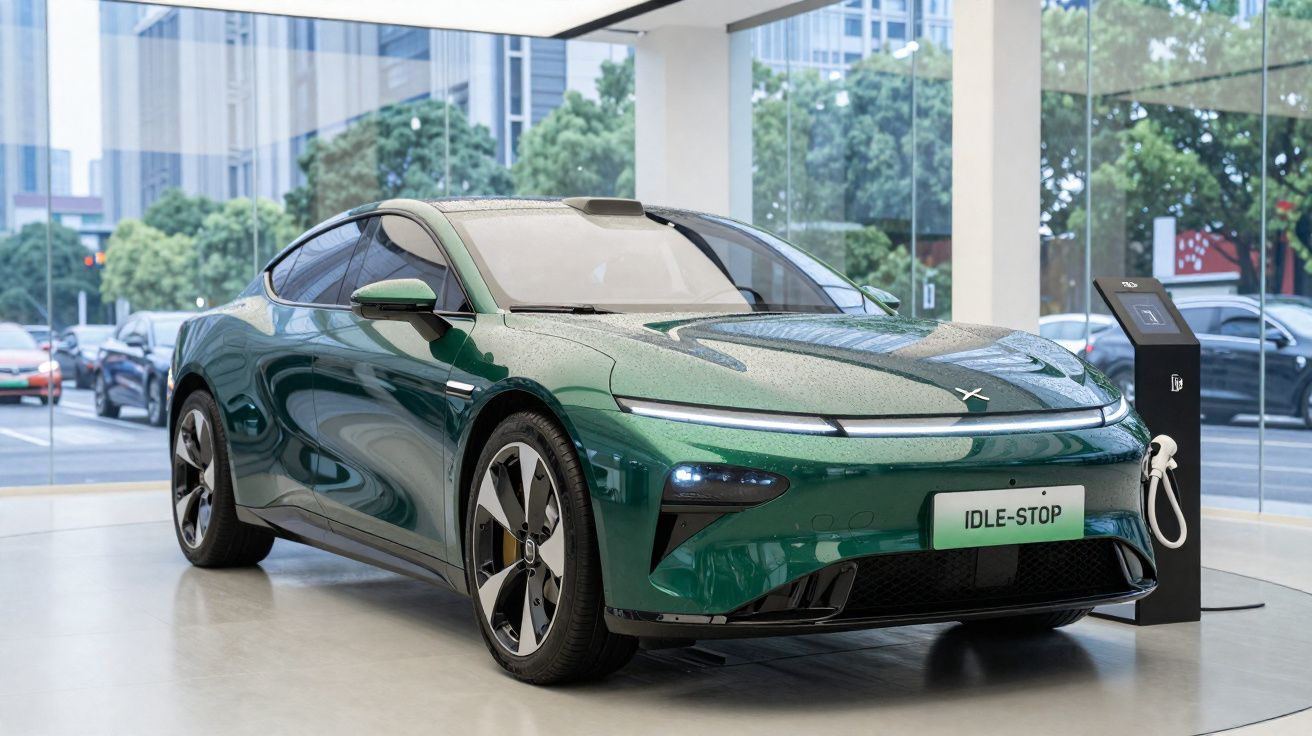
Some motorists enjoy the hush when the engine cuts out at the lights. Others hit the off switch out of habit the moment they set off.
Car makers promote idle-stop (often labelled start-stop) as a straightforward way to lower fuel use and CO₂ without altering your driving style. The sales pitch is tidy; the real-world benefit depends heavily on where you drive, how often you come to a halt, and how long you typically sit stationary.
What a start-stop (idle-stop) system actually does
An idle-stop system shuts the engine down when the vehicle is stationary, then restarts it as you pull away. Crucially, the car’s electrics remain powered: lighting, power steering assistance, airbags, infotainment, and heating and cooling continue to operate.
Exactly how it activates depends on the transmission:
- Manual gearbox: you’ll generally select neutral and release the clutch for the engine to stop, then press the clutch to trigger a restart.
- Automatic gearbox: firm pressure on the brake usually prompts shutdown; easing off the brake restarts the engine. The transmission separates drive from the engine so it doesn’t stall.
In urban driving, independent testing from European motoring organisations commonly suggests around 10–15% lower fuel consumption with idle-stop operating.
That spread largely comes down to stop frequency. Lots of short, repeated halts can add up to meaningful savings. Long motorway stretches offer very little benefit because you spend almost no time at a standstill.
How much money are we talking about?
To put the claim on a firmer footing, here’s a worked example using broadly typical use.
A petrol car averaging about 7.8 L/100 km and covering roughly 12,550 km per year (about 7,800 miles) will use close to 980 litres of fuel annually. If idle-stop reduces fuel use by 10–15% in stop-heavy driving, that can equate to roughly 100–150 litres saved over a year (depending on how urban your driving is).
At around £1.45 per litre, that works out at roughly £140–£210 per year.
Your own result could be lower or higher: lots of city queues and junctions will push savings up, while a rural or motorway-heavy routine will pull them down.
| Scenario | Typical time spent idling | Potential fuel saving | Illustrative cash (at ~£1.45/L) | Notes |
|---|---|---|---|---|
| Urban commute | 15–25% | 10–15% | ~£140–£210/yr | Frequent lights, congestion and queues |
| Suburban mix | 8–12% | 5–8% | ~£70–£115/yr | Moderate stop frequency |
| Mostly motorway | 2–4% | 0–3% | ~£0–£45/yr | Few stationary periods |
Assumptions: ~12,550 km/year, ~7.8 L/100 km, and £1.45/L. Swap in your own annual distance, real-world consumption and local pump price to tailor the estimate.
Why the system sometimes doesn’t cut in
Idle-stop won’t necessarily operate at every stop. The control software constantly weighs battery condition, cabin comfort, and safety requirements. If it decides switching off would be marginal, it will keep the engine running.
Common reasons include:
- Low battery voltage or an ageing battery.
- Very cold or very hot conditions, especially with heavy heating or air conditioning demand.
- The engine not yet up to operating temperature.
- Steep hills or awkward parking angles.
- Signs you’re about to park (for example: seatbelt unfastened, door open, bonnet open, steering on full lock).
- Park assist or other driver aids actively operating.
- A trailer connected.
If the car judges that stopping the engine could affect comfort, safety, or emissions management, it will simply stay running.
Some vehicles also pause idle-stop during emissions-related events (such as diesel particulate filter regeneration) or when the 12V system needs additional charging.
Wear and tear: truth vs myth
A common worry-especially among drivers used to older cars-is that repeated restarts will rapidly wear out starters and batteries. In most modern vehicles, the components are designed specifically for frequent cycling. It’s normal to see reinforced starter motors, tougher ring gears, and AGM/EFB batteries rated for many more start cycles than traditional lead-acid units.
There is, however, a real trade-off: these upgraded batteries tend to cost more, and starter components can be pricier as well. Manufacturers design the car as a package, with service schedules and parts specifications intended to cope with the extra workload so that the fuel saving accrues over years rather than weeks.
If restarts begin to feel sluggish or hesitant, don’t force the issue-have the battery tested. A borderline 12V battery is one of the most common reasons a vehicle disables idle-stop on its own.
Emissions and air quality: the benefit beyond your fuel bill
While the pounds-and-pence saving matters, idle-stop is also aimed at reducing unnecessary tailpipe output when you’re stationary. Less time idling generally means less CO₂ overall, and it can also reduce local pollutants in slow-moving traffic where pedestrians and cyclists are close to exhaust outlets.
That said, the biggest environmental gains come when idle-stop is combined with smoother, more anticipatory driving-avoiding harsh acceleration, leaving a bigger gap in queues, and reducing stop-start surging that wastes fuel regardless of whether the engine cuts out.
Should you switch it off?
Many cars provide a dashboard button that disables idle-stop for the current journey. Some owners go further and attempt to remove it permanently, which can cause problems.
Germany’s ADAC has warned that permanently disabling factory idle-stop can affect a car’s operating approval and may create insurance complications after a collision.
Regulation and enforcement vary between markets, and insurance policies differ. If you’re considering any permanent modification, check both local rules and your insurer’s position. If you simply need the engine running for a short spell, the manufacturer’s built-in, temporary override is typically the safer option.
When a quick manual override makes sense for idle-stop
- Stop-and-creep congestion where pauses are under 3–5 seconds and you keep inching forward.
- Complex junctions or tight parking manoeuvres where instant throttle response feels more predictable with the engine running.
- Severe cold if you’re relying on engine heat for demisting and the windows keep misting up.
- A steep hill start if you’re still learning how the vehicle’s hill-hold and clutch/brake calibration behave.
A practical rule of thumb: if you expect to be stationary for more than about 10 seconds, switching the engine off usually saves fuel. Under that, the advantage tends to shrink.
Getting the most from idle-stop
Small habits can improve how consistently the feature works and reduce the chances it drops out unexpectedly.
- Look after the 12V battery. Repeated short journeys can leave it undercharged; add the occasional longer run or use a smart charger in winter.
- Use recirculation in hot weather. The cabin cools more quickly, so the engine is more likely to stay off for longer at stops.
- Go easy on high-draw accessories while stationary. Maximum fan speed, heated seats and the rear screen heater all add electrical load.
- Service on schedule. Clean oil and correctly functioning sensors support quick, smooth restarts.
- Combine it with eco-driving. Anticipate traffic lights, leave space, and lift off earlier to reduce unnecessary stopping.
What about hybrids and 48-volt systems?
Mild hybrids build on idle-stop using a stronger starter-generator and a small battery pack (often a 48-volt system). They can shut the engine down earlier, restart more seamlessly, and give a little assistance on pull-away. In town, that typically increases the overall saving without changing how you refuel or charge day to day.
Full hybrids go further still: they can move off using electric power and keep the engine off at low speeds for longer periods. If most of your time is spent in urban traffic, these systems raise the ceiling on what basic idle-stop can achieve.
A quick pocket calculation you can try
- Take your annual distance in kilometres (or convert from miles).
- Multiply by your average consumption in L/100 km, then divide by 100 to estimate yearly litres used.
- Estimate your urban share (for example, 0.5 for “half my driving”).
- For a cautious estimate, apply 10% saving to the urban portion; for a more optimistic estimate, apply 15%.
- Multiply the litres saved by your local price per litre.
Example: 16,000 km/year at 7.3 L/100 km uses about 1,168 litres. If roughly 50% of your driving is urban and idle-stop saves 12% in that portion, you save about 70 litres in a year. At £1.55/L, that’s roughly £109 not spent idling at red lights.

Comments
No comments yet. Be the first to comment!
Leave a Comment