
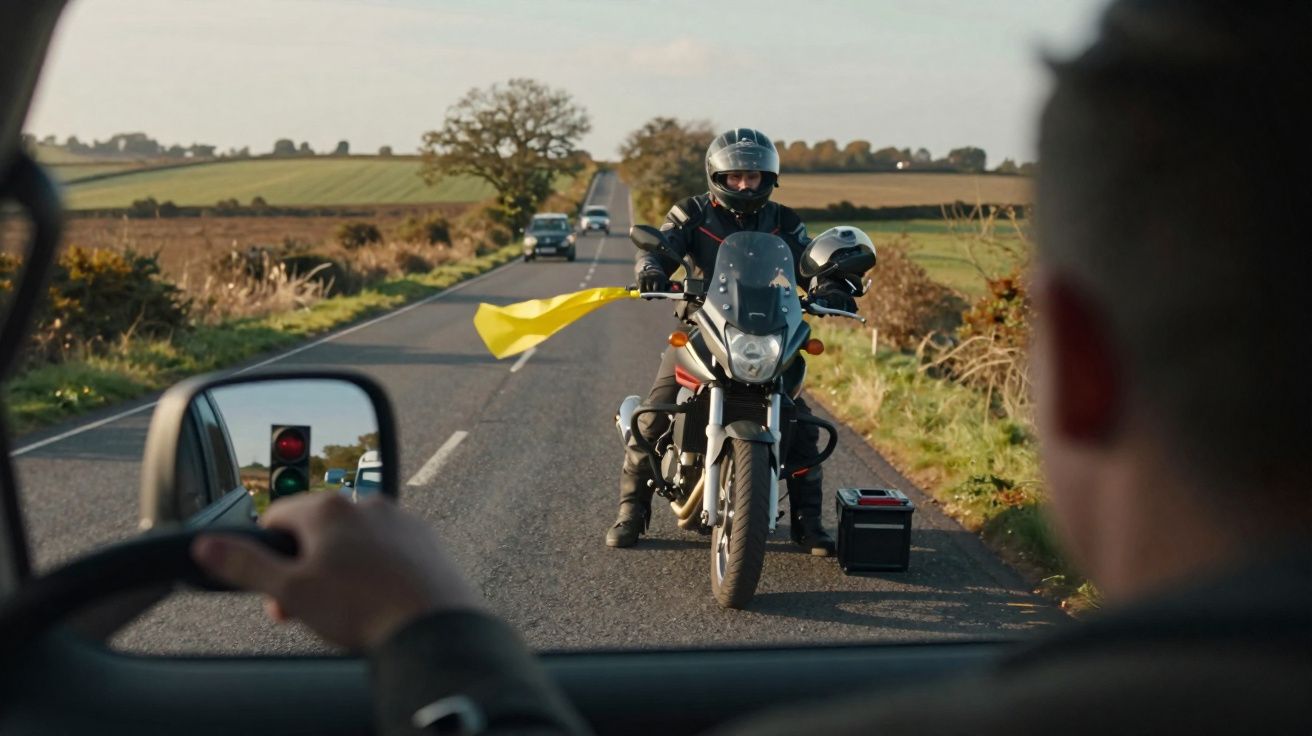
You’re waiting at a red light, half-listening to your playlist, when a motorbike edges up alongside. The rider’s gloves look well-used, his jacket is dusted with road grime, and on the right handlebar a small yellow rag flickers in the airflow. It isn’t a stylish add-on. It isn’t a brand colour. It’s simply a faded square of yellow cloth, tied off with an ordinary knot, twitching with every tiny roll of the throttle.
It makes you pause: is that just a bit of fabric somebody forgot to remove, or is it a message you’re meant to notice?
The lights change. The rider accelerates away. The yellow rag vanishes into the flow of traffic.
That brief flash of colour often carries more meaning than you’d assume.
What a yellow rag on a motorbike really says to those who understand
Out on the road, riders communicate in a language of small, wordless cues: a boot dropped slightly off the peg, a quick nod, a brief flick of high beam. In that world of micro-signals, a yellow rag tied to a handlebar can act as a quiet, unofficial code. It doesn’t demand attention like hazard lights or a horn. It just sits there in the wind, implying that something about this bike or this journey isn’t entirely “standard”.
To a driver who’s never come across it, it can look like a makeshift decoration. To many riders, it reads more like a discreet request: give me a little room, a little time, and a bit of patience.
One evening on a ring road outside a large European city, I found myself behind a small 125 cc motorcycle heavily loaded with luggage and piloted by a visibly tense rider. On his right handlebar, a yellow strip of cloth fluttered like an anxious flag. He pulled away cautiously, and in bends his line wavered slightly. Lorries swept past, pushing long gusts of air towards him; each time, I watched his shoulders tighten.
At the next service station we ended up parked next to each other. He caught me glancing at the rag and offered a lopsided smile. “First long trip,” he said. “I tied the yellow thing on so people don’t get annoyed if I’m a bit slow.”
It wasn’t an official marker and it wasn’t written down anywhere, yet it still influenced how some other road users behaved around him.
Across different regions and rider circles, the yellow rag can carry slightly different meanings. Some people use it to hint at a mechanical issue that doesn’t completely stop the ride-weak brakes or a clutch that’s playing up, for instance. Others tie one on when they’re carrying something fragile or awkwardly balanced. A few learner riders adopt it as a stand-in “L” plate when the proper sign is missing or damaged.
What matters most isn’t a universal rule carved in stone. It’s the intention: a simple, visible signal that effectively says, “Today my riding may be less predictable-please leave me a bit of margin.” For anyone who lives on two wheels, that margin can be the difference between a fright and a collision.
A UK note on the yellow rag and official signals
In the United Kingdom, learner riders are expected to display proper L-plates where required, and roadworthiness rules still apply regardless of any informal signals. A yellow rag doesn’t replace legal requirements, nor does it grant priority-it’s closer to a courtesy note to other road users. If you ever see one, treat it as a hint to expect slower pull-aways, gentler cornering, or an unusual load, rather than as a formal instruction.
How riders use this low-tech signal - and when it really counts
The “system” is almost comically simple. A rider takes a strip of yellow cloth-roughly handkerchief-sized-and ties it securely around the end of a handlebar, most often on the right. It needs to be short enough not to snag, yet long enough to stay noticeable as it flaps in the wind. Some riders cut a piece from an old T-shirt; others use an emergency bandana they keep under the seat.
The colour choice isn’t random. Yellow is easy to spot in traffic, it catches peripheral vision, and it’s widely associated with caution and attention. In a world where everything rushes by at 80 km/h, it functions like a tiny, improvised high-visibility marker.
The common misunderstanding is assuming it’s “just for show”. For a novice, that strip of cloth can feel like a kind of psychological armour: I’m still learning-please don’t sit on my rear wheel. For a delivery rider whose top box isn’t quite secure, it’s a warning that the bike might react unpredictably over a pothole. For someone limping home on a partially repaired machine, it’s a polite admission that everything isn’t perfect.
Most people recognise that exposed feeling in traffic-the hope that the vehicle behind you will understand what you can’t shout through a helmet.
Some experienced riders laugh at the idea in public, but in private plenty admit they’ve resorted to a rag or even a piece of tape more than once.
“On a long trip through Spain,” says Marc, a rider with 20 years’ experience, “my rear brake started playing up. I could keep going, but I wanted drivers to think twice before tailgating me. I tied a yellow cloth to the handlebar. It’s not officially recognised, but other riders understood. It makes you feel less on your own.”
The thinking is consistent: be visible, be interpreted correctly, be given space. These are the main reasons riders give for using it:
- To flag a minor but genuine mechanical concern while continuing the journey.
- To indicate they’re learners, or out of practice after a long break from riding.
- To warn the bike is heavily loaded or slightly unstable, especially on long trips.
- To request gentler overtakes and a larger buffer from surrounding vehicles.
- To create a little breathing room in congested or aggressive traffic.
Reading these silent codes could change how you drive tomorrow
Once you spot it, it’s hard to ignore. The small yellow rag becomes like a subtitle in the film of traffic-an extra line of meaning above the engine noise and the smear of headlights. When a motorbike carrying that signal appears in your mirrors, it can reframe what you’re seeing: not merely “a motorbike”, but a person quietly asking you for an extra half-second of patience.
That small shift in perspective can change your whole tone behind the wheel.
This is where the idea matters to everyone, not only riders. If more car drivers recognised these tiny, unofficial signals, everyday traffic would feel less like a contest and more like shared space. A yellow rag doesn’t confer special rights and it doesn’t override the Highway Code. What it does is invite a sensible adjustment: leave a larger following gap, avoid sharp, close passes, and don’t use the horn simply because the rider takes an extra second to move off.
Honestly, nobody manages that perfectly every day. But on the occasions you do, you can feel the difference.
We often imagine road safety is all about big signage, flashing arrows and layers of regulation. The reality on the tarmac is more nuanced. People lean on micro-gestures, improvised conventions and low-tech solutions to reduce risk. The yellow rag is one of those grassroots inventions: unofficial, a bit scruffy, and unmistakably human.
It says, without speaking: “I’m doing my best, but I’m not a machine.” Whether you ride on two wheels or drive on four, that’s a message worth taking seriously.
Practical courtesy when you notice a yellow rag on a motorbike
If you do see a yellow rag on a handlebar, the safest response is simple: assume the rider may need more time and space than you expect. Give them room to brake smoothly, choose a wider gap before overtaking, and avoid pressuring them at junctions. Even if the rag turns out to mean nothing at all, the extra margin costs you very little and can prevent a chain of rushed decisions.
| Key point | Detail | Value for the reader |
|---|---|---|
| Understand the yellow rag signal | Often used to indicate a rider who is learning, tired, loaded, or riding with a minor issue | Helps you stay calm and avoid risky manoeuvres around that bike |
| Respect the margin of safety | Increase following distance and avoid pressuring the rider from behind | Lowers the chance of sudden braking, swerves, or panic reactions |
| Adopt a more attentive mindset | Look for small, unofficial signals on the road, not only official signs | Makes you a more empathetic, anticipatory driver or rider |
FAQ:
- Does a yellow rag have an official legal meaning? No. It isn’t an official road sign. It’s an informal signal some riders use to communicate that extra caution or patience may be needed.
- Is a yellow rag only for beginner riders? No. Learners sometimes use it, but experienced riders may also tie one on when dealing with a minor mechanical issue, extreme fatigue, or an awkward load.
- Should I behave differently if I see it? Yes: hang back a little more, avoid abrupt overtakes, and accept that the bike may accelerate or corner more slowly than you anticipate.
- Can I get fined for using one on my bike? In many places, a small piece of cloth on the handlebar is generally tolerated provided it doesn’t obstruct lights, mirrors, or safe control of the bike. Rules vary by country, so check your local regulations.
- Can a different colour rag mean something else? Some local groups create their own colour codes, but there’s nothing universal. Yellow is common because it’s highly visible and naturally associated with caution, keeping the message straightforward.






Comments
No comments yet. Be the first to comment!
Leave a Comment