
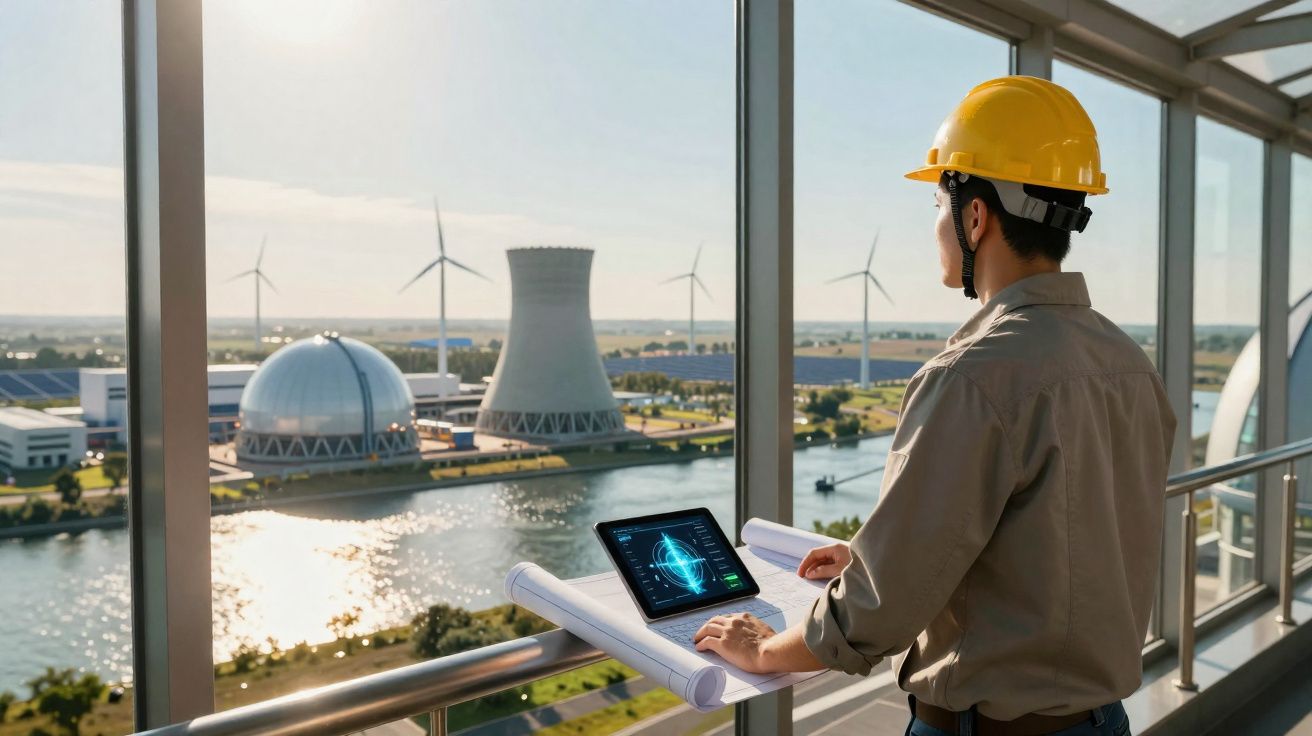
Across Europe and further afield, governments are discreetly committing billions to a technology that many people still link mainly with historical emergencies.
As wind turbines and solar arrays continue to spread across coastlines and farmland, nuclear reactors still produce roughly a tenth of the world’s electricity. That leaves an unavoidable question hanging in the air: is nuclear power a genuine climate backstop, a high-stakes industrial wager, or a legacy system kept running through habit?
How a pressurised water reactor (PWR) actually works
The majority of reactors operating today are pressurised water reactors (PWRs). Their purpose sounds straightforward-convert heat from atomic reactions into rotating turbines-but the engineering route is highly complex.
At the heart of the plant sits the reactor core. Fuel rods filled with uranium‑235 pellets are arranged inside a steel reactor vessel. When a neutron strikes a U‑235 nucleus, the atom splits (fission). That split produces additional neutrons and releases energy, mostly as heat, which can sustain the chain reaction.
To keep the reaction controlled, control rods made from neutron‑absorbing materials are inserted or withdrawn from the core. Their role is to stabilise power output so it remains steady rather than accelerating dangerously.
A sealed primary circuit pumps water through the core at extremely high pressure-typically about 155 bar. Under that pressure, the water can exceed 300°C without boiling. This same water performs two jobs at once: it removes heat (coolant) and slows neutrons down (moderator), helping fission proceed efficiently.
The heated, pressurised primary water then flows into steam generators, where it transfers heat to a separate secondary circuit running at a lower pressure. Water in that secondary loop boils into steam, which spins a turbine coupled to an alternator to produce electricity.
The defining PWR move is that the radioactive primary loop is kept separate from the turbine loop, so most radioactivity stays confined within thick steel and concrete containment.
Once steam has passed through the turbine, it is cooled and condensed back into liquid in large cooling systems-often using seawater or river water-and then recirculated.
Overall thermal efficiency is typically about 33%: around one third of the heat becomes electricity, while the remainder leaves as waste heat. Future reactor designs aim to lift efficiency by running at higher temperatures and/or using alternative coolants.
Safety by design: the “defence in depth” approach in nuclear power
Nuclear engineering is built on the premise that faults will occur. The response is to design multiple, overlapping safety layers so that a single failure cannot snowball into a major event.
This philosophy-defence in depth-begins with conservative engineering: thick reactor vessels, robust pipework, and generous safety margins. On top of that, plants incorporate several independent safety systems:
- Active systems: powered pumps and valves capable of injecting cooling water into the core.
- Passive systems: gravity-fed reservoirs, natural circulation paths and heat exchangers that function without outside electricity.
- Physical barriers: fuel cladding, the steel reactor vessel, the sealed primary circuit, and reinforced concrete containment structures.
Following Three Mile Island, Chernobyl and Fukushima, regulators tightened expectations across the sector. New builds are now required to tolerate scenarios such as extended station blackouts, major earthquakes and serious flooding.
Generation III reactors are generally expected to keep the core in a safe state for at least 72 hours without external power, relying largely on passive cooling.
PWRs also have an inherently helpful characteristic: a negative temperature coefficient of reactivity. As temperatures rise, the nuclear reaction naturally tends to slow, so the physics of the fuel and coolant nudges the system towards a safer condition.
Nuclear’s position in the global electricity mix
Despite the attention commanded by renewables, nuclear remains a significant source of low‑carbon electricity. In 2023, nuclear plants produced roughly 2,600 terawatt-hours (TWh)-about 9–10% of worldwide generation.
| Energy source | Output (TWh, 2023) | Approx. global share |
|---|---|---|
| Coal | ~10,000 | ~36% |
| Gas | ~6,500 | ~23% |
| Hydro | ~4,300 | ~15% |
| Nuclear | ~2,600 | 9–10% |
| Wind | ~2,200 | ~8% |
| Solar | ~1,600 | ~6% |
The United States is still the biggest producer of nuclear electricity, with China in second place. France is the standout for dependence on reactors: nuclear supplies over 60% of French electricity, contributing to one of the lowest‑carbon grids among major economies.
Costs, intermittency and the nuclear–renewables clash
If you compare headline prices per megawatt‑hour, new nuclear projects often look costly. Recent figures place advanced reactors at about $110/MWh (roughly £85/MWh, depending on exchange rates). By comparison, modern onshore wind can be near $40/MWh, while utility‑scale solar has dropped quickly, with some contracts trending towards $25–30/MWh.
However, those top-line numbers can obscure the operational challenge of weather‑dependent power. Solar output falls when daylight fades or cloud cover thickens; wind generation dips when conditions calm. Their capacity factor-how often they generate at full output-can sink to single digits for solar on some grids, while wind commonly sits around 40%.
Once wind and solar take up a large share of a grid, each additional percentage point typically demands backup: batteries, flexible gas generation, storage, or long-distance transmission lines.
That backup is not free. When variable renewables reach high penetration, the extra balancing and system costs are often put at $25–40/MWh. Nuclear stations, in contrast, generally operate most of the time, frequently achieving capacity factors above 80%. This continuous output can keep grids stable through cold snaps, heatwaves and extended windless periods.
This reliability is why many decarbonisation models still include nuclear-not as a competitor to renewables, but as a firm low‑carbon anchor that can reduce the total cost of achieving a carbon‑neutral power system.
Extending reactor lifetimes and the reality of decommissioning
One factor that shapes national choices-especially in Europe-is the ageing profile of existing reactors. Extending the operating life of a PWR can be cheaper and faster than building a replacement, but it requires rigorous inspections, component upgrades and regulator approval, particularly around pressure vessels, steam generators and safety systems.
At the other end of the timeline, decommissioning is a long, tightly regulated industrial process involving dismantling, site remediation and waste management. The scale and duration of decommissioning programmes influence public confidence and financing assumptions, because the full cost of nuclear electricity includes not only construction and operation but also how responsibly a country closes plants down.
What happens to spent fuel and nuclear waste?
Public arguments about nuclear power often return to waste-usually without distinguishing between categories or volumes. When you look at the numbers in detail, the picture becomes more specific.
Consider France, one of the most nuclear‑intensive nations. In 2023, France recorded around 1.85 million cubic metres of radioactive waste across all categories. Over half of that total is very low level material, typically contaminated rubble or equipment arising from decommissioning work.
The high‑level portion-highly radioactive material, largely associated with spent fuel-amounts to only a few thousand cubic metres, roughly enough to fill a couple of Olympic swimming pools. Those few thousand cubic metres are also where the hardest long-term challenge sits.
Most national plans focus on deep geological repositories: engineered tunnels located several hundred metres underground in stable rock, intended to isolate waste while it cools and decays over very long periods. Finland has already licensed such a facility, and Sweden and France are progressing along comparable routes.
In parallel, researchers are developing fast reactors and advanced fuel cycles that aim to use some long-lived waste as fuel. The goal is to reduce long-term radiotoxicity and shorten the management horizon from hundreds of thousands of years to thousands-or tens of thousands-of years.
EPRs: Europe’s flagship Generation III+ project, at scale
Among large commercial reactors, the European Pressurised Reactor (EPR) has become shorthand for both high ambition and difficult delivery.
A single EPR is rated at about 1,650 MWe. The design includes double concrete containment, four independent safety trains, and strong passive-cooling capability. In theory, that translates into very low accident probabilities and resilience against major external hazards.
In practice, build-out has been more painful. At Flamanville in Normandy, the first French EPR reached initial criticality only in 2024, after 17 years of construction, with costs rising to around €13.2 billion.
Advocates argue that EPR programmes are absorbing a “first-of-a-kind” penalty, and that later units should be quicker and cheaper once the supply chain and skills base mature.
Finland’s Olkiluoto 3 has been supplying electricity since 2023 and has reported capacity factors above 90%, indicating strong performance once operational. In the UK, Hinkley Point C-also based on the EPR-has become one of Europe’s largest construction efforts, including huge forged components shipped from France.
SMRs: small modular reactors, large ambitions
While mega‑reactors draw public attention, a parallel competition is accelerating around small modular reactors (SMRs). These designs generally target outputs of roughly 50 to 300 MWe, far below the traditional gigawatt‑scale model.
The central SMR promise is industrialisation: manufacture a significant share of the plant in factories, then transport modules to site for assembly. If achieved, that could reduce construction timelines and limit the bespoke civil engineering risks that often derail large projects.
Governments see several potential roles for SMRs: supplying remote communities, firming up renewable-heavy systems where grids are constrained, and delivering both electricity and industrial heat for sectors such as steel, chemicals and hydrogen production.
- Smaller upfront capital per unit, potentially easing financing.
- More siting options, including repurposed coal power station locations.
- Standardised fleets that could reduce training and maintenance costs.
Sceptics counter that the economics depend on building SMRs in large numbers to unlock factory learning curves. A small run of demonstration units is unlikely to produce genuinely low-cost electricity. There are also security and safeguards questions if many small reactors are deployed across new jurisdictions.
From Generation II to Generation IV: what changes under the bonnet
The nuclear sector commonly groups designs into “generations”. Most of today’s established PWR fleet sits in Generation II, while improved Generation III and III+ units are now entering service. Generation IV, still largely in the demonstrator phase, targets higher efficiencies and different fuel cycles.
| Generation | Typical period | Key features | Status |
|---|---|---|---|
| I | 1950s–60s | Early prototypes, limited safety sophistication | Shut down or being decommissioned |
| II | 1970s–90s | Standard PWRs and BWRs, mainly active safety systems | Majority of today’s global fleet |
| III / III+ | 1990s–2025 | More passive safety, stronger containment | Operating and under construction |
| IV | 2030–2050 | Fast neutrons, closed fuel cycles | Demonstrators and R&D |
Generation IV concepts include sodium‑cooled fast reactors, molten salt reactors and high‑temperature gas‑cooled reactors. Many aim to extract more energy from fuel, cut waste burdens and reach higher operating temperatures suitable for industrial heat uses.
Fuel supply, enrichment and the geopolitical dimension
Another practical issue shaping nuclear expansion is the fuel supply chain. Uranium mining, conversion, enrichment and fuel fabrication are globalised industries, and some steps are concentrated in a limited number of countries and companies. For policymakers, this makes energy security and supplier diversity an increasingly prominent part of the nuclear debate.
Some advanced designs-particularly certain SMRs and fast reactors-may require alternative fuels or different enrichment levels, which can place additional demands on enrichment capacity, regulation and safeguards.
Key terms that often decide the argument
Three concepts repeatedly appear in energy policy discussions and are frequently misunderstood.
Capacity factor. This measures actual generation compared with what a plant would produce if it ran at full output all year. A nuclear station operating at 85% capacity factor will deliver far more electricity than a solar farm at 15%, even if their nameplate capacities are identical.
LCOE (levelised cost of electricity). A lifetime cost-per-megawatt‑hour figure that includes construction, fuel, operations and decommissioning. It does not easily reflect system-level expenses such as balancing variable renewables or reinforcing transmission networks.
Baseload vs flexibility. Traditional planning assumed nuclear would run continuously while hydro and gas would ramp up and down. Some modern reactors-particularly in France-already load follow, shifting output day-to-day in response to demand and wind generation.
Scenarios for 2050: nuclear in a net zero grid
Energy modellers outline multiple routes to net zero electricity by mid‑century. One pathway relies on extensive overbuild of renewables plus storage, with nuclear declining as today’s stations retire. Another retains or expands nuclear capacity, limiting the scale of storage and backup required.
In reality, strategies will diverge by country. Nations with ageing fleets must choose between costly life extensions and expensive replacements. Others-such as Poland and several Gulf states-see nuclear as a way to reduce reliance on coal while maintaining firm power output.
The eventual balance between PWRs, EPR-scale projects and future SMRs is likely to be driven less by physics than by public confidence, financing conditions and political tolerance for delays.
For households, the consequences will appear not only on bills but also on the horizon: offshore wind arrays, solar mega‑sites, expanded transmission corridors and nuclear sites all compete for land, views and marine space. Any chosen mix carries trade‑offs that extend far beyond the perimeter fence of a power station.



Comments
No comments yet. Be the first to comment!
Leave a Comment