
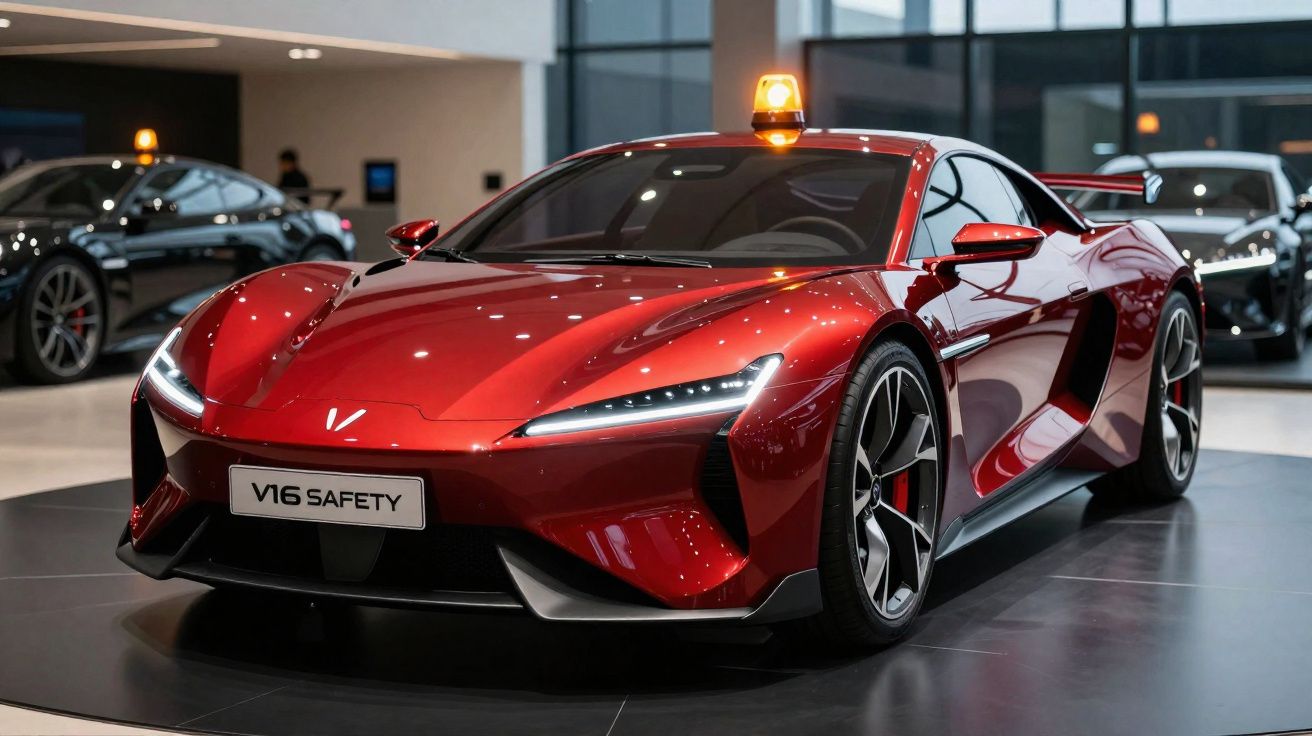
Anyone driving to Spain should take a hard look at what they carry in the car. Spain’s traffic authority is phasing out a familiar breakdown aid and mandating a new warning system instead. The aim is to reduce roadside risk on motorways and rural roads - but the rule does not affect every driver in the same way.
What is changing in Spain: a legal requirement replacing the classic warning triangle
For years, Spain - like most of Europe - relied on the warning triangle as the standard way to alert other road users after a breakdown or collision. Placed several dozen metres behind the vehicle, it was intended to give approaching traffic enough time to react. In Spain, that era is coming to an end.
From 1 January 2026, vehicles registered in Spain must carry a V16 emergency light. This compact, high-intensity warning lamp is set to replace the warning triangle entirely for Spanish-registered vehicles. The triangle may still be common in many boots, but on Spanish number plates it will no longer be the officially accepted solution.
From 2026, the V16 emergency light will be the only authorised breakdown warning system for vehicles registered in Spain.
This is not an overnight change. Since mid-2021, both systems have been permitted side by side. From 1 July 2021, drivers in Spain could use either a warning triangle or a V16 beacon. However, once 2026 begins, Spanish owners lose that choice: only the V16 emergency light will count.
How the V16 emergency light (V16 beacon) works
At heart, the V16 beacon is a small yellow–orange flashing light designed to sit on the roof of the car. It is intended to be straightforward to use - especially when visibility is poor or adrenaline is running high.
- Magnetic mounting: the light attaches to the vehicle roof using a magnet.
- Use from inside the car: it can be placed without stepping into live traffic or onto the hard shoulder.
- 360-degree visibility: the flashing signal is visible all around the vehicle, like a compact warning beacon in an amber colour.
- Fast activation: a single press starts the flashing sequence.
The key difference versus a warning triangle is that it removes the most dangerous part of the process: walking along the roadside to set the triangle at a distance. Traditionally, drivers were expected to get out, ideally put on a high-visibility vest, and position the triangle roughly 50 to 100 metres behind the car (depending on local guidance). On motorways - particularly in rain, darkness or fog - that walk can be genuinely hazardous.
Why Spain is making the switch
Spain’s traffic authority now considers the older approach too risky in practice. When drivers attempt to place a warning triangle, injuries and fatalities can occur if they are struck by passing vehicles on the carriageway or hard shoulder. The V16 emergency light is designed to reduce that exposure.
With a V16 beacon, the driver stays in the vehicle - the dangerous walk along the hard shoulder is removed.
There is also a second driver behind the policy: technology. A warning triangle is purely passive. Many modern V16 emergency lights can do more than flash - they can also connect and share location data, which is where the new requirement becomes particularly significant.
Integrated GPS in the V16 emergency light: a roof-mounted digital distress signal
A number of approved V16 emergency lights include an integrated GPS module. In the event of a breakdown or crash, the device can transmit the vehicle’s position to the relevant emergency and roadside assistance services. That can be especially valuable on motorways, remote stretches of road, or anywhere with confusing junction layouts.
In practical terms, this can mean:
- the location is sent automatically;
- there is less reliance on explaining directions over the phone;
- recovery and emergency teams can locate the vehicle more quickly, even in poor visibility or difficult terrain.
Used this way, the V16 emergency light acts as an additional safety layer alongside systems such as eCall and other connected emergency services found in newer cars. It can also give older vehicles a form of “digital safety net” without needing factory-fitted connectivity.
Does the V16 emergency light requirement apply to foreign drivers (including UK visitors)?
The question most visitors ask is whether they must buy a V16 emergency light before driving to Spain. For now, Spain’s guidance is reassuring.
Vehicles with foreign registration currently do not need a V16 emergency light, provided they carry a warning triangle.
So, if you are travelling in a UK-registered vehicle (or any other non-Spanish plate), you remain subject to the equipment rules of your home country. In other words, as long as you have the required kit for your registration jurisdiction - including a warning triangle where applicable - you should not be fined in Spain simply for not carrying a V16 emergency light.
That said, many safety specialists suggest considering one if you regularly drive in Spain or elsewhere in southern Europe. The benefit is obvious: you can signal danger without putting yourself in harm’s way to place a triangle. And if you later register a vehicle in Spain or keep a car there long-term, the V16 emergency light becomes essential.
Hire cars and company vehicles: a practical extra consideration (new)
If you are hiring a car in Spain from 2026 onwards, the vehicle will be Spanish-registered and should therefore be equipped with a compliant V16 emergency light by the rental company. Even so, it is worth checking at pick-up what safety kit is supplied (high-visibility vest, first-aid kit if included, spare bulbs where relevant) and asking staff to show you where the V16 device is stored and how it operates. The best safety equipment is the equipment you can find quickly under pressure.
Choosing a compliant device: approval, batteries and connectivity (new)
If you decide to buy a V16 emergency light voluntarily, make sure it is approved for use in Spain rather than simply “a magnetic amber light”. Look for clear confirmation that it meets the V16 specification required by Spanish rules. Also check practicalities: whether it has a long-life internal battery, how it charges (if rechargeable), and whether any connected/GPS features require ongoing service support. A cheap, non-approved unit may be useless when it matters most.
What drivers can do now before a Spain road trip
If you drive to Spain regularly, a few straightforward steps can improve both compliance and safety:
- Review your standard kit: warning triangle, first-aid kit, and a high-visibility vest that is easy to reach (not buried in the boot).
- Check your roof surface: confirm there is a suitable magnetic area for a V16 emergency light to attach securely.
- Consider buying an approved V16 emergency light if Spain is a frequent destination or you spend long periods driving there.
- Test the device before you travel: practise switching it on and placing it so it becomes second nature.
When purchasing, the main point is simple: not every magnetic warning lamp is acceptable. Reputable sellers clearly state that the product conforms to the Spanish V16 emergency light requirements.
Part of a wider European road-safety debate
Spain’s decision fits into a broader conversation about how new technology changes real-world safety. In the United Kingdom, for example, attention has recently focused on a different issue: modern headlamps. Many drivers report glare from today’s LED systems, particularly when lights are misaligned, leading to complaints from other road users.
That puts the spotlight on a wider question: as vehicles gain brighter lighting, more driver assistance features, automatic emergency calls, and now connected breakdown beacons, how do we ensure these innovations genuinely reduce risk rather than shifting it elsewhere?
Benefits and limits of the new V16 emergency light warning technology
The V16 emergency light shows a clear direction of travel: it pairs traditional visibility with digital connectivity. Even so, it is not a cure-all:
- It does not replace a high-visibility vest - you may still need to leave the vehicle.
- It cannot prevent secondary collisions if the car is stopped in a particularly dangerous location, such as just beyond a blind bend.
- It depends on reliable power, whether through its own battery or another supply.
Even with those limitations, the safety advantage is compelling in any situation where seconds matter and stepping out onto the hard shoulder is a serious risk. On motorways, where lorries and cars pass stranded vehicles at high speed, avoiding the walk to position a warning triangle could genuinely save lives.
For anyone who drives often - privately or for work - Spain’s new rule is a useful prompt to reassess personal safety habits: add a warning light if it suits your travel pattern, check headlamps and brake lights regularly, and refresh your understanding of what to do during a breakdown. On night drives and long holiday routes across multiple countries, preparation is often the difference between a near miss and a major incident.

Comments
No comments yet. Be the first to comment!
Leave a Comment