
The old Renault bumped along the rutted track as though it had memorised every bend. Michel, 72, gripped the wheel and narrowed his eyes against the pale autumn sun, doing his best to ignore the heaviness sitting in his stomach.
A month earlier, that weight had arrived in the form of a thick, brown envelope from the tax office. One letter was enough to turn a harmless act of neighbourliness into a sleepless, paperwork-soaked nightmare.
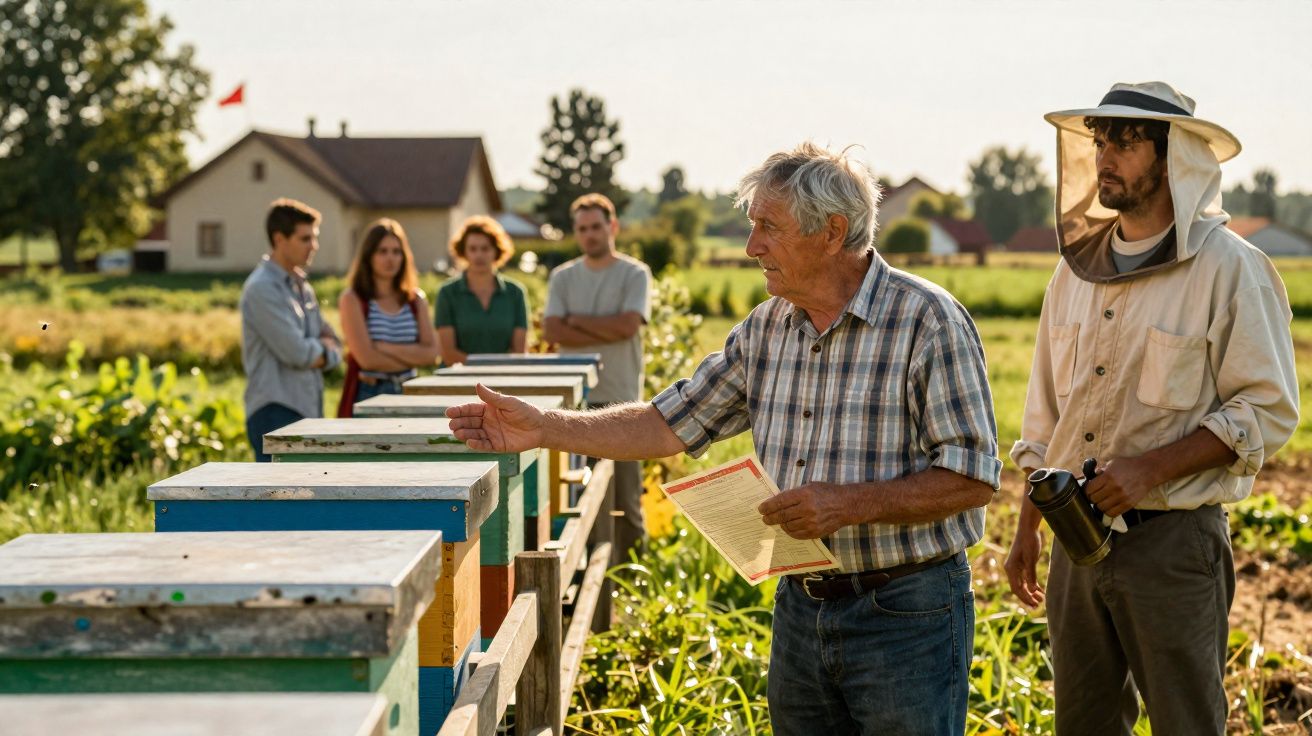
Five years before, he had driven the same lane with an entirely different feeling. A nearby neighbour had asked to set down a handful of beehives on Michel’s unused patch of land - “only until I’m back on my feet”. Michel agreed as casually as you say yes to a cup of tea. No contract. No sums. No second thoughts. Just a favour between rural people who still believed a word was a bond.
On the page, though, those quiet wooden boxes had transformed his modest retirement plot into something else entirely: a taxable farm.
When a few beehives become a “business” you never agreed to
When the tax inspector rang for the first time, Michel assumed someone was having him on. “Mr L., you haven’t declared your agricultural activity,” the caller said. Michel laughed - and then went silent when he heard the number: several thousand pounds in back taxes, plus penalties.
Somewhere inside a database no one in his village had even heard of, his parcel now appeared as worked farmland. The logic is brutally tidy: bees on land implies production; production implies potential income; potential income attracts tax - even if, in reality, not a penny changed hands.
The inspector didn’t sound vindictive. Just detached, like someone reading lines from a screen rather than speaking to a person.
Cases like Michel’s are surfacing in small communities across Europe, from Brittany to the Balkans. In one area, a retired teacher let a young farmer stack hay bales on her pasture “for one season” and later found herself accused of an undeclared lease. Elsewhere, a widow allowed an organic grower to trial vegetables on a corner of her field; the local office reclassified the land, removed exemptions, and hit her with a tax reassessment.
Behind each story sits the same silent equation: on paper, land use looks like money, even when nobody has actually earned anything. The law doesn’t always have room for the fact that the real transaction was trust, not profit.
That’s how a straightforward favour starts warping into something darker. People who believed they were being decent suddenly find themselves treated as small-time tax dodgers. Neighbours who used to swap eggs and lend tools begin murmuring about who is “really” following the rules. On call-in shows and village Facebook groups, the lines harden into two familiar camps: Sign the forms and live with it versus These rules were built for agribusiness, not pensioners.
The beehives stay put - but the boundary between solidarity and suspicion shifts.
The rulebook meets the village fence: beehives, taxes, and trust
On market day, the argument can sound rehearsed.
By the cheese counter, you’ll hear the rule-first voices. They’ll argue that France, Germany, the UK - choose your country - can’t run on handshakes and good intentions. “If you let one pensioner slide, why not the big players?” says Jean, a former civil servant, as he weighs tomatoes. In his view, the state only functions if everyone is treated the same, regardless of how sympathetic the backstory is.
For people like Jean, compassion belongs in private generosity, not in bending tax rules.
A few metres away, beside the honey jars, the tone changes. “What’s Michel meant to do - pay a solicitor over a couple of beehives?” asks Marie, 64, who still leaves apples out for the beekeeper’s children. She knows the beekeeper, knows the debts, remembers the rainy afternoon when he admitted he might have to sell his hives. That context colours everything for her.
To Marie, the bill isn’t evidence of fairness. It’s proof of a system that can see a hive, a parcel number and a missing form - but can’t see the conversation that happened first.
Under the legal dispute, another pulse is hard to miss: resentment about class and leverage. Retirees who spent decades counting every penny watch multinational firms “agree” outcomes with tax authorities while they get no flexibility at all. Meanwhile, urban professionals toss around hot takes about “tax optimisation” as if it’s an entertaining brain-teaser. Out here, an older man opens a letter telling him he owes the equivalent of half his annual pension because someone placed bees on his field.
And if we’re honest, almost nobody reads every line of agricultural tax guidance before saying yes to helping a neighbour.
That’s what turns this from a technical question into a moral one: who gets the benefit of the doubt - the spreadsheet, or the human being?
How to say “yes” to helping - without stepping into a tax trap
There is a modest, unromantic way to protect yourself without stamping out the instinct to help. When someone asks to use your land - for beehives, hay, hens, solar panels, whatever - pause the friendly chat for ten minutes and write down three basics:
- whose equipment or livestock it is
- how long it will be there
- what is being paid (even if the answer is “nothing”)
Then add one blunt line: “I do not participate in this activity; I am only lending the space.”
It can feel formal, even faintly rude. But it converts a fuzzy favour into something clear if a bureaucrat later comes knocking.
Most people skip this because it feels cold. You don’t want to hand a friend a mini-contract when they already feel awkward asking. We’ve all swallowed doubts in that moment because we don’t want to seem suspicious or “too town-ish”. The problem is that silence can be interpreted by the state as consent to an economic relationship you never intended.
A gentler script is: “I’m happy to help, but I’ve had paperwork scares before. Let’s write a quick note so neither of us ends up in trouble.” It shares the discomfort rather than making your neighbour feel accused.
A practical checklist from the town hall (and why it matters to the tax office)
Sometimes what people want most isn’t another form - it’s someone willing to say out loud that the situation feels unfair. A village mayor in the south-west put it like this:
“Between the law and justice, there’s a wide ditch. My job is to build as many small bridges as I can, without pretending the ditch isn’t there.”
To build those bridges, he drew up a simple checklist for anyone lending land informally:
- Describe what’s on the land in plain words, not technical jargon.
- State clearly that no rent is paid - or write the exact token amount if there is one.
- Keep any letters, texts or emails that show this was “helping out”, not a commercial deal.
- Ask the town hall (local council) whether the use could alter your land’s status on official maps.
- Agree in writing that the user handles all farm-related declarations - not the owner.
None of this guarantees the tax office will ignore you. But it gives you something concrete to push back with, rather than relying on memory and a helpless shrug.
Two extra checks that can save pain later: even where tax is the headline worry, it’s worth thinking beyond it. First, consider liability and insurance: if someone is operating beehives on your land and a visitor is stung, or a vehicle damages a boundary, you’ll want to know who is covered. Second, be mindful of practical management and access: write down where vehicles may drive, which gate is used, and whether the beekeeper can store kit on-site. Small details like these often prevent bigger disputes than tax ever does.
If you’ve already said yes and now you’re uneasy: don’t wait for a letter. Ask the beekeeper or farmer to confirm the arrangement in writing now (start date, end date, no rent, and who files declarations). Then contact the town hall or relevant tax helpline to ask whether this land use triggers any change of classification. Acting early is usually far cheaper - financially and emotionally - than trying to untangle it years later.
What this fight over bees really reveals about us
A story about a retiree and a beekeeper is, on the face of it, small. There are no thunderous parliamentary speeches and no viral courtroom footage. It smells like damp soil, diesel, bargain coffee in chipped mugs - and bureaucracy printed on thin paper. Perhaps that’s exactly why it sticks in the mind.
It presses a quiet question: when our systems collide with our instincts, which one wins?
Some people will insist that stricter rules protect the common good. Others will argue that a society that penalises kindness has already lost its way. Underneath, both sides fear a similar thing - that the game is fixed, either by rule-breakers who get away with it or by institutions that crush the softer parts of being human.
Meanwhile, the bees keep working, indifferent to cadastral maps and tax codes. The hives remain where they are - or they’re moved to some other forgotten edge of someone else’s field. Michel now looks at his own land differently: half-inclined to refuse the next favour, half-ashamed that he even feels that pull.
Somewhere between blind obedience to the rulebook and reckless disregard for it lies a narrow, awkward path. Walking it means accepting that mercy can’t erase every line - and that laws with no room for mercy can feel like a second, colder country laid over the one we actually live in. The choice of which country we nurture - on paper and in practice - is being made in these small, almost invisible stories long before it reaches any ballot box.
| Key point | Detail | Value for the reader |
|---|---|---|
| Hidden farm reclassification | Letting someone use your land for bees or crops can change its tax status without you noticing | Helps you recognise when a “simple favour” might come with financial consequences |
| Write it down | A short, plain-language note on who uses the land, for how long, and for what | Gives you evidence that you’re helping, not running an undeclared business |
| Ask early, not late | A quick question at the town hall or tax office before saying yes | Prevents nasty surprises that explode years later, when it’s hardest to put right |
FAQ
- Question 1 Can lending land for beehives really trigger farm taxes on a retiree?
- Question 2 How can I help a struggling farmer or beekeeper without risking a tax reassessment?
- Question 3 Does writing “no money involved” automatically protect me from the tax office?
- Question 4 Why do some people insist on “rules first” even when the cases seem heartbreaking?
- Question 5 What should I do if I’ve already said yes to someone using my land and now I’m worried?






Comments
No comments yet. Be the first to comment!
Leave a Comment