
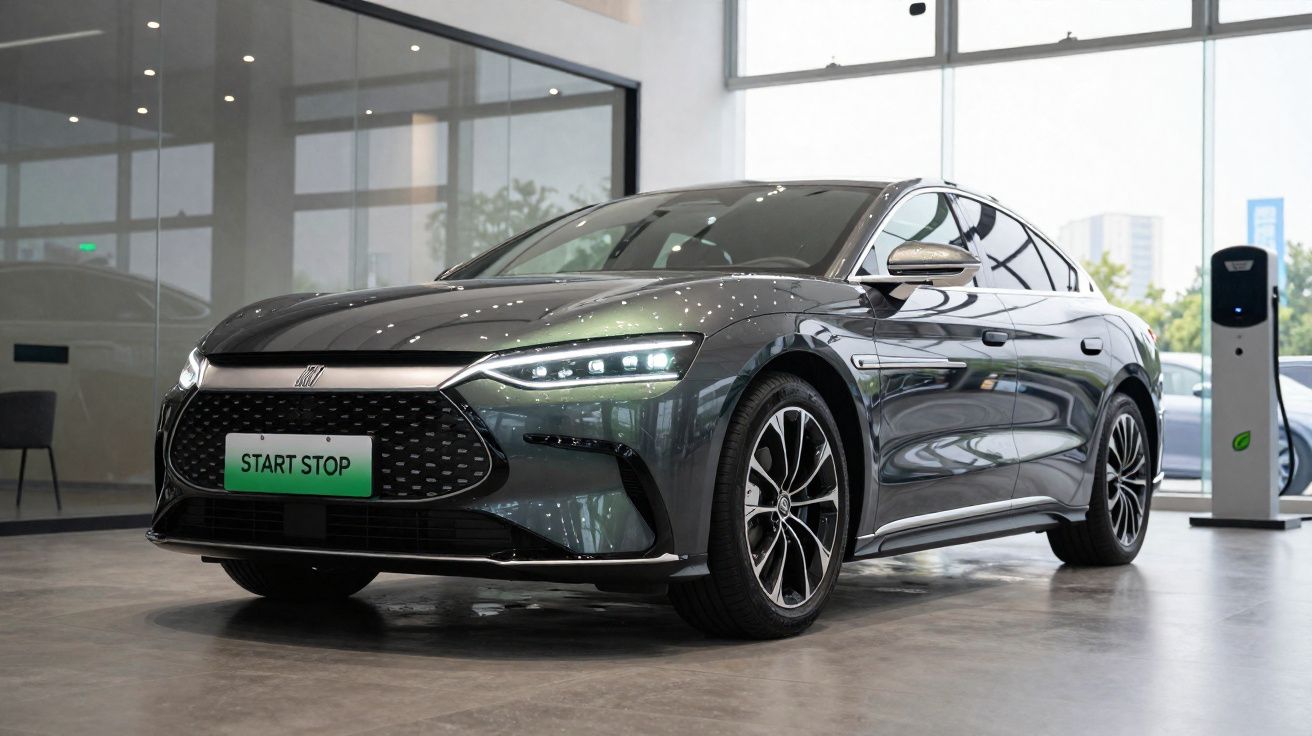
On the left sat my new hybrid; on the right, an older diesel estate. In the hybrid the engine was off - just silence. In the estate there was a steady rumble, a faint vibration through the seat, and that thin haze of diesel exhaust you can almost taste. After about ten seconds the diesel driver glanced over, visibly irritated, and tapped his steering wheel as if to say, “Well then - happy with your eco toy?”
I caught myself staring at the hybrid’s bonnet and thinking: does this constant shutting down and firing up actually save fuel? Or does it eventually just get on your nerves when the engine kicks back in right as you’re trying to creep forward? We’re living in an age where cars have become machines built around compromise - and the start-stop system sits right in the middle of it.
Start-Stop in rush-hour traffic: clever fuel-saver or stress-inducer?
Climb into almost any modern car and you’ll meet start-stop within seconds of pressing the start button. That small symbol - an “A” inside a circle - is everywhere now. The promise is seductively straightforward: if the car isn’t moving, the engine doesn’t need to run. Less fuel burned, fewer emissions at a standstill. On paper it feels like a free conscience upgrade.
Out on real roads, it can feel rather less elegant. Most drivers know the exact moment: you’re at the front of a queue, the line ahead suddenly starts rolling, and that’s the instant the engine decides to shut down. There’s a flash of “oh no”, a tiny pause, a shudder of life as the engine restarts - and the gap you wanted is already gone.
How the Start-Stop system works (and why it sometimes hesitates)
In engineering terms, start-stop is not especially mysterious. The engine management system continuously checks whether a list of conditions is met: sufficient battery charge, correct engine temperature, no extreme steering input, and (depending on the car) the gearbox in neutral or the clutch depressed. When everything lines up and the vehicle comes to a halt, it switches the engine off.
As soon as you dip the clutch, select a gear, or release the brake (again depending on the set-up), the engine is started again. To survive this routine, manufacturers fit tougher starters, reinforced batteries, and a web of sensors that decide when the system should and shouldn’t intervene. The clever bit is speed: modern systems can restart in the blink of an eye - often quicker than you can move your foot from brake to accelerator. But what feels seamless in a controlled test can feel far more noticeable in messy, stop-start city traffic.
What I saw in a week of driving with Start-Stop
I once spent a full week paying close attention to my start-stop system: urban driving, plenty of traffic lights, plenty of rush-hour congestion. The car was a compact petrol model with modern electronics and a fairly new battery.
By the end of the week, the trip computer showed roughly 0.6 litres per 100 km less consumption in pure city use. That doesn’t sound dramatic, but scale it up to 10,000 km and you’re looking at about 60 litres saved. At today’s prices, that’s effectively a full tank’s worth you didn’t have to buy - simply because the engine stayed quiet when you weren’t going anywhere.
Even so, I noticed something else: the more tired I felt, the more often I turned the feature off. One button, one click - and suddenly there was that familiar, mildly reassuring idle at the lights.
Getting value from Start-Stop instead of fighting it
If you want start-stop to work for you rather than just putting up with it, a few simple habits make a bigger difference than most people expect:
- Don’t keep toggling it on and off. The system is designed to operate regularly. Switching it off every trip tends to erase the benefits without delivering a meaningful long-term comfort gain.
- Let it pay off at longer stops. At a long red temporary light, a railway crossing, or a stationary queue, engine-off time genuinely saves fuel. A stop of one or two seconds rarely makes much difference.
- Drive a touch more smoothly. Look further ahead, lift off earlier, and avoid filling every tiny gap in stop-and-go traffic with a rushed burst forward. Done right, start-stop becomes a quiet assistant rather than a constant interruption.
The everyday habits that make Start-Stop feel worse than it is
Many drivers end up blaming the system for behaviour patterns the car is simply responding to. A classic example is hovering in “creep” traffic with the brake only half pressed, which can cause repeated stop–start cycles: the engine cuts, restarts, then cuts again moments later. In a manual car, another common trigger is keeping the clutch down while still deciding whether to change lanes - the car interprets that as “we’re about to move” and restarts the engine.
That’s when it feels jerky and low-quality, as though the technology is unfinished. The blunt reality is that our own micro-habits often turn start-stop into an irritant. And honestly, nobody sits down each morning to practise “start-stop-friendly” driving. We’re people, not simulator drivers.
“Start-stop is like that over-keen colleague who keeps switching the lights off behind you - for the right reasons, but usually at the wrong moment.”
A balanced view: where Start-Stop helps, and where it tests your patience
Look at it without emotion and you quickly see there are two truths at once. On one side, there’s measurable fuel saving - especially in dense urban driving. On the other, there’s your personal tolerance for a car that interrupts its own behaviour.
A few points help put the debate into perspective:
- Situation matters: in heavy city traffic, start-stop delivers far more benefit than it does on open rural roads.
- Feelings vs figures: annoyance is often louder than the real-world downside.
- Wear-and-tear concerns: modern components are built to handle large numbers of start cycles.
- Personal preference: most cars allow you to disable the system for that specific journey.
- The direction of travel: in hybrids and EVs, engine-off at low speed or standstill feels completely normal - which makes start-stop seem far less strange.
Two extra realities: batteries, auxiliaries, and what “normal” looks like over time
One aspect that doesn’t get enough attention is battery health. Cars with start-stop typically use AGM or EFB batteries and smart charging strategies, but the system is only as smooth as the battery is strong. If your battery is ageing or you mostly do short trips, the car may disable start-stop more often - not because something is broken, but because it’s protecting the ability to restart reliably and run essentials like lights, heating, and demisting.
It’s also worth remembering that comfort systems influence the behaviour you see. If the windscreen needs clearing, the cabin needs cooling, or the electrical load is high, start-stop may decide that keeping the engine running is the lesser evil. In other words: inconsistency is often the system doing its job, not the system failing.
So is Start-Stop progress, or a compliance feature?
That leaves the uncomfortable question: is start-stop a genuine step towards more sensible day-to-day motoring, or simply a feature squeezed out of official consumption and emissions test cycles? The honest answer is probably “a bit of both”. It’s a tool, not a miracle cure.
For some drivers it quickly becomes a quiet, useful routine. For others it feels like a permanent foreign object inside their own car - poking at their pride, their sense of control, and their need for predictability. If you can bring yourself to test it properly for a few weeks, you may find it’s far less dramatic than the loudest pub arguments suggest.
| Key point | Detail | Added value for the reader |
|---|---|---|
| Put fuel savings into a realistic context | In city driving, often 3–8% lower fuel use, depending on the route and how much stop-and-go you do | Helps readers judge whether the feature pays back in their daily routine |
| Comfort and getting used to it | Feels odd at first; after a few weeks the engine cut-off usually becomes normal | Reduces fear of the “annoyance factor” and lowers the barrier to trying it |
| Use the technology instead of resisting it | With smoother pedal inputs and more anticipation, start-stop works far more harmoniously | Practical levers to make the system feel gentler and more efficient day to day |
FAQ: Start-Stop
Question 1: Does Start-Stop really save petrol, or is it just marketing?
Under real urban conditions, start-stop does save measurable fuel when the car is frequently stationary for meaningful periods. The saving is rarely spectacular in a single week, but it adds up over years - especially for commuters facing lots of traffic lights and queues.Question 2: Doesn’t frequent restarting damage the starter motor and battery?
Vehicles designed with start-stop use strengthened starters and dedicated AGM or EFB batteries. These are built specifically for high numbers of start cycles. Issues are more likely when a battery is already old and close to its limit.Question 3: Can I switch Start-Stop off permanently?
From the factory, most cars only let you disable it for the current journey; the next time you start the car, it defaults back to on. Some workshops or coding options can make it stay off, but that can affect warranty and, in some cases, compliance.Question 4: Why doesn’t my engine switch off even though I’m stationary?
The system checks multiple criteria: battery condition, engine temperature, climate control demand, road gradient, and steering angle. If one parameter isn’t within limits, the engine stays on. That’s usually built-in safety logic rather than a fault.Question 5: Is Start-Stop even worthwhile in winter or extreme heat?
In very cold or very hot weather, start-stop often activates less to maintain heating or air conditioning performance. If you value comfort over saving fuel in those conditions, disabling it for those journeys is a reasonable choice - and you don’t need to feel guilty about it.



Comments
No comments yet. Be the first to comment!
Leave a Comment