
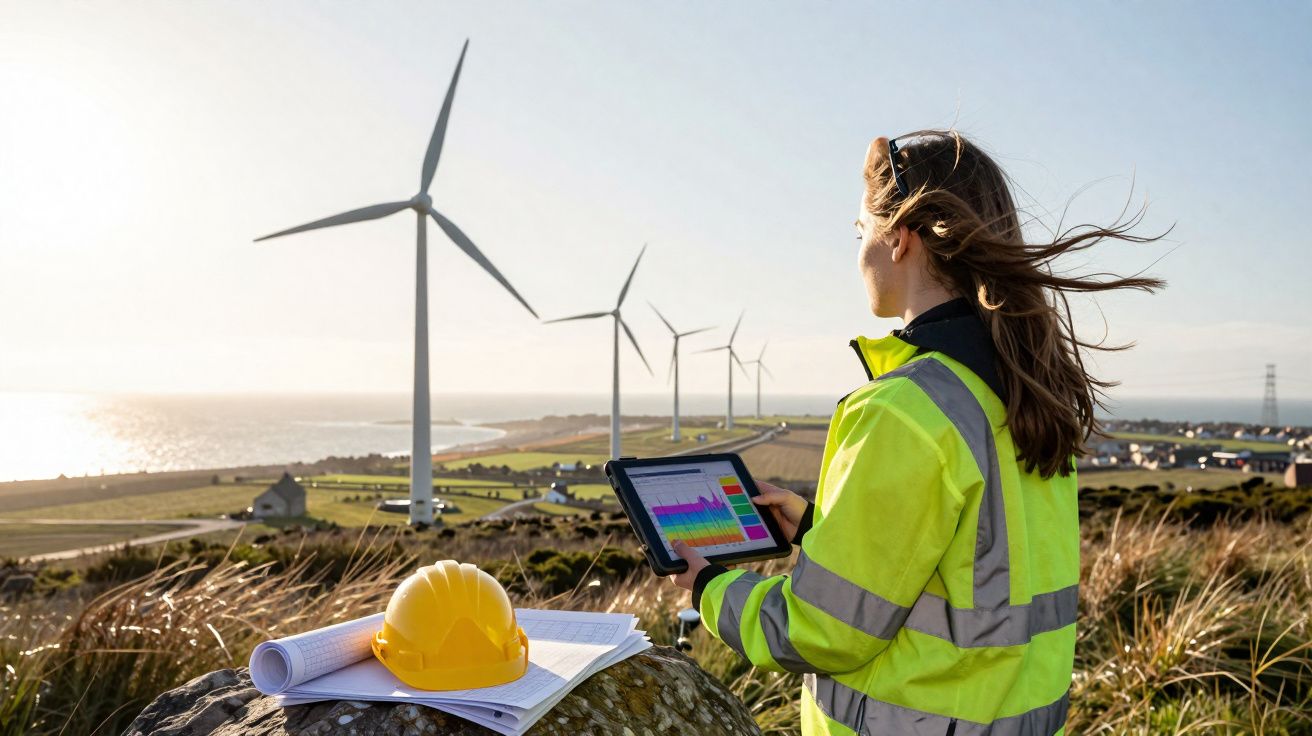
A biting, gusty evening in the middle of November delivered a quiet landmark for Britain’s energy system. As households turned up thermostats and put the kettle on, turbines out at sea - and across the land - generated enough electricity for a few pivotal hours to shift the balance of the national grid.
Record night for offshore wind and onshore wind: 22.7 GW sets a new benchmark
On 11 November 2025, powerful winds moving over northern England and along the Scottish coastline pushed large numbers of offshore wind and onshore wind turbines close to full output. Figures published by the National Energy System Operator (Neso) show that wind generation hit 22.7 gigawatts (GW) - the highest level ever recorded in Great Britain.
At the moment of maximum output, that wind power was enough, in simple household terms, to match the electricity needs of around 22 million homes. In other words, during a period when demand was high and the grid often relies heavily on gas, wind was effectively carrying almost the entire domestic load.
Wind provided 55.7% of Britain’s electricity on 11 November, with over 22.7 GW coming from turbines on land and at sea.
Neso’s breakdown shows that 43.6% of electricity that evening came from wind farms connected directly to the national transmission grid. Another 12.1% was supplied by embedded wind generation - typically smaller schemes and local connections that feed into regional distribution networks rather than flowing first through high‑voltage transmission lines.
Combined, those two streams lifted wind’s total share to 55.7% - a psychologically significant marker for a power system long dominated by natural gas, and previously coal.
The wider energy mix: more than one windy evening
Even when the weather is doing the heavy lifting, a modern power system cannot run on a single technology alone. While wind dominated, other sources still played crucial roles in keeping the grid steady, responsive and secure.
Britain’s electricity mix on 11 November (Neso snapshot)
Neso’s numbers from that evening read less like an overnight revolution and more like a clear snapshot of an energy system mid‑transition.
| Energy source | Share of generation | Homes supplied (equivalent) |
|---|---|---|
| Wind (national grid) | 43.6% | 17.2 million |
| Wind (local networks) | 12.1% | 4.8 million |
| Natural gas | 12.5% | 4.9 million |
| Interconnectors (imports) | 11.3% | 4.4 million |
| Nuclear | 8% | 3.1 million |
| Biomass | 8% | 3.1 million |
| Hydropower | 1.4% | 560,000 |
| Storage | 1.1% | 440,000 |
Natural gas still accounted for roughly one eighth of generation, providing backup when demand shifts quickly or when wind output changes. Nuclear and biomass contributed steadier supply, while interconnectors (imports) via subsea cables helped bridge the gap between variable domestic generation and peaks in consumption.
Storage remained relatively small at 1.1%, but its role is increasingly strategic. Batteries and pumped‑storage hydro stations are being used more often to manage second‑to‑second and minute‑to‑minute swings - softening spikes and dips in wind output so that fossil‑fuel plants do not have to ramp up as frequently.
A growing blend of wind, nuclear, biomass, hydro and storage points to a grid that is progressively less dependent on gas and gradually breaking long‑standing fossil fuel patterns.
From price shocks to fleets of turbines: why the 22.7 GW record matters
Reduced exposure to gas and oil market volatility
When wind output is high, wholesale electricity prices often fall because wind farms do not need imported fuel to operate. They are largely insulated from gas supply contracts, pipeline disruptions, and the day‑to‑day turbulence of oil and LNG markets.
Once turbines are installed and connected to shore, operating costs are comparatively predictable: maintenance, insurance, financing and grid charges remain, but there is no ongoing fuel bill. Each megawatt‑hour generated by wind can replace electricity that might otherwise be produced by gas‑fired plants - which has direct implications for consumer bills when markets are tight.
That said, high wind does not guarantee low prices every day. Periods of calm still push the system back towards gas generation and imports. Even so, each record‑setting evening shows how dramatically gas demand can shrink when wind conditions and system operation align.
Climate, air quality and local economic impacts
Every additional gigawatt‑hour from wind reduces emissions compared with gas or coal. Offshore wind produces electricity with no direct CO₂ emissions at the point of generation, and it also avoids local particulate pollution and nitrogen oxides where it operates. That supports the UK’s legally binding carbon budgets under the Climate Change Act and contributes to long‑term improvements in air quality, particularly as fossil generation continues to decline around urban centres and former coal regions.
There is a clear industrial dimension as well. Ports and industrial areas - including Hull and Teesside - have increasingly positioned themselves as offshore wind hubs, handling blades, foundations, converter platforms and subsea cables. The 22.7 GW milestone did more than keep lights on: it reflected years of investment in supply chains, skills and port upgrades.
New pressures: grid connections and constraints (added context)
A higher share of wind also brings new operational and infrastructure challenges. When large volumes of power are produced far from where it is used, the system needs enough transmission capacity to move electricity efficiently - and when it cannot, constraint payments and curtailment can rise. The practical lesson from nights like 11 November is that building generation must be matched by reinforcing grid lines, accelerating connections and improving how flexibility is rewarded.
Communities and the sea: consent, coexistence and planning (added context)
As offshore wind expands, public consent and marine planning become more important. Coastal communities may experience construction traffic and new onshore substations, while marine industries focus on safe coexistence with shipping routes and fishing grounds. Alongside that, developers are increasingly expected to evidence environmental management - from seabed disturbance to biodiversity impacts - so that scaling up offshore wind also maintains public trust.
Offshore giants: the Dogger Bank era in the North Sea
Dogger Bank and other North Sea leaders
A large share of this momentum comes from major offshore projects that have turned the North Sea into a sustained construction programme. Dogger Bank, located on a shallow sandbank roughly 130 kilometres off England’s north‑east coast, is the site of what is set to become the world’s largest offshore wind complex.
Built in three phases - Dogger Bank A, B and C - the project is expected to reach about 3.6 GW of installed capacity when complete. That is comparable to, or greater than, the capacity of some nuclear power stations, delivered through hundreds of turbines positioned far offshore.
Dogger Bank is part of a wider group: the UK hosts several of the world’s largest offshore wind farms, many of which were already contributing electricity during the November record.
The world’s largest offshore wind farms today
- Dogger Bank (UK): 3,600 MW planned capacity across three phases, with 277 turbines scheduled between 2023 and 2026.
- Hornsea 2 (UK): 1,386 MW from 165 turbines in the North Sea, in commercial operation since 2022.
- Hornsea 1 (UK): 1,218 MW, among the first mega‑scale offshore projects when it entered service in 2020.
- Walney Extension (UK): 659 MW in the Irish Sea, commissioned in 2018.
- Borssele 1 & 2 (Netherlands): 752 MW, a major North Sea project outside UK waters.
These schemes benefit from scale: bigger turbines harvest more energy per foundation, subsea cables can carry larger loads, and system operators can manage fewer high‑capacity grid connection points rather than coordinating output from a much larger number of small sites.
Dogger Bank and the Hornsea cluster increasingly function as backbone infrastructure, influencing how the UK designs and operates its power system into the 2030s.
How close can Britain get to a zero‑carbon grid?
The case for fossil‑free hours - and eventually days
Neso’s chief operating officer, Kayte O’Neill, has repeatedly said Britain could run its grid with zero direct CO₂ emissions for several hours at a time, and ultimately for whole days. The UK has already experienced stretches with no coal on the system; extending that achievement to gas is the next major step.
Reaching longer fossil‑free periods depends on three requirements: more low‑carbon generation capacity, greater flexibility, and smarter demand. The record on 11 November primarily showcased the first, while also indicating progress on the other two.
Flexibility is provided through multiple tools:
- Batteries and pumped‑storage absorb short surges and discharge during brief shortfalls.
- Interconnectors to Norway, France, Belgium, the Netherlands and Denmark operate as balancing valves during regional oversupply or tightness.
- Demand‑side response schemes encourage businesses - and increasingly households - to shift some usage away from peak times in exchange for lower costs.
The intermittency problem, without the jargon
Wind cannot be switched on to order. When generation drops sharply, system operators need alternatives that can respond within minutes, or even seconds. Gas turbines still provide much of that fast response today, but storage, hydro and flexible demand are steadily taking on a larger share of the task.
In pure output terms, 22.7 GW demonstrates the scale that wind can reach. The more difficult issue is dependability: can the system maintain high wind shares not only on exceptional nights, but also through grey, mild winter weeks when demand remains elevated and wind speeds are low?
This is where forecasting and planning matter. Operators rely on weather predictions, probabilistic modelling and historic performance to decide how much dispatchable capacity must remain available. Offshore wind is often steadier than onshore wind, but even offshore fleets can see prolonged lulls when high‑pressure weather settles over the North Sea.
What the record means for households, investors and policy
For households, the takeaway is encouraging but not instantaneous. One windy evening will not immediately translate into cheaper bills. Over the longer term, however, every added gigawatt of wind can reduce the UK’s exposure to imported gas price spikes. The November peak illustrates how far wind can cut gas demand precisely when markets and demand are most stressed - the same conditions that drove previous wholesale price surges.
For investors, the milestone is another signal that the UK remains among the world’s most active offshore wind markets. Large developments such as Dogger Bank and Hornsea, alongside emerging floating wind proposals, depend on confidence that the grid can absorb substantial volumes of variable power and that policy support remains broadly stable. The 22.7 GW event strengthens that investment case.
For policymakers, the figures also act as a reality check for the government’s 2030 ambition: around 95% of Britain’s electricity from low‑carbon sources. Achieving it implies not only more wind and solar, but also nuclear life extensions (and potentially new reactors), expanded storage, and stronger demand‑side measures - all while maintaining affordability and security of supply.
Technically, 11 November provides a valuable real‑world stress test. System operators can analyse frequency control, ramp rates, constraint payments and curtailment patterns to refine market rules and operational practices. Those insights feed into practical decisions such as where to strengthen transmission lines, how much battery capacity to encourage, and how to price flexibility so that businesses and consumers adjust demand at the right times.
For anyone trying to understand the real difference between 30%, 50% or 70% wind on a national grid, this record functions as a live case study. Engineers will scrutinise how quickly gas generation reduced, how imports shifted, and how storage performed. Economists will examine wholesale price movements. Coastal communities may cite the moment either to support or oppose new planning proposals connected to the next wave of offshore wind build‑out.






Comments
No comments yet. Be the first to comment!
Leave a Comment