
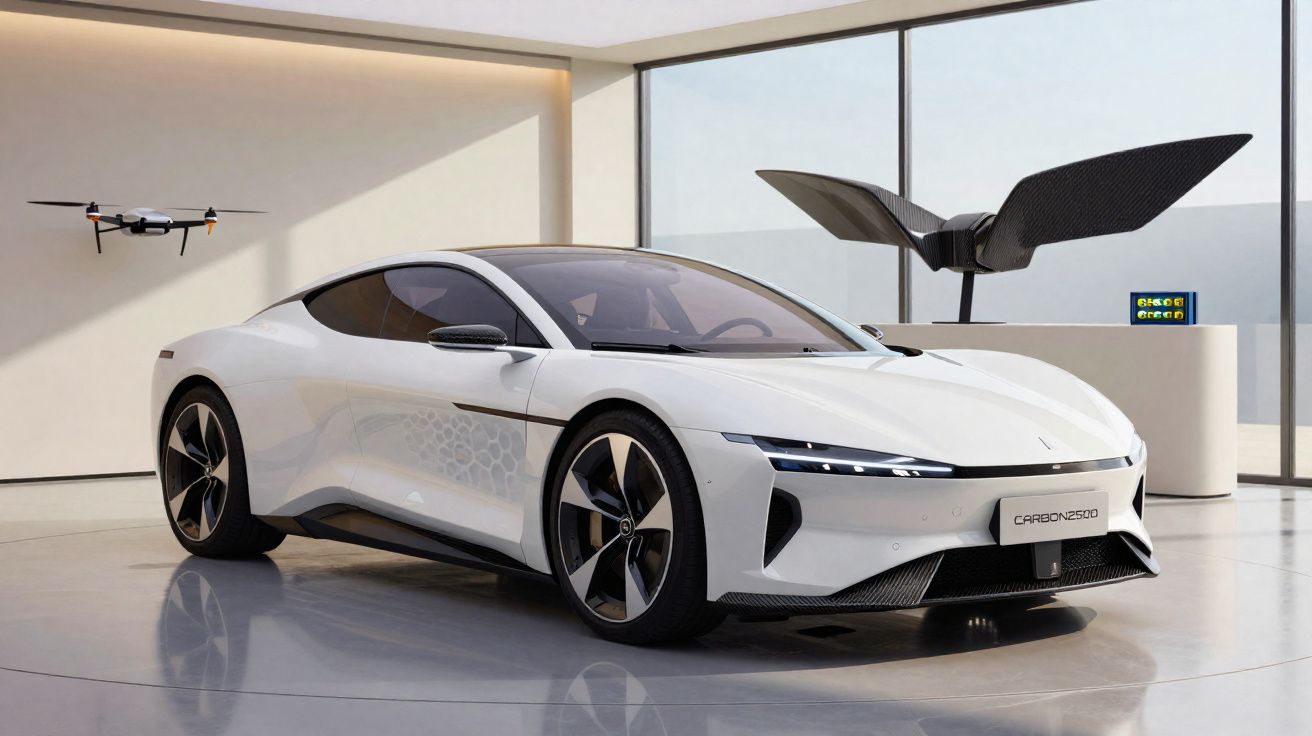
Engineers are reimagining carbon fibre as far more than a lightweight, high-strength skeleton. The ambition is straightforward: instead of the vehicle body merely coping with potholes, torsion and vibration, it should also store electricity. Achieving that shift is anything but simple, because it calls for novel materials, carefully designed interfaces and a deliberate compromise between mechanical performance and energy storage. If it succeeds, it points towards EV journeys stretching over days and drones able to stay aloft for hours at a time.
What structural batteries are
Structural batteries combine two functions in one component: they carry mechanical loads while also storing energy. In cars, drones and aircraft, that means the battery no longer has to sit in a heavy, separate enclosure. Instead, it can be built into a shell, a floor section or a wing structure-so the mass you would normally dedicate to “just packaging” starts contributing to both stiffness and range.
When the battery becomes part of the chassis, mass that used to be passive turns into something that both supports the vehicle and powers it.
At the heart of much of this work is carbon fibre. It is low in weight, very stiff for its mass and electrically conductive. Used cleverly, carbon fibres can act as reinforcement and as a current-collecting network, potentially reducing the need for metal parts and some wiring while hosting active energy-storage materials. The decisive factor is often not the fibre itself, but what happens where the fibre, binder and electrolyte meet-those interfaces frequently determine whether performance holds up or falls away.
Two paths to lighter power
Decoupled designs
In decoupled structural batteries, familiar commercial cells are embedded within a carbon-fibre laminate. This approach can improve packaging efficiency and add some rigidity, but the vehicle is still fundamentally carrying conventional cells. You do save weight, yet the structure’s battery role remains limited.
Coupled designs
Coupled designs go further by building the electrochemical system directly into a load-bearing composite. Here, the carbon fibres themselves function as electrodes and the electrolyte becomes part of the matrix. Fewer discrete parts are required, overall mass drops further, and the range benefit can be more meaningful. The challenge is that electrodes must retain capacity while under real structural stress, and the electrolyte must be solid or quasi-solid: it needs to conduct ions effectively while resisting cracking and damage propagation.
Interface engineering is the quiet hero
Electrodes in a structural composite are asked to do two difficult things simultaneously: deliver high capacity and remain intact through bending, vibration and repeated thermal cycling. One route researchers are pursuing is strengthening carbon-fibre electrodes with epoxy-based binders. Traditional PVDF binders can allow active material to shift when a part flexes; epoxy can better anchor active particles to fibres, improving cohesion while still leaving pathways for electrons and ions.
Stronger bonding at the fibre–binder–electrolyte interface can increase mechanical integrity without choking charge transport.
Electrolytes bring their own trade-offs. Matrices with lots of epoxy can be robust, yet they may restrict ion mobility. Adding liquid plasticisers can raise conductivity, but if the network is too rigid-or develops microcracks-there is a greater risk of leakage or performance drift. That is driving interest in hybrid matrices designed to sit in the middle: elastic enough for ion movement, stiff enough for structural duty, and stable across temperature swings.
An additional practical angle is sensing and control. Because the “battery” is also a primary structure, developers are exploring embedded monitoring-such as fibre-based strain sensing, impedance tracking and local temperature measurement-so damage and ageing can be detected early rather than discovered after performance has already dropped.
Why zinc-ion is getting attention
Zinc-ion chemistry is increasingly seen as a realistic option for structural batteries. Zinc is plentiful and relatively low-cost, and it offers respectable charge storage per unit mass. Aqueous or gel electrolytes can reduce fire risk, and manufacturing can often be carried out in ambient air-helpful for cost and scalability. A common configuration pairs a zinc powder anode with a manganese dioxide cathode, often nano-structured to increase electrochemical activity.
By pairing zinc-ion cells with carbon-fibre composites, teams are aiming for structural components that are safer yet still provide useful energy density. In many applications the system-level outcome matters more than a peak cell-level figure. If a structural battery replaces floor panels or crash members, the vehicle’s total mass can fall even when the underlying cell chemistry does not match the highest-energy lithium-ion cells.
| Attribute | Lithium-ion | Zinc-ion | Structural carbon + zinc-ion |
|---|---|---|---|
| Material availability | Moderate | High | High |
| Fire risk | Elevated | Low | Low |
| Energy density | High | Moderate | Moderate (offset by weight removal) |
| Cost trajectory | Volatile | Favourable | Favourable at scale |
| Structural role | External to structure | External or semi-structural | Primary load-bearing |
What 2,500 km could look like in practice
The headline 2,500 km figure is attention-grabbing, but reaching it is typically the result of multiple improvements working together. Structural batteries reduce mass by merging energy storage into the body. Aerodynamic refinements cut drag. Efficient motors and heat pumps reduce losses. In the near term, structural batteries on their own could plausibly deliver a double-digit range improvement in otherwise like-for-like vehicles. Combine that with less wiring, fewer fasteners and more efficient packaging, and long-distance EVs start to look more credible.
- Mass reduction: swap floor, roof or sill panels for structural cells.
- Volume efficiency: recover space previously used for bulky modules and enclosures.
- Thermal efficiency: build cooling channels into the laminate.
- Wiring cuts: use carbon fibres for local current paths, reducing copper runs.
Covering multiple thousands of kilometres without stopping would still demand excellent aerodynamics and a very large energy budget. Heavy vehicles such as trucks, buses and long-range saloons are likely to see the earliest range benefits. For urban cars, the bigger gains may show up as reduced cost, improved cabin or cargo space, and easier packaging rather than extreme range.
Drones may win first: structural batteries with carbon fibre wings and fuselages
Small aircraft are exceptionally sensitive to mass. Saving even a few grams can translate directly into additional flight time. A drone wing or fuselage that also acts as the battery removes separate housings, brackets and redundant supports. Endurance increases, payload flexibility improves, and overall integration becomes cleaner. Fixed-wing drones could stay on station longer with the same nominal pack energy, while multirotors may be able to carry more capable sensors or operate in warmer conditions without reaching thermal limits so quickly.
What still stands in the way
Designing a battery to carry loads addresses only part of the problem. It also needs to tolerate crashes, kerb strikes, bird impacts, road spray and prolonged exposure to the environment. Repairs must be practical and localised, and end-of-life processing should allow fibres, metals and polymers to be separated without relying on excessively harsh chemistry.
Key hurdles include:
- Electrolyte durability through repeated flexing and temperature cycling.
- Long-term adhesion between fibre, binder and active material.
- Self-healing resins that restrict microcracks and preserve conductivity.
- Moisture barriers that protect the system without blocking ion transport.
- Standardised test methods covering both crashworthiness and cell ageing.
To move from demonstrations to everyday use, structural batteries must meet battery requirements and crash requirements-and then show they can be repaired sensibly.
Manufacturing consistency is another bottleneck. Producing a composite that is simultaneously structurally sound and electrochemically uniform demands tight process control: fibre wet-out, void content, curing profile and electrolyte distribution all influence both strength and capacity. Quality assurance is therefore likely to rely on more non-destructive inspection-such as ultrasound and electrical impedance checks-than is typical for either conventional composites or conventional battery packs alone.
Near-term signals to watch
Car makers are experimenting with composite floor sections that integrate energy storage in prototypes and limited-use models. Drone companies are testing structural packs first in lower-risk airframes where endurance is the priority. Meanwhile, universities and start-ups continue to publish results on epoxy-based electrolytes and fibre-compatible binders that improve ionic pathways. Early commercial traction is most likely in drones, robotics and lightweight vehicles operating at moderate voltages.
Helpful context for buyers and builders
Structural batteries will change servicing and insurance assumptions. A damaged body panel may also represent a compromised energy store, so repair guidance, isolation strategies and inspection routines become essential. First responders will need clear cut zones and reliable shutdown procedures. Regulators are also likely to expect dual compliance routes: one for energy systems and another for structural performance, with the combined system judged under both sets of criteria.
A simple sizing example illustrates the appeal. If a mid-size EV reduces mass by 12% by adopting structural cells while keeping the same total energy content, it can see a similar order of efficiency improvement on motorway driving. Add modest aerodynamic updates and intelligent thermal routing inside the laminate, and the resulting range increase can make cross-country travel feel far less constrained. Apply the same arithmetic to delivery drones and the benefit becomes additional minutes per mission-often enough to reduce the number of aircraft needed for a given route density.
Useful terms to keep in mind include: decoupled vs coupled structural batteries; binder cohesion vs ionic conductivity; aqueous zinc-ion vs non-aqueous systems; and common failure modes such as delamination, dendrite growth and electrolyte drying. Each links directly to practical questions: How repairable is it? How safe is it under abuse? What happens to performance in winter?
There are still risks, but the advantages are tangible. Carbon fibres combine stiffness and conductivity in one material, while zinc-ion chemistries offer a route towards safer manufacture and potentially simpler recycling. If interface engineering continues to improve, the most noticeable change may be subtle: lighter vehicles, longer trips, and energy storage that is built into the structure so neatly you barely notice it’s there.



Comments
No comments yet. Be the first to comment!
Leave a Comment