
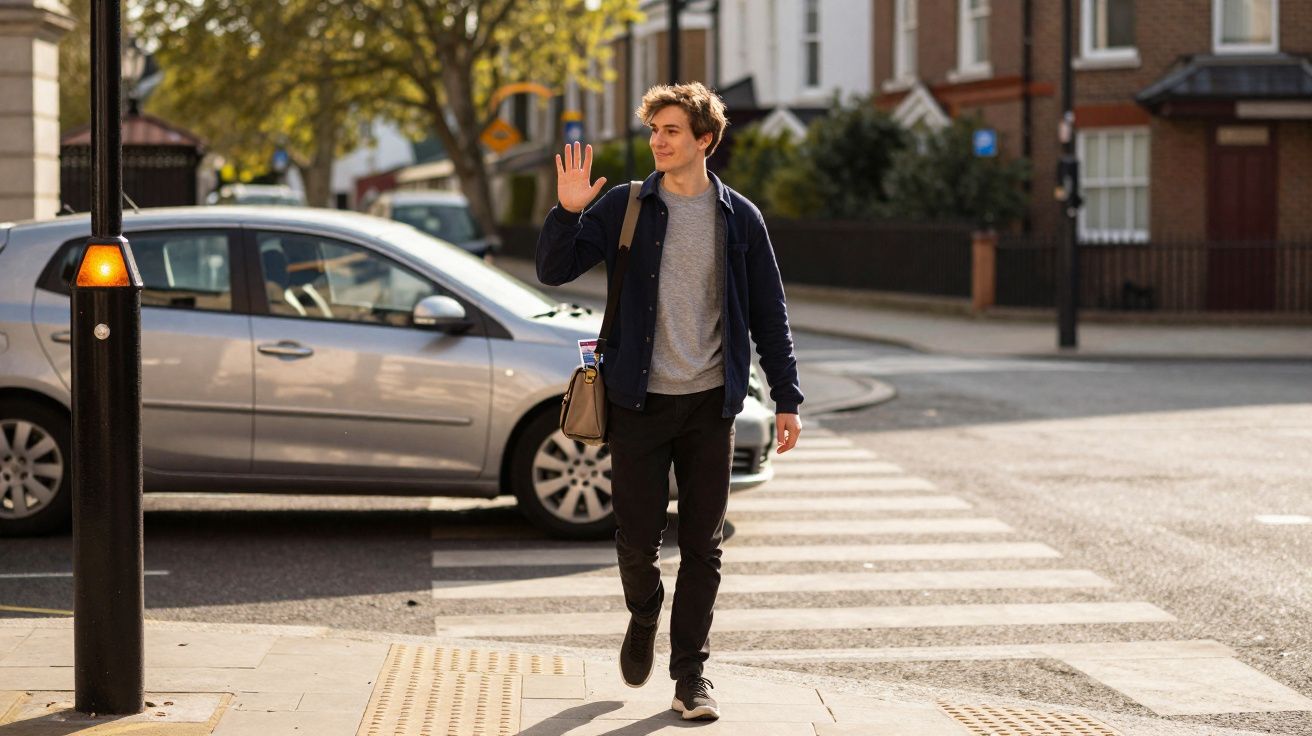
You’re standing at a pedestrian crossing on a dull Tuesday morning, takeaway coffee losing its heat, when a car properly comes to a halt. The driver lifts two fingers from the steering wheel in a casual nod. You step down from the kerb, moving a little quicker than you meant to, and your hand rises almost automatically. A brief wave. A faint smile. A small, tossed “thank you” across a ribbon of tarmac.
Then the unexpected bit: you soften. Your stride steadies. Your shoulders unclench by a fraction. The car glides on and, without any obvious reason, the day feels slightly less abrasive.
Psychologists have begun paying close attention to that tiny “thank you” wave. What they’re finding isn’t really about manners at all-it has a lot to do with who feels safe, who feels acknowledged, and who is quietly carrying more apprehension than they show.
Why a tiny “thank you” wave at a pedestrian crossing reveals more than you’d assume
Spend time walking in any city and you’ll see a pattern. Some people cross with their head up, pace steady, arm lifting in an easy “cheers” towards the driver. Others tighten, keep their gaze low, hurry across with stiff arms, and look as though they’re trying to disappear. Same painted lines, same traffic flow-completely different bodies.
When psychologists unobtrusively observe pedestrian crossings, that polite wave becomes a surprisingly strong behavioural marker. It isn’t just courtesy. It’s bound up with how secure someone feels in shared public space, how much control they believe they have in the moment, and whether strangers register as potential danger or as fellow people trying to get through the day.
A traffic psychology group in Germany recorded hundreds of zebra crossings over a period of weeks. Their first headline observation was straightforward: pedestrians who gave a “thank you” wave were much more likely to make eye contact with drivers, maintain a normal walking rhythm, and keep within the crossing’s boundaries.
Those who didn’t wave tended to move differently-shorter strides, more checking behind them, and a noticeable habit of drifting diagonally, as if the priority was simply to get off the road as quickly as possible. When the researchers later spoke to a sample of pedestrians, another pattern emerged: frequent wavers generally scored higher on measures linked to social trust and perceived agency, while non‑wavers more often described anxiety in busy places and past experiences of being overlooked or dismissed in public.
Psychologists connect this small gesture to a cluster of traits and lived experiences. A voluntary “thank you” wave often reflects mutual recognition: “I noticed you stopped, and I feel safe enough to acknowledge it.” It also depends on an assumption that the driver is participating in a shared set of rules, rather than behaving like an unpredictable threat inside a heavy metal shell.
Psychologically, it functions like a miniature stress-test of your relationship with society. Do you move through public life braced for impact, or do you leave room for small, decent exchanges between strangers? That hand lifting is often the answer-long before any questionnaire.
The pedestrian crossing wave as micro‑kindness that quietly rebuilds trust
Researchers who study “micro‑kindness” often focus on repeatable, low-effort rituals. The pedestrian crossing wave is about as simple as it gets. You don’t have to feel cheerful, and you don’t have to perform friendliness. You briefly interrupt your irritation, orient towards the driver who stopped, and lift your hand in a clear, visible motion.
That’s all. No beaming grin. No overdone gratitude. The message is essentially: you respected my space, I noticed, and I’m responding as an equal-not as someone pleading for kindness. In that sense, the wave is less about submission and more about quiet self‑positioning.
Most people know the other version of the story: the car brakes late, tyres whisper, and your stomach flips. In that split second, your body wants to sprint, glare, or act as if nothing happened. In messy crossings like that, the wave can be a surprisingly stabilising choice.
Picture an older woman balancing shopping bags, nearly clipped by a distracted driver. She stops, takes a breath, then continues. The driver looks horrified. She gives a brisk “all right” wave and carries on at her own pace. The risk doesn’t vanish, but the script changes: she’s no longer only a near‑victim-she’s back in agency, responding rather than merely reacting. That’s the subtle psychological power of acknowledging and then choosing your next move.
Researchers who look at everyday civility often describe three layers beneath this behaviour:
- Learned habit: people brought up where road courtesy is taught almost like table manners tend to wave without thinking.
- Emotional regulation: the gesture creates a tiny pause that helps settle the nervous system after the micro‑stress of stepping into traffic.
- Identity: regular wavers frequently see themselves as “someone who improves the atmosphere”, even in anonymous spaces.
And yes-nobody manages this flawlessly. Some mornings you’re exhausted, running late, or simply not up for human contact. Still, when people deliberately reintroduce the wave into their routine, many report a small but meaningful shift: less feeling buffeted by the city, more sense of taking part in a shared (and sometimes fragile) social fabric.
A UK note: zebra crossings, the Highway Code, and why context matters
In the UK, zebra crossings carry a strong cultural script: drivers are expected to give way when someone is waiting to cross, and pedestrians are encouraged to cross with care. Because the expectation is clearer than in some places, the “thank you” wave can become a quick way of reinforcing a cooperative norm-an informal sign that the rule system is working today.
At the same time, not every pedestrian can easily offer a wave. People using a cane, crutches, a wheelchair, a buggy, or carrying bags may prioritise balance and visibility over gestures. In those cases, a brief head nod, a moment of looking towards the windscreen, or simply crossing steadily can serve the same purpose: moving through public space with as much agency as the moment allows.
What psychologists suggest you try at your next pedestrian crossing
In practical terms, many therapists and behavioural coaches now use the pedestrian crossing wave as a small real‑world exercise. The approach is deliberately simple. For one week, whenever a driver clearly stops to let you cross, try three steps:
- Slow to a comfortable pace rather than dashing as if you’re apologising for existing.
- Lift your gaze and briefly meet the driver’s eyes-or at least look towards the windscreen.
- Give a small, unmistakable “thank you” wave.
The point is not to reward drivers. The aim is to help your brain shift from pure survival mode into relational mode in a setting that often spikes stress.
If you live with anxiety, you might worry that waving makes you more visible, or that you’ll feel self‑conscious. That reaction is common-especially if you were taught not to draw attention to yourself. Psychologists tend to emphasise this: the wave is optional and it isn’t a measure of your value.
What often helps is starting in low-pressure conditions: early Sunday mornings, quieter residential streets, or calmer times in smaller neighbourhoods. Begin with the smallest possible version-perhaps just lifting two fingers off your bag strap. As your body learns that acknowledging strangers doesn’t lead to anything terrible, the movement often becomes simpler and less emotionally charged.
Many psychologists describe the pedestrian crossing wave as “a one‑second rehearsal for living in a society where people actually notice each other”. It’s small, repeatable, and rooted in real tarmac and real risk-which is exactly why it can land more powerfully than vague advice about “being more open”.
Start small
Choose one familiar crossing and practise the wave only there, so your brain associates that spot with a calmer routine.Notice your body
After you wave, quickly check in: are your shoulders looser, jaw less tight, breathing a touch steadier?Don’t overanalyse the driver
You’re not there to interpret their personality; the gesture is for your sense of agency, not for their approval.Allow missed moments
Some days you’ll forget or feel too drained. That doesn’t erase progress or mean anything dramatic about your character.Use the wave as a check‑in
If you notice you haven’t waved in weeks, gently ask yourself: have I been feeling more under siege than usual?
A pedestrian crossing, a car, and what it quietly discloses about us
Once you start noticing, the street becomes a moving psychology laboratory. The teenager in headphones who strides across and flicks up a relaxed wave is signalling something very different from the office worker who half-runs with rigid arms and eyes fixed straight ahead. Neither is “good” or “bad”, but both are communicating a story-about safety, power, and what they expect from strangers.
Psychologists don’t frame the “thank you” wave as a moral obligation. They treat it as a small, unusually honest indicator of your internal weather. On days when trust feels available, your hand rises almost without instruction. On days when everything feels harsh, the gesture may not even reach your shoulder. Tracking that pattern over time can tell you more about stress, overload, or burnout than many self‑help slogans ever will.
| Key point | Detail | Value for the reader |
|---|---|---|
| Pedestrian crossing waves reflect perceived safety | People who wave often report more perceived agency and mutual recognition in public space | Helps you notice how safe or unsafe you feel moving through your town or city |
| The gesture can be used as a micro‑exercise | Therapists use it to practise social trust and emotional regulation in real situations | Offers a simple, concrete tool to gently challenge anxiety or social withdrawal |
| Patterns over time reveal inner shifts | Changes in whether and how you wave can track changes in stress or burnout | Gives you an everyday signal to check in with your mental and emotional state |
FAQ
Is not waving “thank you” a sign that I’m rude or selfish?
Not necessarily. It might reflect stress, fear, habit, cultural norms, or plain distraction. Psychologists are usually less interested in judging the behaviour and more interested in what it suggests about how safe and empowered you feel in that moment.Do psychologists really study something as small as a pedestrian crossing wave?
Yes. Traffic psychology, environmental psychology, and urban studies all examine tiny public-space gestures because they reveal how people manage fear, trust, and cooperation in everyday life.Can this gesture actually reduce my anxiety?
By itself, it isn’t a cure. However, as part of a series of small, safe social experiments, it can slightly lower tension and help your body rehearse calm, reciprocal contact with strangers.What if drivers don’t notice or respond to my wave?
That’s fine. The main psychological benefit sits with you: choosing to respond as an active participant rather than feeling like a passive obstacle, regardless of the driver’s reaction.Is the meaning of the wave the same in every country?
No. In some places, a nod or brief eye contact is more common; elsewhere, a hand wave is standard. What tends to remain consistent is the core idea: a quick, voluntary sign that you noticed the other person’s behaviour and felt able to respond.






Comments
No comments yet. Be the first to comment!
Leave a Comment